
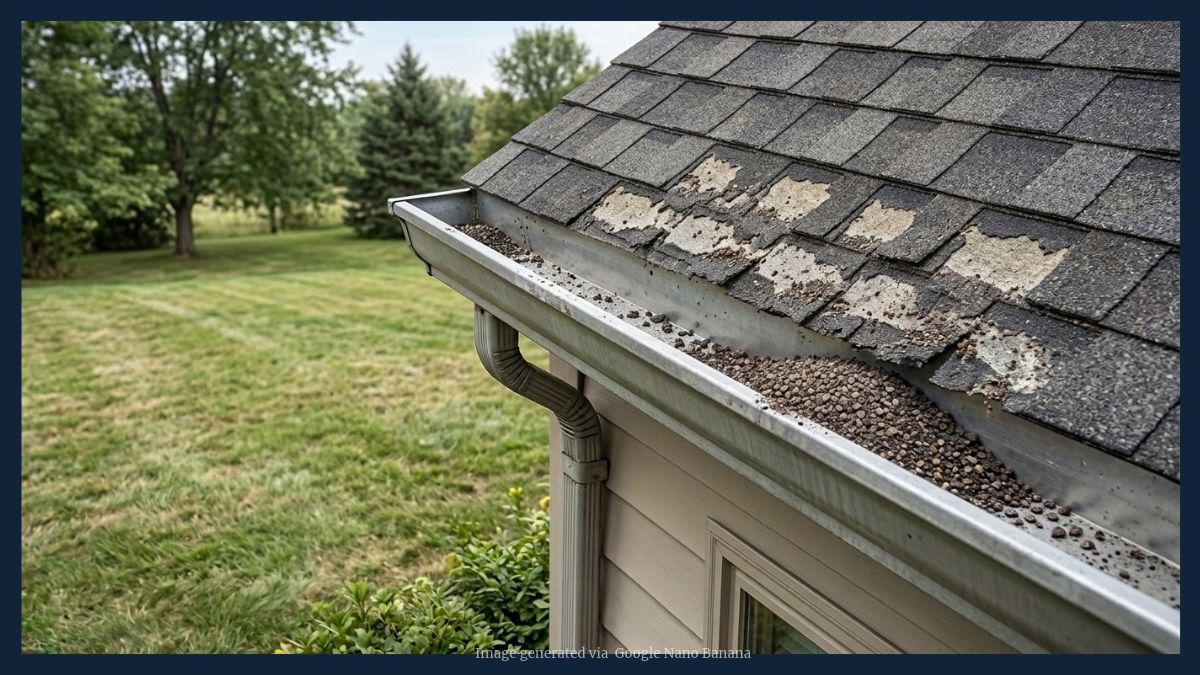
Roof shingle granules collecting in the gutters usually come from asphalt shingles shedding their protective mineral coating. A small amount is normal, especially during the first months after a new roof installation. However, heavy or increasing granule loss on an older roof may indicate weathering, storm damage, or deteriorating shingles.
- A small amount of granule loss is normal on asphalt shingle roofs.
- New shingles may shed excess manufacturing granules during the early period after installation.
- Granules protect the underlying asphalt from ultraviolet radiation and contribute to the shingle’s weathering performance.
- Heavy or increasing granule accumulation on an older roof may indicate deterioration.
- Bare patches and exposed asphalt are more concerning than loose granules in the gutters alone.
- Hail, foot traffic, and concentrated water runoff can contribute to localized granule loss.
- Never climb onto the roof to inspect granule loss yourself.
- A qualified roofing contractor can determine whether the roof needs maintenance, repair, or replacement.
Excess granules from a newly installed roof
If your roof was recently replaced, finding granules in the gutters may be completely normal.
Asphalt shingles are manufactured with mineral granules embedded into their asphalt coating. During production, manufacturers may apply more granules than will ultimately remain firmly attached to the shingle.
Some excess particles, sometimes called “rider granules” or “hitchhiker granules,” are not firmly embedded in the asphalt. They can loosen during packaging, transportation, installation, and the first period of exposure to rain and weather.
As rainwater runs down the roof, these loose particles travel toward the gutters and downspouts.
According to GAF’s technical advisory bulletin on granule loss on new shingles, this type of shedding is generally most noticeable soon after installation and gradually decreases.
IKO also explains in its technical bulletin on excess roofing granules that the loss of these loosely attached granules is normal and does not, by itself, reduce the weatherproofing life of the shingles.
How to recognize normal new-roof granule loss
You may notice:
- A small accumulation of granules after rainfall.
- Loose particles around downspout outlets.
- More granules shortly after installation than several months later.
- No obvious bare patches or exposed asphalt on the shingles.
- No accompanying signs of leaks or widespread shingle deterioration.
The important clue is the trend. Normal shedding should generally decrease rather than remain heavy or become progressively worse.
What homeowners should do
If your roof is new, monitor the amount of granules collecting in the gutters during routine gutter maintenance.
Keep records of the installation date, photographs of the accumulation, and any observations of visible roof damage.
If the shedding remains unusually heavy, increases, or appears alongside bare patches, ask the roofing contractor to inspect the roof and review the manufacturer’s installation and warranty guidance.
Normal aging and weathering of asphalt shingles
Even properly installed asphalt shingles gradually lose granules as they age.
The mineral granules on an asphalt shingle serve an important protective purpose. They help shield the underlying asphalt from ultraviolet radiation and contribute to the roof’s resistance to weather exposure.
Over time, sunlight, temperature changes, rain, and other environmental conditions gradually affect the shingle surface and the bond holding the granules in place.
As that bond deteriorates, some granules become loose and wash into the gutters.
Signs that granule loss may be related to aging
Look for a combination of conditions rather than relying on gutter debris alone:
- Granules accumulate gradually over repeated gutter cleanings.
- The roof is approaching or has exceeded its expected service life.
- Some shingles appear thinner or more weathered than others.
- Shingle surfaces show widespread wear.
- Curling, cracking, or other deterioration appears alongside granule loss.
Aging does not necessarily mean that the roof has failed. Its remaining service life depends on the shingle type, installation quality, climate, ventilation, maintenance, and exposure to severe weather.
Why exposed asphalt matters
When granules come off, the underlying asphalt becomes more exposed to sunlight and weathering.
This can accelerate deterioration of the affected area. As the shingles lose more of their protective surface, they may become increasingly vulnerable to cracking, brittleness, and other forms of damage.
A few loose particles in the gutter do not establish that this process is occurring across the roof. Visible bare areas are a more meaningful warning sign.
What homeowners should do
If your roof is older and granule accumulation is increasing, arrange a professional roof inspection.
A roofer can assess whether the granule loss is consistent with normal aging or whether the shingles are deteriorating prematurely.
Hail and severe weather damage
Hail can dislodge granules when it strikes asphalt shingles.
The severity of the damage depends on several factors, including hailstone size, impact force, wind conditions, shingle age, and the condition of the asphalt coating.
Older or weathered shingles may be more vulnerable because the bond holding their granules can already have deteriorated.
Signs that hail may have damaged your shingles
Possible clues include:
- A sudden increase in granules after a hailstorm.
- Localized areas of granule loss.
- Circular impact marks or damaged areas on the shingles.
- Bruising or fractures in the shingle surface.
- Damage to roof vents, gutters, flashing, or other exposed components.
Hail damage does not always look like a large missing section of roofing material. Some damage can be subtle and difficult to identify from the ground.
Also, granules in the gutters alone cannot prove that hail caused the loss.
What homeowners should do
If you notice a sudden increase in granules after a hailstorm, document the date and visible signs of damage.
Photograph the gutters, downspouts, and any visible roof damage from a safe location. Arrange an inspection by a qualified roofing contractor.
If you suspect storm damage, review your insurance policy and contact your insurer about its inspection and documentation requirements. Avoid making assumptions about coverage based on gutter debris alone.
Foot traffic and physical damage
Walking on an asphalt shingle roof can loosen or remove granules, especially when the shingles are already weathered.
Granules are embedded in the asphalt surface, but repeated pressure and friction can disturb them.
Foot traffic may occur during:
- Roof inspections.
- Gutter cleaning.
- Installation of holiday lights.
- Satellite dish or antenna work.
- HVAC or chimney maintenance.
- Other roof repairs.
The damage may be concentrated along walking paths or around areas where workers repeatedly stand or move equipment.
Signs of granule loss from foot traffic
Possible clues include:
- Localized wear rather than widespread loss.
- Bare or scuffed areas along roof access paths.
- Granule loss near roof penetrations or equipment.
- Damage concentrated around areas where maintenance work was performed.
These patterns are not conclusive. Other forms of localized damage can look similar.
What homeowners should do
Avoid unnecessary foot traffic on asphalt shingles.
If roofing or maintenance work has recently been performed, ask the contractor whether workers accessed the affected roof sections and whether any damage was identified.
A qualified roofer can assess whether the damage is cosmetic, localized, or likely to affect the shingles’ ability to protect the roof.
Do not climb onto the roof to look for granule loss or inspect suspected damage. Roof surfaces can be slippery, steep, unstable, or weakened by deterioration. Wet shingles, loose granules, and moss can increase the risk of slipping. Use ground-level observations and hire a qualified roofing professional for close inspection. Keep children and pets away from areas where roofing debris may fall.
Poor granule adhesion or manufacturing problems
Granules are intended to remain embedded in the asphalt coating throughout the shingle’s useful service life.
If they do not adhere properly, the shingles may lose their protective surface earlier than expected.
Although some early shedding is normal, unusually heavy or persistent granule loss may warrant investigation.
Possible contributing factors include:
- Problems with the asphalt coating or granule bonding.
- Manufacturing defects.
- Material quality issues.
- Damage during transportation or installation.
- Installation conditions that affect the roofing material.
It is important not to confuse ordinary loose manufacturing granules with a defect in the shingle itself.
Signs that premature granule loss may be occurring
- Significant shedding continues beyond the initial installation period.
- Granule loss appears unusually heavy or uneven.
- Bare asphalt patches develop on relatively new shingles.
- Similar deterioration appears across multiple roof sections.
- The roof shows signs of premature aging despite being relatively young.
What homeowners should do
Review the roofing contract, product information, and applicable manufacturer warranty.
If the roof is relatively new and shows unusual granule loss, contact the installing contractor and request an inspection.
Take photographs and retain relevant installation and purchase documents. Do not assume that the condition is automatically covered by a warranty; coverage depends on the specific product, warranty terms, and circumstances.
Concentrated water runoff from upper roof sections
Water draining from an upper roof section can sometimes discharge onto a lower shingle surface with enough force to erode its granules.
This may happen when an upper gutter or downspout directs a concentrated stream of water onto the roof below.
GAF discusses this issue in its technical advisory bulletin on damage to shingles from gutters and downspouts.
Repeated runoff can gradually remove granules from the affected area, exposing the asphalt underneath. In some circumstances, forceful water discharge can also contribute to water intrusion between shingles.
Signs of concentrated runoff damage
- Granule loss is concentrated directly below an upper gutter outlet.
- A visible erosion path appears on the lower roof.
- The affected shingles look more worn than surrounding areas.
- Granule accumulation increases during heavy rainfall.
- Water appears to discharge onto the roof rather than being carried away through a suitable drainage route.
What homeowners should do
Observe the roof from the ground during rainfall if it is safe to do so.
Look for water spilling from upper gutters or downspouts onto lower roofing sections.
A roofing or gutter professional can assess the drainage arrangement and recommend an appropriate correction. Do not redirect downspouts or modify roof drainage systems without checking how the changes will affect the rest of the property.
How to tell whether shingle granule loss is normal or concerning
The amount of granules in the gutter is only one part of the diagnosis.
Consider the roof’s age, the timing of the shedding, the pattern of accumulation, and the visible condition of the shingles.
| What you notice | Possible explanation | Recommended action |
|---|---|---|
| A small amount of granules on a new roof | Loose manufacturing granules | Monitor whether shedding decreases |
| Gradually increasing granules on an older roof | Normal aging or deterioration | Arrange a roof condition assessment |
| A sudden increase after a hailstorm | Possible storm-related damage | Document and arrange an inspection |
| Bare patches exposing asphalt | Loss of protective granule coverage | Have the affected shingles assessed |
| Localized wear along roof access paths | Possible foot-traffic damage | Ask a roofer to inspect the area |
| Granule loss below an upper downspout | Concentrated water runoff | Have the drainage arrangement assessed |
| Heavy shedding on a relatively new roof | Possible premature loss or material problem | Contact the installer and review warranty guidance |
How to inspect for roof granule loss safely
Homeowners can collect useful information without climbing onto the roof.
1. Check the gutters from a safe location
During routine gutter maintenance performed from a safe position, observe whether the gutters contain small amounts of loose grit or substantial accumulations.
Roof granules can look like coarse sand, often with dark, gray, brown, or other colors matching the shingles.
However, dirt, roofing debris, and other particles may also collect in gutters. Appearance alone does not establish the source.
2. Observe the downspout discharge areas
After rainfall, look for granule deposits around the places where downspouts release water.
A noticeable accumulation may help identify which roof sections are shedding material.
Compare the amount over time rather than drawing conclusions from one observation.
3. Examine the roof from the ground
Use binoculars or a camera with optical zoom if needed.
Look for:
- Uneven or discolored shingle surfaces.
- Visible bare patches.
- Curling or cracked shingles.
- Missing shingles.
- Areas that appear unusually worn.
- Debris or damage following a storm.
Ground-level observations cannot replace a close roof inspection, but they can help identify conditions that deserve professional attention.
4. Check the roof’s age and maintenance history
Find out when the roof was installed and, if possible, identify the shingle manufacturer and product.
Also consider whether the roof has experienced recent hail, strong winds, repairs, or maintenance work.
This information can help a roofing contractor narrow down the possible causes of granule loss.
Do not use a ladder to reach gutters or climb onto a roof if you are not equipped and trained to work safely at height. Falls from ladders and roofs can cause serious injuries. Avoid working near overhead electrical lines, wet surfaces, or unstable ground. Hire a qualified professional for elevated inspections and repairs.
When should you call a roofing professional?
Not every accumulation of granules requires immediate roof replacement. However, certain patterns justify a professional inspection.
- Granule loss is heavy or continues to increase.
- A relatively new roof shows unusually extensive shedding.
- Bare patches or exposed asphalt are visible.
- Granule loss occurs alongside curling, cracking, or missing shingles.
- A hailstorm or severe weather event may have damaged the roof.
- Water stains or leaks appear inside the home.
- You notice concentrated erosion below an upper gutter outlet or downspout.
- The roof is older and shows multiple signs of deterioration.
Should you hire a professional?
A roofing professional can inspect the shingles, identify patterns of granule loss, assess visible damage, and determine whether repairs or further evaluation are appropriate.
Depending on the condition of the roof, the contractor may recommend:
- Monitoring minor, normal shedding.
- Replacing a limited number of damaged shingles.
- Correcting drainage problems.
- Addressing localized storm or installation damage.
- Evaluating the roof for broader deterioration.
- Planning a roof replacement when repairs are no longer a practical solution.
If the roof is relatively new, ask the contractor to compare the observed condition with the manufacturer’s product requirements and warranty provisions.
A professional inspection is particularly worthwhile when granule loss is accompanied by visible bare areas or signs of water intrusion.
Homeowner checklist: Investigating granules in the gutters
Use this checklist to organize your observations before contacting a roofing contractor.
- Identify the approximate age of the roof.
- Check whether the roof was recently installed or repaired.
- Observe how much granule material collects in the gutters.
- Compare the accumulation over multiple gutter cleanings.
- Check whether the amount increases after rainfall.
- Look for visible bare patches or exposed asphalt from the ground.
- Look for curling, cracking, or missing shingles.
- Note whether a hailstorm or severe weather occurred recently.
- Consider whether roof maintenance or foot traffic may have caused localized damage.
- Observe whether upper gutters or downspouts discharge water onto lower roof sections.
- Photograph visible damage from a safe location.
- Keep roofing invoices, product details, and warranty documents.
- Arrange a professional inspection if the loss is heavy, increasing, or accompanied by visible deterioration.
Frequently asked questions
Yes. Some granule loss is normal on asphalt shingle roofs. Newly installed shingles may shed loose excess granules left over from manufacturing, while older shingles gradually lose some granules through ordinary weathering.
New asphalt shingles may contain excess granules that are not firmly embedded in the asphalt coating. These loose particles can wash into the gutters during the first period of exposure to rain.
Shingle granules usually look like coarse, sand-like particles. Their colors often match the mineral coating of the asphalt shingles, so they may appear gray, brown, black, red, or a mixture of colors.
Granule loss alone does not automatically cause a leak. However, extensive loss exposes the underlying asphalt to sunlight and weathering, which can accelerate shingle deterioration.
Not necessarily. Small amounts of granule shedding can be normal, and localized damage may be repairable.
Yes. Hail impacts can dislodge granules from asphalt shingles, particularly when the roof is already weathered.
Yes, when necessary for ordinary gutter maintenance. Excessive debris can contribute to drainage problems, and granules may accumulate alongside leaves, dirt, and other material.
There is no single amount of granules in a gutter that reliably establishes excessive shingle deterioration.
Sources and references:
- GAF, Technical Advisory Bulletin R-112: Granule Loss on New Shingles
https://www.gaf.com/en-us/document-library/documents/technical-bulletins-%26-notes/r-112-granule-loss-on-new-shingles.pdf - IKO, Excess Roofing Granules on Shingles
https://www.iko.com/na/document/tbr02-excess-roofing-granules-on-shingles-product-bulletin/ - GAF, Technical Advisory Bulletin R-150: Damage to Shingles from Gutter and Downspout
https://www.gaf.com/en-us/document-library/documents/technical-bulletins-%26-notes/r-150-damage-to-shingles-from-gutter-and-downspout.pdf - InterNACHI, Mastering Roof Inspections: Asphalt Composition Shingles, Part 46
https://www.nachi.org/asphalt-comp-shingles-part46-100.htm - InterNACHI, Mastering Roof Inspections: Asphalt Composition Shingles, Part 34
https://www.nachi.org/asphalt-comp-shingles-part34-88.htm - GAF, Steep-Slope Pro Field Guide
https://www.gaf.com/en-us/document-library/documents/installation-instructions-%26-guides/guide__steepslope_profield_guide_version_20__english.pdf
