
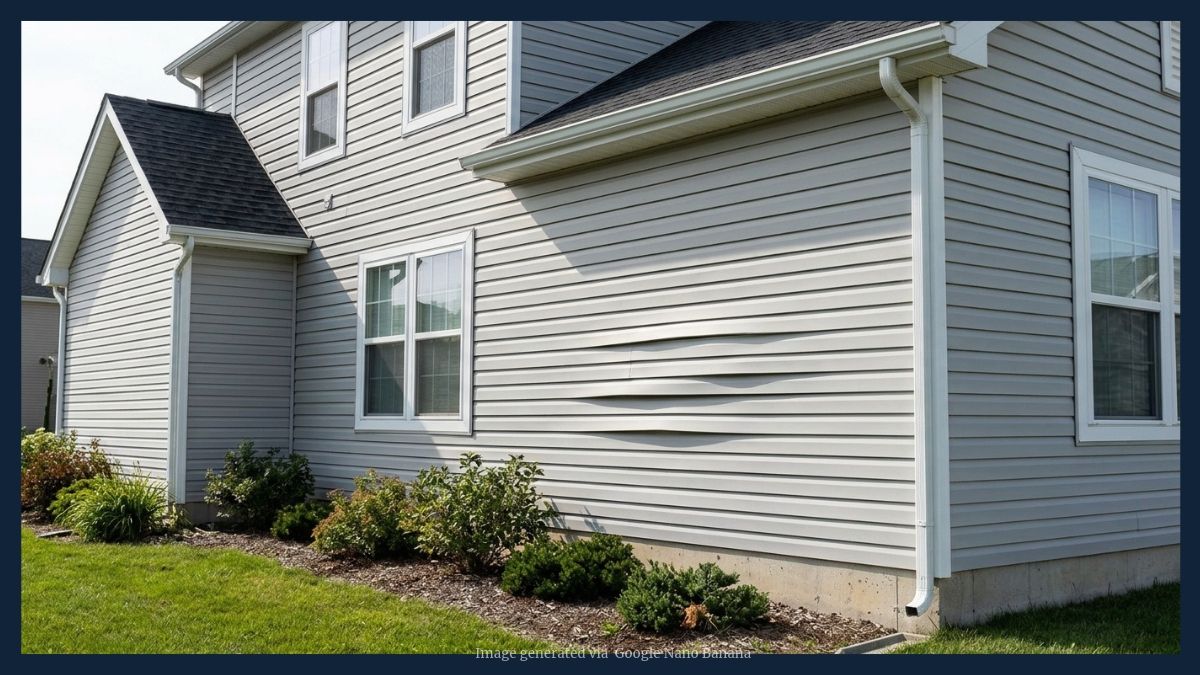
Exterior siding can warp, buckle, or develop waves when it experiences excessive heat, moisture-related expansion, restricted movement, or improper installation. The cause often depends on the siding material. Vinyl siding commonly buckles when it cannot expand and contract freely, while wood and engineered wood siding can deform when exposed to repeated moisture changes. Water intrusion behind any siding material can also contribute to damage.
- Vinyl siding needs room to expand and contract. Tight fasteners or insufficient clearance can cause rippling and buckling.
- Wood and engineered wood siding can swell, warp, or deteriorate when moisture levels change repeatedly.
- Dark paint that absorbs more heat than the original vinyl siding color can contribute to distortion.
- Water entering around windows, doors, roof-to-wall intersections, and exterior openings can damage the wall assembly behind the siding.
- Buckling that appears after a renovation or siding replacement may point to an installation or material issue.
- Widespread distortion, soft areas, staining, or visible rot should be professionally assessed.
- Replacing damaged siding without correcting the source of heat, moisture, or movement may lead to recurring problems.
The siding cannot expand and contract freely
One of the most common explanations for buckling, particularly with vinyl siding, is restricted movement.
Exterior temperatures change throughout the year. Siding materials respond to these changes by expanding in warmer conditions and contracting as temperatures fall. Vinyl siding is especially sensitive to temperature-related movement.
If panels are fastened too tightly, installed without adequate clearance, or trapped against trim and other obstructions, they may not have enough room to move. As the material expands, pressure can build up and cause the panels to ripple, bow, or buckle outward.
Signs this may be the cause
- Vinyl panels appear wavy or uneven.
- Buckling is more noticeable during hot weather.
- Distortion occurs near windows, doors, corners, or trim.
- Panels appear tightly compressed rather than visibly swollen.
- The problem started after new siding was installed.
What homeowners should know
Vinyl siding is generally designed to hang from its fasteners rather than be tightly clamped against the wall. Installation instructions specify how fasteners should be positioned and how much clearance should be left at openings and stops.
The exact requirements vary by product, so installers should follow the siding manufacturer’s instructions rather than apply one measurement to every product.
Moisture is causing the siding to swell or deform
Moisture is a major concern with wood and wood-based siding. When these materials absorb water, their dimensions can change. Repeated wetting and drying may eventually cause boards or panels to warp, cup, swell, split, or buckle.
Water exposure can come from several sources:
- Rain entering through damaged joints or gaps.
- Leaking gutters or downspouts.
- Poor flashing around windows and doors.
- Roof leaks or poorly protected roof-to-wall intersections.
- Water splashing repeatedly against the lower siding.
- Condensation or moisture trapped within the wall assembly.
Wood siding is particularly vulnerable when it remains wet for extended periods. Engineered wood products can also be affected when water reaches vulnerable edges, joints, or damaged areas.
Signs this may be the cause
- Wood siding appears swollen, curved, or uneven.
- Paint is peeling, blistering, or cracking.
- Boards have soft or deteriorated sections.
- The problem is concentrated near windows, doors, gutters, or roof intersections.
- The wall has a musty smell or visible interior water staining.
Persistent moisture can contribute to wood decay and conditions that support mold growth. If the siding is visibly deteriorating, or you notice mold-like growth or a musty odor indoors, avoid disturbing affected materials. Do not cut into the wall or remove potentially contaminated materials without understanding the extent of the problem.
Keep children and pets away from affected areas, and arrange an assessment by a qualified building or moisture specialist. If anyone experiences significant symptoms associated with a suspected indoor exposure, seek appropriate medical advice.
Why moisture behind siding matters
Siding is not necessarily a completely waterproof barrier. Rainwater can sometimes pass through joints and openings, which is why exterior wall assemblies need properly installed flashing and a water-resistive barrier to direct moisture away from the structure.
If water gets behind the siding and cannot drain or dry properly, it can damage the sheathing, framing, insulation, and interior finishes.
A visibly warped board may therefore be only the surface symptom of a larger moisture problem.
Excessive heat is distorting vinyl siding
Vinyl siding can become distorted when exposed to excessive heat. This can happen when the siding is installed in a location where heat becomes concentrated or when an unsuitable coating increases the amount of heat absorbed by the material.
One example is repainting vinyl siding with a darker color than its original finish. Darker colors generally absorb more solar energy, potentially raising the siding’s surface temperature beyond what the product was designed to tolerate.
Reflected heat can also contribute to localized distortion. Certain nearby windows and reflective surfaces may concentrate sunlight onto sections of exterior siding.
Signs this may be the cause
- Vinyl siding is warped mainly on one section of the house.
- Distortion is concentrated near reflective windows or other heat sources.
- The affected area receives strong direct sunlight.
- The siding was recently repainted a darker color.
- The panels appear melted, softened, or permanently deformed.
What homeowners should do
Look for patterns that may explain why one section is more affected than the rest. Check whether the distorted area is near a large window, reflective surface, or recently repainted section.
Do not attempt to reshape severely deformed vinyl panels with a heat gun or open flame. Applying additional heat can make the damage worse and may create a fire hazard.
Do not use a torch, heat gun, or other high-temperature tool to soften or reshape installed siding. Excessive heat can damage the material, ignite nearby combustible components, or expose people to hazardous fumes from overheated materials. Have a siding contractor assess permanently distorted panels and determine whether replacement is necessary.
Fasteners were installed incorrectly
Siding needs appropriate support while still allowing for the movement specified by its manufacturer.
Problems can occur when installers:
- Drive nails or screws too tightly.
- Place fasteners in the wrong part of the panel.
- Fasten through areas that are not intended for direct fastening.
- Use an unsuitable fastener type or length.
- Install panels unevenly.
- Fail to follow the required fastening pattern.
With vinyl siding, fasteners that prevent the panels from moving freely can contribute to buckling and rippling. Incorrect fastening can also leave panels uneven or cause them to distort around individual attachment points.
Wood and fiber-cement siding have their own fastening requirements. The correct approach depends on the product, substrate, thickness, and installation system.
Signs this may be the cause
- Buckling follows a repeating pattern along the wall.
- Panels look uneven around nail or screw locations.
- Distortion appeared shortly after installation.
- Certain boards seem to have pulled away from their supporting surface.
- Fasteners are visibly exposed, loose, or improperly positioned.
What homeowners should know
Incorrect fastening is not always obvious from the ground. A contractor may need to inspect the attachment points and compare them with the manufacturer’s installation instructions.
Avoid randomly adding nails or screws to flatten the siding. Additional fasteners can create new problems if they are placed incorrectly.
Poor flashing or drainage is allowing water behind the siding
Even siding that appears intact can have moisture problems if the wall’s drainage and flashing details are not working correctly.
Flashing helps direct rainwater away from vulnerable openings and transitions. When it is missing, damaged, or incorrectly installed, water can enter behind the exterior cladding.
Common problem areas include:
- Window and door openings.
- Roof-to-wall intersections.
- Exterior vents and utility penetrations.
- Outdoor light fixtures.
- Wall corners and trim transitions.
- The bottom edge of siding near the foundation.
Water may then accumulate in the wall assembly, causing wood-based materials to swell, deteriorate, or lose their ability to support the siding properly.
Signs this may be the cause
- Warping appears below a window or near a door.
- Siding is damaged beneath a roof intersection.
- Paint or caulk is failing around exterior openings.
- The wall has recurring water stains after rain.
- Interior drywall or trim shows signs of moisture.
- There is visible deterioration around the bottom of the exterior wall.
Do not remove large sections of siding or open the wall simply to investigate suspected water intrusion. Hidden electrical wiring, plumbing, insulation, and deteriorated materials may be present.
If water is entering near electrical equipment, outlets, or exterior wiring, avoid touching wet components and arrange an assessment by a qualified electrician and building professional as appropriate.
If there is an immediate electrical or fire hazard, keep people away and contact emergency services.
The siding was installed over an uneven or unsuitable surface
Siding generally relies on a suitable, properly prepared supporting surface. If the wall sheathing, furring strips, or framing are uneven, the finished siding may not sit flat.
A poorly prepared substrate can cause visible waves, bulges, or irregular lines even when the siding panels themselves are not defective.
Possible contributing conditions include:
- Uneven wall sheathing.
- Incorrectly installed furring strips.
- Damaged or deteriorated backing materials.
- Framing irregularities.
- Inadequate support at panel joints.
- Incorrect installation spacing.
This problem may be more noticeable after a full siding replacement because the new material makes existing wall irregularities easier to see.
Signs this may be the cause
- Large sections of siding look wavy rather than individual panels.
- Distortion follows the underlying wall framing.
- The wall was uneven before the siding was installed.
- New siding appears irregular soon after installation.
- Buckling occurs across several boards or panels in the same area.
What homeowners should know
A contractor should determine whether the distortion is limited to the siding or reflects a problem with the wall assembly underneath. Replacing the exterior panels alone may not correct an uneven or damaged substrate.
The siding material is deteriorating or defective
Not every siding problem is caused by poor installation or maintenance. Material deterioration, manufacturing issues, or product-specific performance problems can also contribute to warping and other visible defects.
Fiber-cement siding, for example, can develop cracking, deterioration, or dimensional changes under certain conditions. The underlying cause may involve the product itself, installation details, moisture management, or a combination of factors.
Wood and engineered wood products can also deteriorate when exposed to unfavorable moisture conditions.
Signs this may be the cause
- Similar defects appear on multiple boards or panels.
- Cracking, flaking, or discoloration accompanies the distortion.
- The problem occurs in areas with no obvious impact damage.
- Several sections installed during the same project show similar deterioration.
- The siding is relatively new but already showing unusual defects.
What homeowners should do
Check the product documentation, warranty, and installation records. If the problem affects several areas, contact the manufacturer or an authorized representative to ask whether the symptoms are consistent with a known product issue.
Do not assume the material is defective based on appearance alone. A qualified inspection should also consider installation quality, moisture exposure, and the condition of the wall behind it.
How to identify the likely cause of warped siding
The location, appearance, and timing of the distortion can help narrow down possible explanations.
| What you notice | Possible explanation | What to investigate |
|---|---|---|
| Vinyl siding buckles during hot weather | Restricted expansion or excessive heat | Fastener placement, clearance, reflected heat |
| Wood boards swell or curve | Moisture absorption | Leaks, drainage, paint condition |
| Buckling appears below windows | Water intrusion | Window flashing, sealant, drainage details |
| Panels ripple along fastening points | Incorrect installation | Fastener position and tightness |
| Several sections look uneven | Substrate or support problem | Sheathing, framing, furring |
| Siding cracks, flakes, or deteriorates | Material damage or moisture exposure | Product condition, installation, water management |
| Damage appears after repainting vinyl | Excessive heat absorption from coating | Paint color and product compatibility |
These are diagnostic clues, not definitive tests. Different problems can produce similar appearances, so a professional may need to inspect the siding and the wall assembly before recommending repairs.
What homeowners can safely check
You can gather useful information about warped siding without removing panels or attempting repairs.
1. Identify the siding material
Determine whether the exterior is made from vinyl, natural wood, engineered wood, fiber cement, or metal. The material affects how it responds to heat, moisture, and installation pressure.
If you are unsure, look for leftover installation materials, product documentation, or previous renovation records.
2. Observe where the distortion occurs
Look for patterns:
- Is it limited to one wall?
- Does it appear near windows or doors?
- Is it concentrated near the roofline or foundation?
- Does it affect individual boards or entire sections?
- Does it occur near a reflective window?
The location may help identify the source of the problem.
3. Check for visible moisture clues
From the ground, look for damaged gutters, overflowing downspouts, missing flashing, peeling paint, and deteriorated trim.
Also check accessible interior walls for water stains or dampness near the affected exterior area.
Do not assume that a lack of interior staining means the wall is dry. Moisture can remain hidden behind the siding.
4. Review recent changes
Think about whether the problem started after:
- A siding replacement or exterior renovation.
- Repainting the exterior.
- Installing new windows.
- Replacing gutters or roof sections.
- Adding reflective surfaces or nearby structures.
- A period of heavy rain or unusually hot weather.
A clear timeline can help a contractor narrow down the likely cause.
5. Photograph the affected areas
Take photographs from a safe location and include wider views that show the entire wall. Close-up photographs can also help document cracks, gaps, and damaged joints.
Record whether the appearance changes during different weather conditions.
Do not climb onto the roof, stand on unstable ladders, or lean out of windows to inspect siding. Keep children and pets away from loose, cracked, or detached panels that could fall. If siding is hanging above an entrance or walkway, keep people clear of the area and arrange prompt professional attention.
When should you call a siding contractor?
A professional assessment is recommended when the siding has developed permanent distortion, widespread buckling, visible deterioration, or signs of water intrusion.
A siding contractor can examine the panels, fastening system, joints, clearances, and supporting surfaces to determine whether the issue is related to installation, material movement, or damage.
You should arrange an inspection when:
- Buckling affects several sections of the exterior.
- Vinyl panels appear permanently warped or melted.
- Wood siding is swollen, soft, cracked, or deteriorating.
- Siding is pulling away from the wall.
- There are recurring leaks or signs of water behind the siding.
- The problem appeared soon after a siding installation.
- You suspect damage to the sheathing or framing.
Which professional should you hire?
| Problem | Appropriate professional |
|---|---|
| Buckled vinyl or incorrectly installed panels | Qualified siding contractor |
| Swollen or deteriorating wood siding | Siding contractor or exterior remodeling specialist |
| Suspected water intrusion or hidden wall damage | Building-envelope or building-moisture specialist |
| Damaged sheathing or framing | Qualified general contractor or structural professional, depending on severity |
| Suspected manufacturing defect | Manufacturer’s technical representative or authorized installer |
What a professional may inspect
Depending on the symptoms, the inspection may include:
- Siding type, condition, and installation method.
- Fastener placement and panel movement.
- Expansion clearances around openings and trim.
- Flashing around windows, doors, and roof intersections.
- Gutters, downspouts, and water drainage.
- Moisture conditions behind affected sections.
- Sheathing, furring, and other supporting materials.
- Product identification and warranty requirements.
A professional may need to remove a limited section of siding to inspect concealed materials. This should be done carefully so that the wall’s moisture protection can be restored correctly.
Should you hire a professional?
If the siding is only slightly uneven and there are no signs of damage, you can begin by documenting the problem and checking accessible exterior details.
However, permanent buckling, soft wood, recurring moisture, loose panels, or distortion across several areas deserves professional attention. The important question is not just how to make the siding look flat again, but why it became distorted.
A qualified contractor can determine whether the solution involves correcting fasteners, replacing damaged panels, improving drainage, or repairing the wall assembly behind the siding.
Homeowner checklist: What to do about warped or buckled siding
Use this checklist to document the problem before arranging repairs.
- Identify the siding material, if possible.
- Photograph the affected wall from a safe location.
- Note whether the distortion affects one panel or several sections.
- Check whether the problem is near windows, doors, gutters, or roof intersections.
- Look for visible cracks, gaps, peeling paint, or deterioration.
- Check for signs of water staining on accessible interior walls.
- Review recent painting, renovation, or siding installation work.
- Record whether the distortion changes during hot or wet weather.
- Keep children and pets away from loose or damaged siding.
- Avoid forcing panels back into place or adding random fasteners.
- Contact a qualified contractor if the distortion is permanent, widespread, or accompanied by moisture damage.
- Keep installation records, product details, photographs, and warranty information.
Frequently asked questions
No. Warped siding can result from heat, restricted expansion and contraction, incorrect fastening, uneven support, or material deterioration.
Yes. Vinyl siding expands in warm conditions. If the panels cannot move freely because of tight fasteners or insufficient clearance, they may buckle.
Wavy vinyl siding may result from fasteners that are too tight, incorrectly positioned, or installed unevenly.
Yes. Most siding systems are designed to shed rain rather than act as a completely waterproof barrier.
Sometimes. If the distortion is caused by an installation issue and the material has not been permanently damaged, a contractor may be able to correct the problem.
Not necessarily. Some buckling is limited to the siding itself. However, if the problem is caused by prolonged moisture exposure, the underlying sheathing or framing may also be affected.
Sources and references:
- U.S. Department of Energy, Building Science Education: Water Managed Walls
https://bsesc.energy.gov/energy-basics/water-managed-walls - Building America Solution Center, Pacific Northwest National Laboratory: Moisture-, Impact-, Fire-, and Pest-Resistant Exterior Siding
https://basc.pnnl.gov/resource-guides/moisture-impact-fire-and-pest-resistant-exterior-siding - APA – The Engineered Wood Association: Buckling of Wood-Based Panel Siding
https://www.apawood.org/guides-tools-training/technical-document-library/technical-notes/buckling-of-wood-based-panel-siding/ - USDA Forest Service, Forest Products Laboratory: Before You Install Exterior Wood-Based Siding
https://research.fs.usda.gov/treesearch/32441 - Sherwin-Williams: Vinyl Siding Warping
https://www.sherwin-williams.com/home-builders/products/resources/SW-ARTICLE-PRO-VINYLSIDINGWARP - Polymeric Exteriors: Vinyl Siding Installation Manual
https://polymericexteriors.org/wp-content/uploads/2022/10/2022-Vinyl-Siding-Installation-Manual-ENGLISH_100322_LR.pdf - InterNACHI: Vinyl Siding Inspection
https://www.nachi.org/vinyl-siding-inspection.htm - IIBEC: Fiber-Cement Siding: Inherent Issues Affecting Performance
https://iibec.org/publication-post/iibec-technical-advisory-no-017-2019-fiber-cement-siding-inherent-issues-affecting-performance/
