
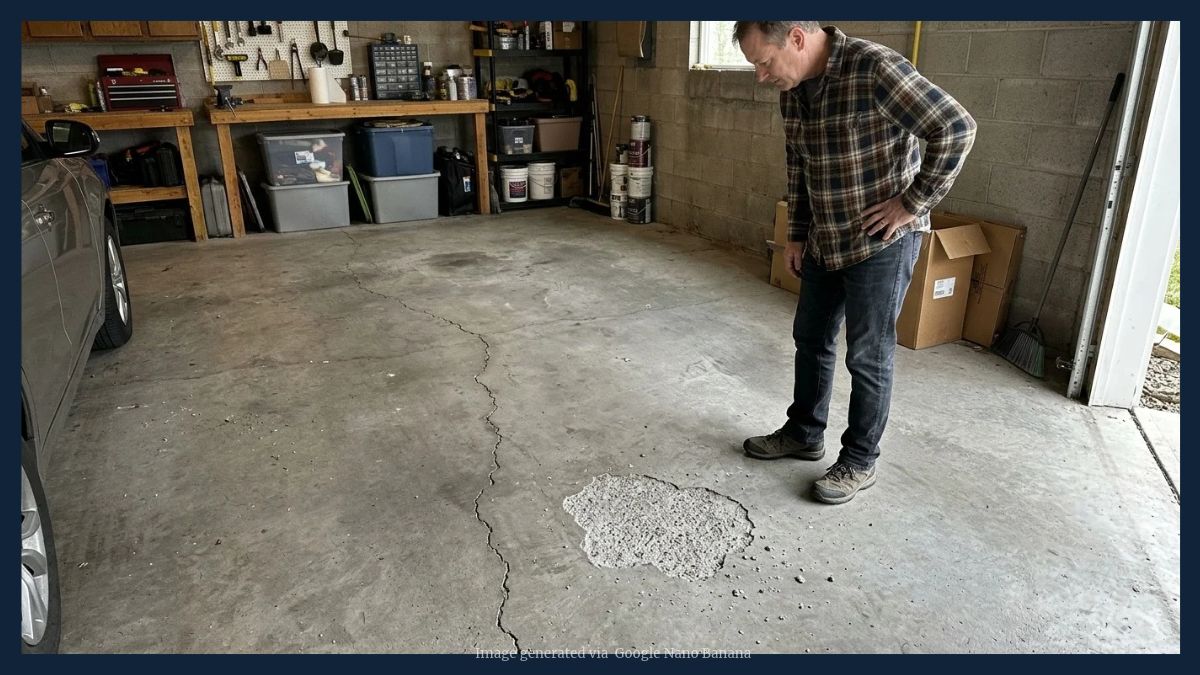
A garage floor that is cracking or flaking may be affected by concrete shrinkage, poor finishing or curing, moisture exposure, surface wear, or movement beneath the slab. Small cracks and minor surface flaking are not always serious, but widespread deterioration, deep cracks, uneven sections, and recurring moisture problems deserve closer attention.
- Small shrinkage cracks are common in concrete and do not automatically indicate structural failure.
- Flaking, scaling, and spalling describe different forms of surface deterioration.
- Poor concrete finishing and curing can leave the garage floor vulnerable to dusting and flaking.
- Moisture, freeze-thaw cycles, and deicing salts can damage concrete surfaces.
- Cracks that widen, develop vertical displacement, or appear alongside settlement deserve professional assessment.
- Coatings can peel when the concrete surface is weak or moisture affects the bond.
- Do not cover damaged concrete with paint or an epoxy coating before identifying the underlying cause.
- Extensive deterioration, persistent moisture, and significant movement may require a concrete contractor or structural professional.
Concrete shrinkage as the slab dries
Concrete naturally changes volume as it hardens and dries. Some of the water used in the concrete mixture eventually evaporates, causing the slab to shrink.
If the concrete cannot shrink freely because of friction with the underlying ground, reinforcement, or other restraints, tensile stresses can develop. When these stresses exceed the concrete’s capacity, cracks may form.
This is known as drying-shrinkage cracking.
According to the American Concrete Institute’s Guide to Concrete Floor and Slab Construction, concrete slabs experience volume reduction as they release moisture and heat. Even properly designed and constructed slabs can develop some cracking and curling.
Control joints are commonly incorporated into concrete floors to encourage cracks to form in planned locations rather than appearing randomly.
What shrinkage cracks look like
You may notice:
- Thin cracks running across the slab.
- Cracks that appear relatively straight or irregular.
- Cracks near control joints or slab edges.
- Cracks that have remained relatively stable over time.
- No obvious vertical displacement between the two sides.
Some cracks are mostly cosmetic, but appearance alone cannot establish their cause or significance.
What homeowners should do
Photograph the cracks and record their approximate length and width. Check whether they appear to be changing over time.
If a crack remains stable and the floor is otherwise level and functional, monitoring may be reasonable. However, cracks that widen, develop vertical displacement, or occur alongside settlement should be assessed by a qualified professional.
Poor concrete finishing or curing
A garage floor can begin flaking because the concrete surface was not properly finished or cured during construction.
The uppermost layer of concrete is particularly important because it is directly exposed to vehicle traffic, moisture, dirt, and other forms of wear.
Poor finishing practices can weaken this surface, making it more likely to dust, scale, or flake.
How improper finishing can damage concrete
Several construction practices can contribute to a weak surface:
- Adding excess water to the concrete mixture.
- Working bleed water back into the surface during finishing.
- Overworking or over-troweling the concrete.
- Finishing the surface at the wrong time.
- Applying dry cement to the surface to absorb excess moisture.
- Inadequate curing after placement.
The American Concrete Institute identifies finishing, jointing, and curing as important factors affecting the quality and durability of concrete floors.
Signs of a weak concrete surface
- The floor produces fine concrete dust.
- Small flakes break away under ordinary use.
- The surface looks powdery or rough.
- Thin layers of concrete peel away.
- The damage appears across a relatively broad area rather than along one isolated crack.
What homeowners should do
If the floor is relatively new and already showing widespread flaking, contact the original contractor before attempting repairs.
Document the affected areas and check the construction or warranty documentation.
A concrete professional can determine whether the damage is limited to the surface or extends deeper into the slab.
Moisture entering the concrete
Concrete is porous and can absorb water. Moisture may reach a garage floor through surface water, leaks, groundwater, or moisture moving upward from beneath the slab.
Repeated exposure can contribute to surface deterioration, especially when the concrete is already weak or damaged.
Moisture can also affect protective coatings applied to the garage floor.
Common sources of moisture
- Rainwater entering through the garage door.
- Poor drainage around the foundation.
- Leaking plumbing.
- Water from vehicles and wet equipment.
- Moisture moving upward through the slab.
- Water entering through existing cracks.
In some garages, moisture can accumulate beneath an epoxy coating or other floor covering. If the coating is not compatible with the slab’s moisture conditions, adhesion problems and peeling may develop.
Signs of moisture-related floor problems
- Damp areas that repeatedly return.
- Dark patches or discoloration.
- White, powdery deposits on the surface.
- Peeling or blistering floor coatings.
- Deterioration concentrated near exterior walls or the garage entrance.
- Water appearing through existing cracks.
White deposits may be efflorescence, which occurs when moisture transports dissolved minerals through concrete and leaves them behind as the water evaporates. Efflorescence is a clue that moisture is moving through the material, but it does not by itself establish the source or severity of the problem.
What homeowners should do
Observe when and where the floor becomes damp. Note whether moisture appears after rainfall, vehicle parking, plumbing use, or other identifiable events.
Check visible drainage conditions around the garage and look for obvious plumbing leaks without dismantling building components.
If moisture persists, investigate its source before applying a coating or patching compound.
Persistent dampness can contribute to mold growth on nearby organic materials, including stored cardboard, wood, and household belongings. Keep children and pets away from areas with suspected mold or contaminated water. Do not mix cleaning chemicals or use strong chemical treatments without following the product’s safety instructions. If moisture is extensive, sewage-related, or associated with significant mold growth, seek appropriate professional assistance.
Freeze-thaw damage and deicing salts
In colder parts of the United States, repeated freezing and thawing can contribute to garage floor flaking and surface deterioration.
Concrete can absorb water through its pores. When that water freezes, it expands and can create internal stresses. Repeated cycles can gradually damage the cement paste near the surface.
This deterioration is often called scaling or spalling.
The problem may be more severe when concrete is frequently exposed to moisture and was not designed or constructed to withstand repeated freezing conditions.
How deicing salts make the problem worse
Vehicles can carry snow, ice, and road deicing chemicals into the garage.
When the ice and snow melt, the resulting water and dissolved salts remain on the floor. Repeated exposure can contribute to scaling and other forms of concrete deterioration.
This is particularly relevant in regions where road salt is commonly used during winter.
Signs of freeze-thaw or salt-related deterioration
- Flaking concentrated near the garage entrance.
- Small pieces of the surface breaking away.
- Pitted or rough concrete.
- Exposed aggregate.
- Deterioration that becomes more noticeable after winter.
- Damage concentrated in areas where vehicles regularly park.
The Federal Highway Administration describes freeze-thaw deterioration as a process that can produce scaling, map cracking, and spalling in concrete exposed to repeated freezing and thawing.
What homeowners should do
Remove accumulated water and debris through appropriate routine cleaning. Where road salt is used, follow the concrete manufacturer’s recommendations for cleaning and maintenance.
Avoid applying additional deicing chemicals to the garage floor unless the product is specifically suitable for the concrete.
A concrete contractor can assess whether the surface can be repaired or whether deeper deterioration has occurred.
Poor drainage and water pooling
Water that repeatedly collects on a garage floor can contribute to surface wear and make existing problems worse.
Poor drainage may occur because the slab was not given an appropriate slope, the surface has settled, or water is entering from outside.
A garage floor should generally direct water toward an appropriate drainage area rather than allowing persistent pooling.
Common reasons water collects on a garage floor
- The floor has an uneven or inadequate slope.
- The driveway directs rainwater toward the garage.
- Water enters beneath the garage door.
- A nearby downspout discharges water too close to the structure.
- The concrete slab has settled.
- Existing cracks allow water to collect or travel through the floor.
Signs of a drainage problem
- Water repeatedly pools in the same location.
- Damp patches remain after surrounding areas have dried.
- Water flows toward the interior rather than toward the garage entrance.
- Surface deterioration is concentrated around low spots.
- Cracks appear alongside uneven or settled sections.
What homeowners should do
Observe the direction of water flow during rainfall, provided it is safe to do so.
Check whether gutters and downspouts discharge water away from the building and whether the driveway directs runoff toward the garage.
If the slab is visibly uneven or has settled, a concrete professional can assess whether the problem involves the slab, its underlying support, or exterior drainage.
Soil settlement or inadequate support beneath the slab
A garage floor slab depends on stable support from the ground beneath it.
If the soil settles, erodes, or becomes unstable, portions of the slab may lose support. This can create bending stresses and contribute to cracking.
Settlement may be associated with:
- Poorly compacted soil before construction.
- Changes in soil moisture.
- Erosion caused by water movement.
- Poor drainage around the garage.
- Voids developing beneath the slab.
- Expansive or otherwise problematic soil conditions.
A crack caused by movement beneath the slab may behave differently from a simple shrinkage crack.
Warning signs of possible settlement
- Cracks that continue to widen.
- One side of a crack sitting higher than the other.
- Noticeable unevenness in the floor.
- Sections of concrete that appear to have sunk.
- Gaps developing between the slab and nearby walls.
- Water collecting in newly formed low areas.
What homeowners should do
Document changes in the floor and note whether cracks appear to be progressing.
Do not assume that filling a crack will correct settlement. If the slab continues to move, a surface repair may crack again.
A concrete repair specialist or qualified structural professional can assess the slab and determine whether the underlying support needs attention.
Heavy loads and impact damage
Garage floors are designed to carry expected residential loads, including vehicles and ordinary storage.
However, excessive loading or repeated impacts can damage a slab that is not adequately designed, supported, or maintained.
Examples include:
- Heavy equipment concentrated in one area.
- Repeated impacts from dropped tools or machinery.
- Loads that exceed the slab’s design capacity.
- Vehicle or equipment movement across already weakened sections.
A slab that has lost support underneath may also become more vulnerable to cracking under ordinary vehicle loads.
Signs of load-related damage
- Cracks concentrated around heavy equipment.
- Localized surface deterioration.
- Damage following a heavy impact.
- Cracks that appear or worsen after equipment is installed.
- Spalling around existing cracks.
What homeowners should do
Avoid placing unusually heavy equipment on a visibly damaged or unstable slab until its condition has been assessed.
If a crack appeared after a significant impact or a change in loading, provide that information to the concrete contractor during inspection.
An incompatible or failing floor coating
Sometimes homeowners describe a garage floor as flaking when the material actually peeling away is a paint or epoxy coating rather than the concrete itself.
Floor coatings depend on proper surface preparation and suitable moisture conditions to bond successfully.
If the concrete surface is weak, contaminated, damp, or inadequately prepared, the coating may fail.
Common reasons garage floor coatings peel
- Moisture moving through the concrete.
- Oil, grease, or other contamination on the surface.
- Inadequate surface preparation.
- Application under unsuitable temperature or humidity conditions.
- Applying the coating before the concrete is sufficiently cured.
- Using a coating that is incompatible with the existing surface.
How to distinguish coating failure from concrete flaking
| What you see | Possible explanation |
|---|---|
| Thin colored sheets peeling away | Paint or coating failure |
| Concrete-colored flakes breaking away | Surface scaling or spalling |
| Coating peeling with concrete attached underneath | Weak concrete surface or poor coating bond |
| Blisters or bubbles in the coating | Possible moisture or adhesion problem |
| Bare, rough concrete beneath the coating | Coating loss or underlying surface deterioration |
What homeowners should do
Identify whether the material coming off is the coating or the concrete itself.
Do not simply apply another layer of paint or epoxy over the damaged area. The underlying cause needs to be addressed first.
A flooring or concrete coating specialist can assess the surface, check moisture conditions, and recommend an appropriate preparation and repair system.
How to tell whether your garage floor cracking or flaking is serious
Not every concrete crack requires extensive repair. However, some patterns indicate that the slab may be moving or deteriorating beyond its surface.
Use the following comparison as a starting point.
| What you notice | Possible explanation | Recommended action |
|---|---|---|
| Thin, stable cracks | Drying shrinkage or thermal movement | Monitor and document |
| Cracks following control joints | Expected concrete movement | Monitor for widening or displacement |
| Powdery or dusty surface | Weak surface layer or finishing problem | Arrange assessment if widespread |
| Small flakes breaking away | Surface scaling | Identify moisture and construction-related causes |
| Deep pits with exposed aggregate | More advanced surface deterioration | Have a concrete contractor inspect |
| Cracks with uneven edges | Possible settlement or movement | Arrange professional assessment |
| Repeated water pooling | Drainage or slab slope problem | Investigate water source and floor condition |
| Coating peeling from the floor | Moisture, contamination, or poor adhesion | Assess concrete and coating conditions |
| Widespread cracking and flaking | Multiple possible causes or extensive deterioration | Arrange a professional evaluation |
What homeowners can safely do
Homeowners can document the condition of a garage floor and look for clues without performing invasive repairs.
1. Photograph the damaged areas
Take clear photographs of:
- Each visible crack.
- Flaking or peeling sections.
- Areas where aggregate is exposed.
- Water stains and damp patches.
- The surrounding walls and floor edges.
Take additional photographs over time to see whether the damage changes.
2. Record the crack pattern
Note whether the cracks are:
- Straight or irregular.
- Concentrated near control joints.
- Close to the garage walls.
- Located around heavy equipment.
- Associated with uneven floor sections.
Do not rely on one visual characteristic to diagnose the cause.
3. Check for moisture
Observe whether damp areas appear after rainfall, vehicle parking, or plumbing use.
Check for visible water entering through the garage door or nearby drainage areas.
4. Identify what is flaking
Determine whether the material coming off is:
- A paint or epoxy coating.
- A thin layer of concrete paste.
- Larger pieces containing aggregate.
- Loose dust and surface particles.
This distinction helps determine which type of contractor may be needed.
5. Avoid covering the damage prematurely
Do not apply paint, epoxy, sealers, or patching products before identifying why the floor is deteriorating.
A coating can hide the visible symptoms without correcting moisture problems, weak concrete, or movement beneath the slab.
Concrete grinding, cutting, drilling, and aggressive surface preparation can release respirable crystalline silica dust, which can cause serious lung disease. Do not dry-grind or dry-cut concrete as a DIY repair. Use appropriately trained professionals with suitable dust-control methods and protective equipment. Keep children and pets away from concrete dust and repair areas. Follow the product safety instructions when using concrete cleaners, sealers, coatings, or repair chemicals, and provide the ventilation required by the manufacturer.
When should you call a concrete professional?
- Cracks continue to widen or multiply.
- One side of a crack is higher than the other.
- Sections of the floor appear to have settled.
- Flaking is widespread or exposes significant aggregate.
- Water repeatedly enters or collects on the slab.
- The floor coating continues to peel after previous repairs.
- Concrete damage affects vehicle parking or safe walking.
- The slab appears unstable or has experienced significant impact damage.
Should you hire a professional?
The right professional depends on the type of damage.
Concrete contractor: Appropriate for surface scaling, spalling, localized concrete repairs, and slab restoration.
Concrete flooring or coating specialist: Appropriate when paint, epoxy, or another floor coating is peeling or failing.
Structural engineer: May be appropriate when there is significant slab movement, differential displacement, substantial settlement, or uncertainty about the structural implications of the damage.
Drainage or waterproofing contractor: May be needed when persistent water intrusion or poor exterior drainage is contributing to the problem.
A professional assessment should identify the cause before recommending a repair. Filling a crack, applying a resurfacer, or installing an epoxy coating will not solve every type of concrete deterioration.
Homeowner checklist: Investigating a cracking or flaking garage floor
Use this checklist to organize your observations before arranging repairs.
- Photograph all visible cracks and damaged areas.
- Record whether the cracks appear to be widening.
- Check whether one side of a crack sits higher than the other.
- Identify whether the damage is cracking, surface flaking, or coating failure.
- Look for areas where aggregate is exposed.
- Check whether water repeatedly collects on the floor.
- Observe whether damp areas appear after rainfall.
- Check for visible drainage problems near the garage.
- Note whether the damage is concentrated near the garage entrance.
- Consider whether road salt or deicing chemicals are carried into the garage.
- Record any recent heavy impacts or changes in equipment loading.
- Keep previous repair, construction, and coating records.
- Avoid covering the damaged surface before identifying the cause.
- Arrange a professional inspection if the damage is extensive, worsening, or associated with movement.
Frequently asked questions
Yes. Some cracking is common in concrete slabs because concrete shrinks as it dries and hardens. Temperature changes and other forms of movement can also contribute.
Moisture can contribute to concrete surface deterioration and may affect the adhesion of paint or epoxy coatings.
Not without assessing the cracks and preparing the surface correctly. Some stable cracks may be suitable for repair before coating, but cracks associated with movement or settlement can reopen and damage the new finish.
No. Some surface deterioration can be repaired without replacing the entire slab. The appropriate solution depends on how deeply the concrete is damaged, whether the slab remains adequately supported, and whether the underlying cause can be corrected.
Cracks near slab edges may be related to drying shrinkage, uneven support, curling, water erosion, or other forms of movement. Edges are also more exposed to moisture and environmental conditions in some garages.
A suitable concrete sealer may help protect a properly prepared floor from certain forms of moisture and surface exposure. However, sealing is not a universal solution. It will not correct a weak concrete surface, active settlement, or an unresolved moisture problem.
Sources and references:
- American Concrete Institute (ACI), Guide to Concrete Floor and Slab Construction, ACI 302.1R-15
https://www.concrete.org/Portals/0/Files/PDF/302.1R-15_Chapter5.pdf - American Society of Concrete Contractors (ASCC), Position Statement #29: Cracks in Slabs on Ground
https://ascconline.org/Portals/ASCC/Files/Position%20Statements/PS-29_CracksInSlabs_webSC-1.pdf - Portland Cement Association, Types of Cracks in Concrete
https://www.ohioconcrete.org/wp-content/uploads/2020/11/IS177.pdf - InterNACHI, Visual Inspection of Concrete
https://www.nachi.org/visual-inspection-concrete.htm - Federal Highway Administration (FHWA), Guidelines for the Detection, Analysis, and Treatment of Materials-Related Distress in Concrete Pavements
https://www.fhwa.dot.gov/publications/research/infrastructure/pavements/pccp/01163/02.cfm - Occupational Safety and Health Administration (OSHA), Respirable Crystalline Silica
https://www.osha.gov/silica-crystalline
