
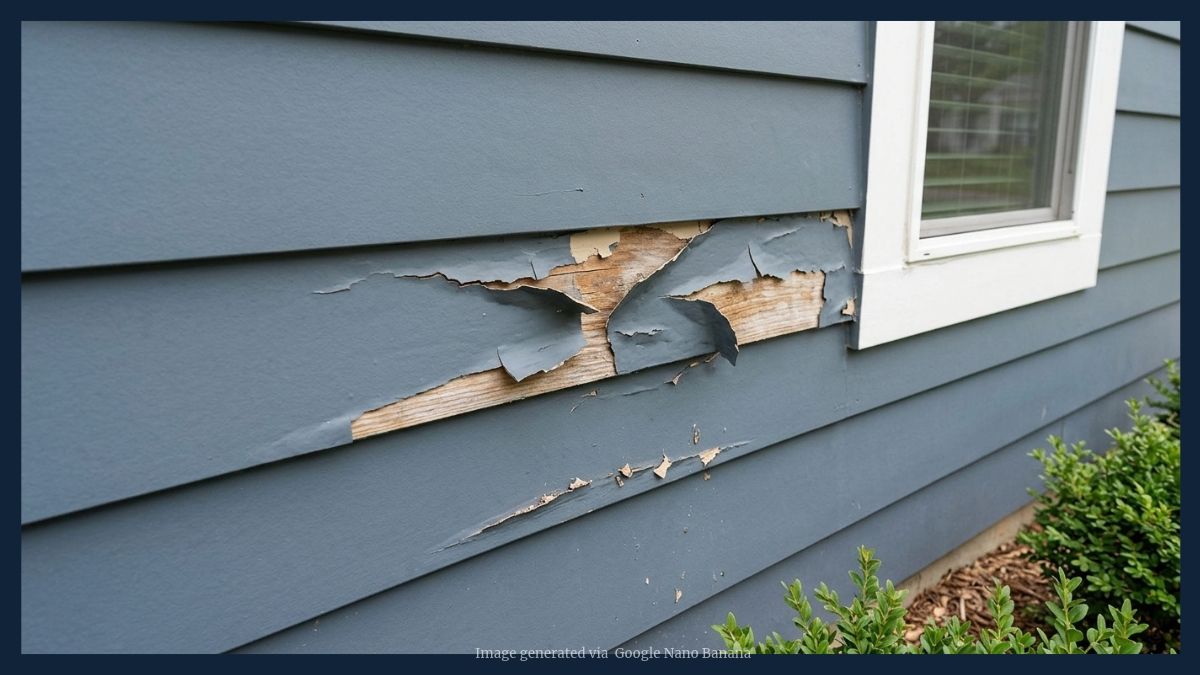
Exterior paint usually peels when it loses adhesion to the surface underneath. Common causes include moisture entering the wall, inadequate surface preparation, painting over damp or dirty materials, unsuitable primer or paint, and applying paint under unfavorable weather conditions. On wood siding, repeated moisture exposure can make the wood swell and shrink, gradually breaking the paint’s bond. On masonry, trapped moisture and salt deposits can also cause paint to lift or flake.
- Moisture is one of the most common causes of exterior paint peeling.
- Paint can fail when applied over damp, dirty, chalky, or poorly prepared surfaces.
- Peeling around windows, doors, roof edges, and lower wall sections may indicate water intrusion.
- Paint applied in unsuitable weather conditions may not bond or cure properly.
- Masonry walls can experience paint failure when moisture and salts accumulate beneath the coating.
- Repainting without fixing the source of moisture or adhesion failure usually produces temporary results.
- Older homes may contain lead-based paint, so removing deteriorated coatings requires appropriate precautions.
Moisture is getting behind the paint
Moisture is one of the most important causes to investigate when exterior paint begins peeling.
Water can enter through cracks, damaged sealant, leaking roofs, poorly maintained gutters, or gaps around windows and doors. It can also move from inside the building toward the exterior when indoor moisture is not properly managed or the wall assembly has a moisture-control problem.
When wood absorbs water, it swells. As it dries, it contracts. Repeated changes put stress on the paint film, causing it to crack, loosen, and eventually peel away.
Even masonry and other non-wood surfaces can experience paint failure when moisture becomes trapped beneath an unsuitable coating.
Common sources of moisture
- Damaged or missing caulk around windows and doors.
- Leaking roof edges or poorly maintained flashing.
- Clogged or overflowing gutters.
- Downspouts discharging water too close to exterior walls.
- Cracks in masonry or exterior render.
- Water entering around vents and utility openings.
- Interior plumbing leaks.
- Excessive indoor humidity or inadequate ventilation.
Signs moisture may be responsible
- Paint peels in large sections or sheets.
- Blistering appears before the paint begins to flake.
- Peeling is concentrated near windows, doors, or roof intersections.
- Wood siding feels soft or shows signs of deterioration.
- There are water stains or damp areas on the interior side of the same wall.
- The problem becomes worse after periods of heavy rain.
Persistent moisture can support mold growth and contribute to wood decay. If you notice extensive mold-like growth, a musty odor, or visibly deteriorated wall materials, avoid disturbing the affected area.
Keep children and pets away, and arrange an assessment by a qualified moisture or building professional. If water is entering near electrical outlets, exterior wiring, or electrical equipment, do not touch wet components.
Have a qualified electrician assess the hazard. Contact emergency services if there is an immediate electrical or fire danger.
What homeowners should check
Look for visible drainage and water-management problems before considering repainting. Check gutters, downspouts, exterior joints, window trim, and roof-to-wall intersections from a safe location.
If the paint is peeling because water is entering the wall, the source of that water needs to be corrected first.
The surface was not properly prepared before painting
Paint needs a clean, stable surface to adhere properly. If the wall was dirty, dusty, chalky, greasy, or covered with loose paint when the new coating was applied, the bond may be weak.
This is particularly common when a new coat is applied over an old finish without adequate cleaning, scraping, or preparation.
Even high-quality exterior paint can peel if the surface underneath is unsuitable.
Common surface preparation mistakes
- Painting over loose or flaking paint.
- Leaving dirt, dust, or grease on the wall.
- Applying paint over chalky surfaces without appropriate preparation.
- Failing to remove mildew or other surface contaminants.
- Skipping primer where the product or substrate requires it.
- Applying a new coating over a glossy or incompatible finish without proper preparation.
Signs poor preparation may be responsible
- The new paint peels away in sheets.
- The previous paint layer remains visible underneath.
- Peeling appears relatively soon after repainting.
- Paint separates around areas that were not cleaned or scraped properly.
- The coating comes away easily in places where the underlying surface looks intact.
What homeowners should know
Paint failure can happen at different layers. Sometimes the new paint separates from the old coating. In other cases, several layers detach together because the original coating has already lost its bond with the wall.
This distinction matters because simply applying another coat over the surface will not restore adhesion.
A professional painter can assess whether the remaining coating is stable and determine how much preparation is necessary before repainting.
The wall was damp when it was painted
A surface can look dry while still containing enough moisture to interfere with paint adhesion.
This can happen after rain, washing, pressure cleaning, condensation, or prolonged exposure to high humidity. Porous materials such as wood, concrete, and masonry may retain moisture below the visible surface.
When paint is applied before the substrate has dried sufficiently, the coating may not bond or cure as intended. Moisture can also become trapped beneath certain coatings, contributing to blistering and peeling.
Signs this may be the cause
- Peeling began relatively soon after the exterior was painted.
- The painting project took place during rainy or humid weather.
- Paint failure is concentrated on areas exposed to rain or washing.
- Blisters appear beneath the paint film.
- The underlying surface shows signs of dampness.
What homeowners should know
Drying requirements vary by surface material, weather conditions, and paint product. A wall that feels dry to the touch is not necessarily ready for painting.
Professional painters should follow the manufacturer’s requirements for substrate moisture, temperature, humidity, and drying time. On surfaces where moisture is a concern, they may use a suitable moisture meter rather than relying only on appearance.
The wrong primer or paint was used
Exterior paint products are designed for particular surfaces and conditions. A coating intended for one material may not perform properly on another.
For example, bare wood, previously painted siding, metal, concrete, and masonry can have different preparation and priming requirements.
Using an unsuitable primer or applying paint over an incompatible existing finish can lead to poor adhesion, blistering, or peeling.
Examples of product-related problems
- Applying paint without the primer required for bare or repaired surfaces.
- Using an interior coating on an exterior wall.
- Applying an unsuitable coating to concrete or masonry.
- Painting over an incompatible existing finish.
- Using a coating that cannot accommodate the movement of the substrate.
- Applying a product outside its recommended conditions.
Signs this may be the cause
- Paint failure occurs across several areas painted during the same project.
- Peeling appears despite the absence of obvious leaks.
- The coating separates from the underlying surface in sheets.
- Different materials on the same building show different paint performance.
- The paint failed relatively soon after application.
What homeowners should do
Check the product labels, technical data sheets, and previous painting records if available.
Confirm that the primer and topcoat are suitable for the actual wall material and compatible with the existing coating. If the previous paint type is unknown, a professional painter can assess the surface and recommend an appropriate coating system.
The paint was applied in unsuitable weather conditions
Exterior paint needs suitable conditions during application and curing. Excessive heat, direct sunlight, low temperatures, high humidity, and rain can affect how a coating dries and bonds.
For example, painting a wall that is too hot may cause the coating to dry too quickly, reducing the time available for proper application and film formation. Rain or dew can interfere with paint that has not dried sufficiently.
Cold temperatures can also affect certain products, while high humidity may slow drying.
Signs this may be the cause
- Peeling appeared shortly after the painting project.
- The wall was painted during very hot or rainy weather.
- Some sections failed while other areas remained intact.
- Paint appears uneven, wrinkled, or poorly bonded.
- The affected areas were exposed to direct sunlight during application.
What homeowners should know
There is no single ideal temperature or humidity range for every exterior paint product. Requirements vary by formulation and manufacturer.
Before repainting, check the product’s specified application temperature, surface temperature, humidity, and rain-free drying period.
The old paint has deteriorated with age
Exterior paint does not last indefinitely. Sunlight, rain, temperature changes, and general weather exposure gradually affect the coating.
As paint ages, it can lose flexibility and become brittle. Small cracks may develop, allowing water to reach the surface underneath. Over time, these cracks can expand and develop into flaking or peeling.
Older paint may also have accumulated several layers from previous repainting projects. If the underlying coats are already weak, additional layers can increase the likelihood of further failure.
Signs this may be the cause
- Paint is peeling across several exposed sections of the building.
- The coating has become brittle or heavily cracked.
- Multiple paint layers are visible at damaged edges.
- The finish looks faded, chalky, or weathered.
- Peeling is more pronounced on walls exposed to direct sun and rain.
What homeowners should do
Determine whether the paint is failing only in isolated areas or whether the entire exterior coating is deteriorating.
Small isolated defects may need localized repairs. Widespread failure may require more extensive preparation and repainting.
Do not assume that applying another coat will extend the life of a deteriorated paint system. The condition of the existing layers must be assessed first.
Masonry walls have moisture or salt-related problems
Paint peeling on concrete, brick, stucco, or other masonry surfaces may involve problems that are different from those affecting wood siding.
Masonry is porous and can absorb moisture. Water may move through the material and carry dissolved salts toward the surface. When the water evaporates, salts can remain behind as visible deposits. This process is commonly associated with efflorescence.
Salt deposits and moisture-related pressure can interfere with the bond between paint and masonry. Certain coatings may also be unsuitable for the surface’s alkalinity or moisture conditions.
Signs this may be the cause
- White, powdery deposits appear on the wall.
- Paint flakes or lifts from concrete, brick, or stucco.
- Peeling is concentrated near the base of the wall.
- The masonry remains damp after rainfall.
- The wall has recurring stains or deposits even after cleaning.
What homeowners should know
Efflorescence is a clue that moisture has moved through the masonry, but it does not identify the exact source of the water.
Possible sources include poor drainage, leaks, ground moisture, or water entering through cracks and joints.
Do not dry-brush or aggressively grind large areas of unknown deposits or deteriorated paint. Dust from old coatings or masonry can be harmful when inhaled, and some older buildings may contain lead-based paint. Avoid disturbing the surface until its condition and any relevant hazards have been assessed.
A professional should identify and address the moisture source, assess the masonry condition, and select a coating appropriate for the substrate.
How to identify the likely cause of exterior paint peeling
The appearance and location of the damage can help narrow down the possibilities.
| What you notice | Possible cause | What to investigate |
|---|---|---|
| Paint peels in large sheets | Poor adhesion or weak underlying paint layers | Surface preparation and coating compatibility |
| Blisters appear before peeling | Moisture or excessive heat | Moisture entry and painting conditions |
| Peeling occurs near windows and doors | Water intrusion | Flashing, sealant, and drainage |
| Paint peels near the bottom of the wall | Splashback, ground moisture, or drainage problems | Downspouts, grading, and wall clearance |
| White powder appears beneath or around peeling paint | Salt deposits or masonry moisture | Water movement through the wall |
| New paint peels soon after application | Damp surface, poor preparation, or unsuitable application conditions | Painting records and product instructions |
| Several exterior walls show widespread failure | Aging coating, preparation problems, or a broader moisture issue | Overall coating condition and wall moisture |
These patterns are clues rather than definitive diagnoses. More than one problem can contribute to paint failure.
What homeowners can safely check
You can gather useful information before arranging repairs. The goal is to document the problem and identify obvious sources of moisture without disturbing potentially hazardous paint.
1. Identify the wall material
Determine whether the affected surface is wood siding, engineered wood, concrete, brick, stucco, or another material.
The correct repair and paint system depend on the substrate.
2. Observe where the paint is peeling
Look for patterns across the exterior:
- Is the peeling limited to one wall?
- Does it occur around windows or doors?
- Is it concentrated near the foundation?
- Does it affect exposed walls more than sheltered ones?
- Is it occurring around cracks or joints?
The location can help identify whether water intrusion, weather exposure, or surface preparation is involved.
3. Look for visible moisture sources
From a safe location, inspect accessible exterior details such as:
- Gutters and downspouts.
- Roof edges and flashing.
- Window and door trim.
- Exterior sealant joints.
- Cracks in masonry.
- Areas where water collects near the foundation.
Do not climb onto the roof or use an unstable ladder to investigate.
4. Check accessible interior areas
If exterior paint is peeling near an interior bathroom, kitchen, laundry room, or plumbing installation, look for visible signs of leaks or dampness on the corresponding interior wall.
This does not prove that indoor moisture is causing the exterior paint failure, but it may provide a useful clue.
5. Review the previous painting work
If the exterior was recently repainted, gather information about:
- The paint and primer brands and product names.
- The date the work was completed.
- Weather conditions during application.
- Whether the surface was washed or pressure-cleaned.
- Whether the old paint was scraped or sanded.
- Whether repairs were made before painting.
This information can help a painter determine whether the problem is related to preparation, application, or the underlying wall.
If the home was built before 1978, its older paint may contain lead. Do not dry-sand, power-sand, grind, burn, or aggressively scrape deteriorated paint until the potential lead hazard has been assessed. Lead-contaminated dust and paint chips can harm adults and children, with young children being particularly vulnerable.
Keep children and pets away from peeling paint and collect no chips by hand without appropriate precautions. Consult an EPA-certified lead-safe contractor or qualified lead professional where applicable.
If lead exposure is suspected, contact a healthcare professional or local public health authority for guidance.
How should peeling exterior paint be repaired?
The repair depends on why the coating failed and how much of the surface is affected.
The general process involves correcting the underlying problem, preparing the surface, selecting a compatible primer and paint, and applying the coating under suitable conditions.
Step 1: Correct the source of moisture
If water is entering the wall, repair the underlying problem before repainting.
This may involve correcting leaking gutters, damaged flashing, defective sealant joints, roof leaks, drainage issues, or plumbing leaks.
Repainting before resolving moisture problems can result in repeated peeling.
Step 2: Assess the condition of the existing paint
Determine whether the remaining paint is firmly attached or whether additional areas are likely to detach.
A professional may perform an adhesion assessment and check the condition of the underlying material.
Step 3: Remove loose paint safely
Loose and deteriorated paint generally needs to be removed before a new coating is applied. The removal method depends on the surface, the condition of the existing paint, and any hazardous-material concerns.
For older buildings, lead-safe methods may be necessary.
Step 4: Prepare the surface
The surface may need cleaning, drying, repairs, and appropriate preparation to provide a stable base for the new coating.
Bare or repaired areas may require a compatible primer. Masonry may need a product specifically formulated for concrete or other alkaline surfaces.
Step 5: Apply a suitable exterior coating
Choose a paint system designed for the wall material and existing conditions.
Follow the manufacturer’s instructions for surface preparation, primer compatibility, application temperature, humidity, drying time, and number of coats.
Step 6: Monitor the repaired area
After the work is complete, periodically check the repaired sections for new cracking, blistering, staining, or peeling.
If the same symptoms return, the underlying cause may not have been fully corrected.
When should you call a professional?
A professional painter or building specialist should assess the problem when peeling is widespread, keeps returning, or appears alongside signs of moisture damage.
- Large sections of paint are separating from the wall.
- Peeling returns soon after repainting.
- Wood siding is soft, swollen, or deteriorating.
- Masonry has recurring damp patches or salt deposits.
- Paint is peeling around windows, doors, or roof intersections.
- Interior and exterior walls show signs of moisture at the same location.
- You suspect the wall assembly or supporting materials have been damaged.
- The property may contain lead-based paint and extensive removal is needed.
Which professional should you hire?
| Problem | Appropriate professional |
|---|---|
| Peeling caused by poor preparation or coating failure | Qualified exterior painting contractor |
| Suspected leaks around windows, doors, or roof edges | Qualified building-envelope or exterior contractor |
| Persistent moisture or hidden wall damage | Building-moisture specialist |
| Deteriorated wood siding | Siding contractor or qualified carpenter |
| Cracking or deteriorating masonry | Masonry contractor |
| Suspected lead-based paint | EPA-certified lead-safe contractor or qualified lead professional |
Should you hire a professional?
If the paint is peeling in a small, isolated area and there are no signs of moisture damage or hazardous materials, a straightforward repair may be possible after the cause has been identified.
However, widespread peeling, recurring paint failure, soft siding, or damp masonry deserves a closer inspection. A professional can determine whether the problem is limited to the coating or whether water is damaging the wall underneath.
For homes built before 1978, professional lead-safe assessment and repair are especially important before disturbing old paint.
The best repair is not simply the one that makes the wall look fresh again. It is the one that restores the coating while addressing the reason it failed.
Homeowner checklist: What to do about peeling exterior paint
Use this checklist to document the problem before arranging repairs.
- Identify the exterior wall material.
- Photograph the peeling areas from a safe location.
- Note whether paint is peeling, blistering, cracking, or flaking.
- Check whether the problem is limited to one wall or affects several sides of the house.
- Look for visible water stains, damaged sealant, or deteriorated trim.
- Inspect accessible gutters and downspouts for drainage problems.
- Check for cracks or recurring white deposits on masonry.
- Look for possible interior moisture sources near the affected exterior wall.
- Review the date and conditions of the last painting project.
- Keep children and pets away from loose paint chips.
- Avoid disturbing old paint if the property may contain lead-based coatings.
- Correct water intrusion before repainting.
- Ask a qualified painter to assess surface preparation and coating compatibility.
- Keep paint labels, product information, and repair records for future maintenance.
Frequently asked questions
Paint that peels within a year may have been applied over a damp, dirty, or poorly prepared surface. Incorrect primer, unsuitable paint, or unfavorable application conditions can also cause early failure.
Not always. Moisture is a common cause, but peeling can also result from poor surface preparation, incompatible coatings, or weather-related application problems.
Large sheets of peeling paint often indicate a loss of adhesion between paint layers or between the coating and the underlying surface.
Water may be entering through damaged sealant, failed flashing, or poorly protected joints around the openings.
Lower wall sections may experience repeated water exposure from rain splashback, poor drainage, leaking downspouts, or ground moisture.
No. Applying a new coat over loose or peeling paint does not restore the bond between the existing coating and the wall.
Pressure washing may remove some loose paint, dirt, and surface contaminants, but it is not suitable for every surface or situation.
Small isolated areas may need localized repair, while widespread peeling, cracking, or loss of adhesion may require more extensive preparation and repainting.
Sources and references:
- U.S. Forest Service, Forest Products Laboratory: Finishes Checklist: A Guide to Achieving Optimum Coating Performance on Exterior Wood Surfaces
https://www.fpl.fs.usda.gov/documnts/pdf2004/fpl_2004_bonura001.pdf - USDA Forest Service: Finishing Wood Exteriors: Selection, Application, and Maintenance
https://www.fpl.fs.usda.gov/documnts/usda/ah647.pdf - U.S. Department of Housing and Urban Development: Guidelines for the Evaluation and Control of Lead-Based Paint Hazards in Housing, Chapter 5
https://apps.hud.gov/offices/lead/lbp/hudguidelines/Ch05.pdf - U.S. Environmental Protection Agency: Exterior Surface Preparation
https://archive.epa.gov/airquality/community/web/pdf/lbpguide.pdf - Sherwin-Williams: Peeling Due to Moisture (Outside)
https://www.sherwin-williams.com/painting-contractors/color/resources/SW-ARTICLE-PRO-EXTPEELDUEMOI - Sherwin-Williams: Peeling Under Eaves
https://www.sherwin-williams.com/architects-specifiers-designers/puttyjoint-knives/resources/SW-ARTICLE-PRO-PEELINGUNDEREAV - BEHR: Paint Peeling from Wood
https://www.behr.com/pro/resources/paint-problem-solver/paint-problem-solver-detail/peeling-from-wood - U.S. EPA: Lead-Based Paint Renovation, Repair and Painting Program
https://www.epa.gov/lead/lead-renovation-repair-and-painting-program
