
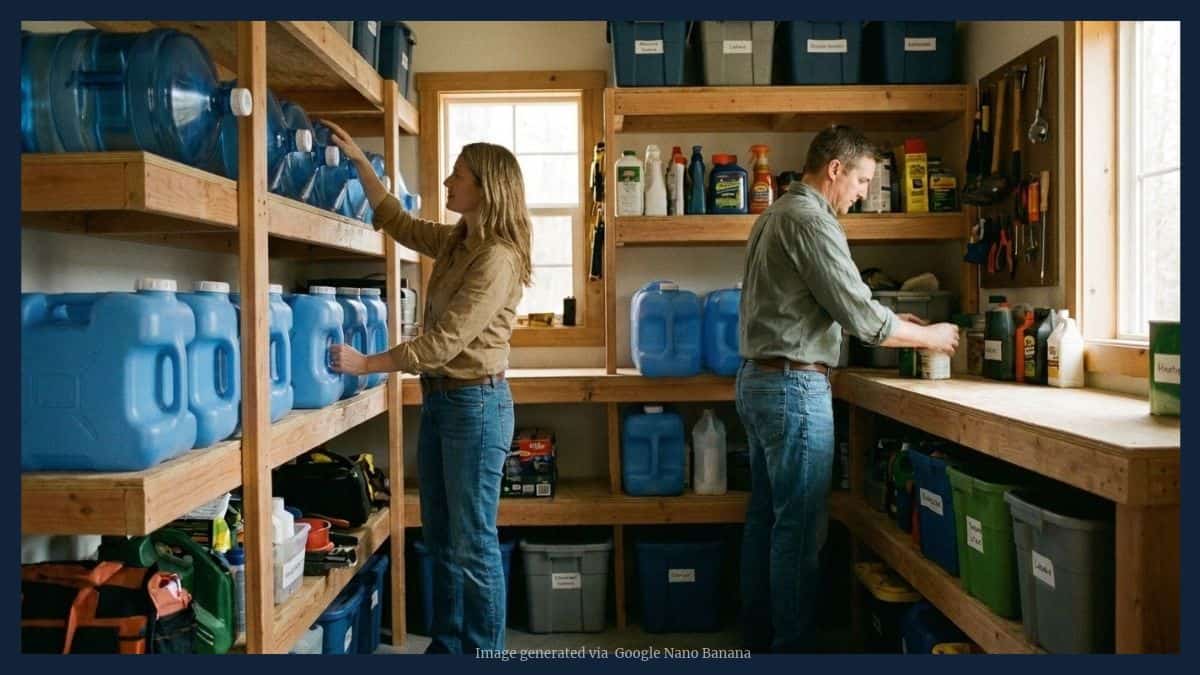
For emergency preparedness, the CDC recommends storing at least 1 gallon of water per person per day for at least 3 days. If you have enough space, aim for a 2-week supply. The amount your household needs depends on how many people live in your home, how long you want to prepare for, and whether anyone has additional water needs.
Use the Dwellnostics calculator below to estimate your household’s basic emergency water supply. Then learn how to store it safely, choose suitable containers, and account for pets, hot weather, and other circumstances.
- Start with 1 gallon of water per person per day.
- Store at least a 3-day supply and aim for 2 weeks if space allows.
- Use clean, food-grade containers for water you fill yourself.
- Keep stored water sealed and protected from heat and direct sunlight.
- Replace self-filled stored water every 6 months.
- Store extra water for pets and household members with additional needs.
- Emergency drinking water storage is separate from the larger amount of water that may be needed for bathing, laundry, flushing toilets, and other household activities.
Emergency Water Storage Calculator

Dwellnostics Home Tool
Emergency Water Storage Calculator
Plan ahead. Estimate your household’s basic water needs before a water shortage or emergency.
Based on at least 1 gallon per person per day for drinking and basic needs. Actual requirements can be higher.
The calculator estimates a basic supply using one gallon per person per day. Readers can select their household size and a preparation period of 3, 7, or 14 days.
The calculator’s result is a starting point. It does not automatically account for pets, medical needs, hot weather, or additional sanitation requirements.
How much water does your household need?
The basic calculation is straightforward:
Household members × gallons per person per day × number of days = total water supply
Using the baseline of 1 gallon per person per day:
| Household size | 3 days | 7 days | 14 days |
|---|---|---|---|
| 1 person | 3 gallons | 7 gallons | 14 gallons |
| 2 people | 6 gallons | 14 gallons | 28 gallons |
| 3 people | 9 gallons | 21 gallons | 42 gallons |
| 4 people | 12 gallons | 28 gallons | 56 gallons |
| 5 people | 15 gallons | 35 gallons | 70 gallons |
| 6 people | 18 gallons | 42 gallons | 84 gallons |
These totals are calculated using the CDC’s baseline recommendation. They are not individualized medical or hydration estimates.
Example: A household of four
A household with two adults and two children can use the following baseline:
- 4 people × 1 gallon × 3 days = 12 gallons
- 4 people × 1 gallon × 7 days = 28 gallons
- 4 people × 1 gallon × 14 days = 56 gallons
The 14-day supply is a substantial amount of water. It may need to be divided among several smaller containers or stored in a dedicated water-storage area.
What does one gallon per person per day cover?
The emergency water guideline is intended to cover drinking and basic needs. Depending on the circumstances, stored water may be used for:
- Drinking
- Preparing food
- Brushing teeth
- Basic hygiene
- Other essential uses
A gallon per person per day is a minimum planning baseline. It should not be interpreted as a strict limit on how much a person may drink.
Water needs can increase because of heat, physical activity, illness, pregnancy, nursing, or other conditions. Ready.gov notes that very hot temperatures can substantially increase water needs.
What about toilet flushing, bathing, and laundry?
The baseline emergency water recommendation is not intended to cover every normal household activity at typical usage levels.
If you want to prepare for a prolonged outage, consider how your household will manage:
- Toilet flushing
- Handwashing
- Bathing
- Laundry
- Dishwashing
- Cleaning
These activities can require considerably more water than drinking and basic food preparation.
During an emergency, follow local public health instructions, especially if authorities issue a boil-water notice or warn that the water supply may be contaminated.
Should you store 3 days, 7 days, or 14 days of water?
The best preparation period depends on your available storage space, budget, and local risks.
3 Days: A basic emergency supply
A 3-day supply is a reasonable starting point for households that are beginning emergency preparedness.
It can help cover a short disruption caused by a power outage, severe storm, or temporary water service interruption.
For a household of four, the baseline is 12 gallons.
7 Days: A more comfortable starting point
A 7-day supply gives your household more time to respond if water service is not restored quickly.
For a household of four, the baseline is 28 gallons.
This may be a practical intermediate goal if you cannot immediately store a 14-day supply.
14 Days: A more substantial emergency supply
The CDC recommends trying to store a 2-week supply if possible. A longer supply can provide more flexibility during an extended disruption.
For a household of four, the baseline is 56 gallons.
You do not necessarily need to purchase or store all of this at once. You can build your supply gradually, starting with the amount you can safely store.
How much extra water should you store?
The one-gallon baseline may not be enough for every household.
Consider additional water for the following circumstances.
Hot weather
Hot weather can increase water needs, particularly when people are active or spending time outdoors.
If your household lives in a hot climate or expects to shelter in place during high temperatures, plan for more than the baseline.
Children, pregnant people, and nursing mothers
Water needs vary by age, health, and circumstances. Children, pregnant people, and nursing mothers may require additional water.
Do not use the basic calculator as a personalized hydration recommendation.
Illness or medical needs
People who are sick or have medical conditions may need additional water.
If a household member has a medical condition that affects fluid requirements, follow their healthcare professional’s advice.
Pets
Pets need their own water supply.
Their requirements vary by species, size, activity, health, and temperature. Do not assume that the household’s human water calculation includes enough water for animals.
If you have multiple pets, calculate their needs separately and add the amount to your emergency plan.
How to store emergency water safely
Having enough water is only part of emergency preparedness. You also need to store it safely.
1. Use commercially bottled water or food-grade containers
Unopened commercially bottled water is the CDC’s safest and most reliable emergency water option.
If you fill your own containers, use clean, food-grade water storage containers. The CDC recommends containers that will not transfer harmful substances into the water.
Avoid containers that previously held toxic chemicals, pesticides, fuel, or other hazardous substances.
2. Clean and sanitize containers before filling
If you are storing water in containers you fill yourself:
- Use containers intended for drinking water.
- Clean and sanitize them according to the manufacturer’s instructions.
- Use safe water to fill them.
- Close the containers tightly.
- Label them with the date they were filled.
Do not assume that a container is safe for drinking water simply because it is clean or made of plastic.
3. Store water away from heat and sunlight
Choose a cool, dark storage location.
Keep water away from direct sunlight, chemicals, fuel, pesticides, and other potential contaminants.
Make sure the containers are stable and that the storage area can safely support their weight.
4. Replace self-filled water every 6 months
The CDC recommends replacing water that you fill yourself every 6 months.
For commercially bottled water, follow the manufacturer’s date and storage instructions.
A simple reminder on your calendar can help prevent your emergency supply from being forgotten.
5. Keep water accessible
During an emergency, you may need to reach your water supply quickly.
Avoid placing all your water in an inaccessible location, such as behind heavy furniture or in an area that may be difficult to reach during a storm.
If you use large containers, make sure you have a safe way to move or dispense the water.
How much space does emergency water storage require?
Water is heavy, so storage space and structural loading matter.
One U.S. gallon of water weighs approximately 8.34 pounds, excluding the container.
| Water quantity | Approximate water weight |
|---|---|
| 3 gallons | 25 pounds |
| 7 gallons | 58 pounds |
| 14 gallons | 117 pounds |
| 28 gallons | 234 pounds |
| 56 gallons | 467 pounds |
| 84 gallons | 701 pounds |
A 14-day supply for a household of four contains 56 gallons of water. The water alone weighs approximately 467 pounds.
That is a significant load. Avoid placing large water containers on elevated shelves or floors that may not be designed to support the weight.
If you plan to store a large quantity in one location, consider the floor’s load capacity and consult a qualified professional if you are unsure.
What should you do if your stored water runs out?
If your emergency supply is exhausted, do not assume that every available water source is safe to drink.
Potential emergency water sources may include:
- Unopened bottled water
- Water from an approved emergency distribution point
- Water from a properly maintained and protected storage system
- Other sources that local authorities have confirmed are safe
If you need to treat water, follow official public health instructions. Some water may be contaminated by chemicals or other hazards that ordinary boiling or disinfection will not remove.
During a water emergency, local authorities may issue specific instructions about drinking water, cooking, bathing, and sanitation.
For guidance on treating water during an emergency, see the CDC’s emergency water safety guidance.
Common emergency water storage mistakes
Avoid these common mistakes when preparing your household’s water supply.
- Storing only enough water for drinking: Basic food preparation and hygiene also require water.
- Ignoring pets: Animals need a separate supply.
- Using unsuitable containers: Containers that held chemicals are not safe for drinking water storage.
- Forgetting to rotate self-filled water: Replace it every 6 months.
- Storing water in direct sunlight: Heat and sunlight can affect storage conditions.
- Putting large containers on weak shelves: Water is heavy and can create a structural hazard.
- Assuming all emergency water can be made safe by boiling: Chemical contamination may require a different response.
- Waiting until an emergency is announced: Water may become difficult to obtain when demand increases.
Emergency water storage checklist
Use this checklist to prepare your household.
- Calculate the basic water needs of everyone in your household.
- Start with at least a 3-day supply.
- Work toward a 14-day supply if space and resources allow.
- Add extra water for pets and special household needs.
- Choose safe, food-grade containers.
- Clean and sanitize containers before filling them.
- Label self-filled water with the date.
- Store water in a cool, dark, accessible location.
- Replace self-filled water every 6 months.
- Review local emergency water guidance.
- Keep a plan for obtaining additional safe water if your stored supply runs out.
Frequently asked questions
It is a minimum emergency planning baseline, not a universal amount for every person or situation. Hot weather, activity, illness, pregnancy, nursing, and other factors can increase water needs.
Start with at least 3 days and try to store a 2-week supply if possible. The appropriate amount depends on your household and local emergency risks.
Pet water needs vary by species, size, activity, health, and temperature. Calculate your pets’ requirements separately and add that amount to your household’s emergency supply.
You can store tap water if it is safe to drink and you use suitable, clean, food-grade containers. Follow the CDC’s instructions for preparing and storing an emergency water supply.
The CDC recommends replacing water that you fill yourself every 6 months. For commercially bottled water, follow the manufacturer’s storage instructions and date information.
Milk containers are generally not recommended for storing drinking water for emergencies. Residual milk can be difficult to remove completely, and some containers may not be designed for long-term water storage.
Use food-grade containers intended for drinking water instead.
Sources and references:
