
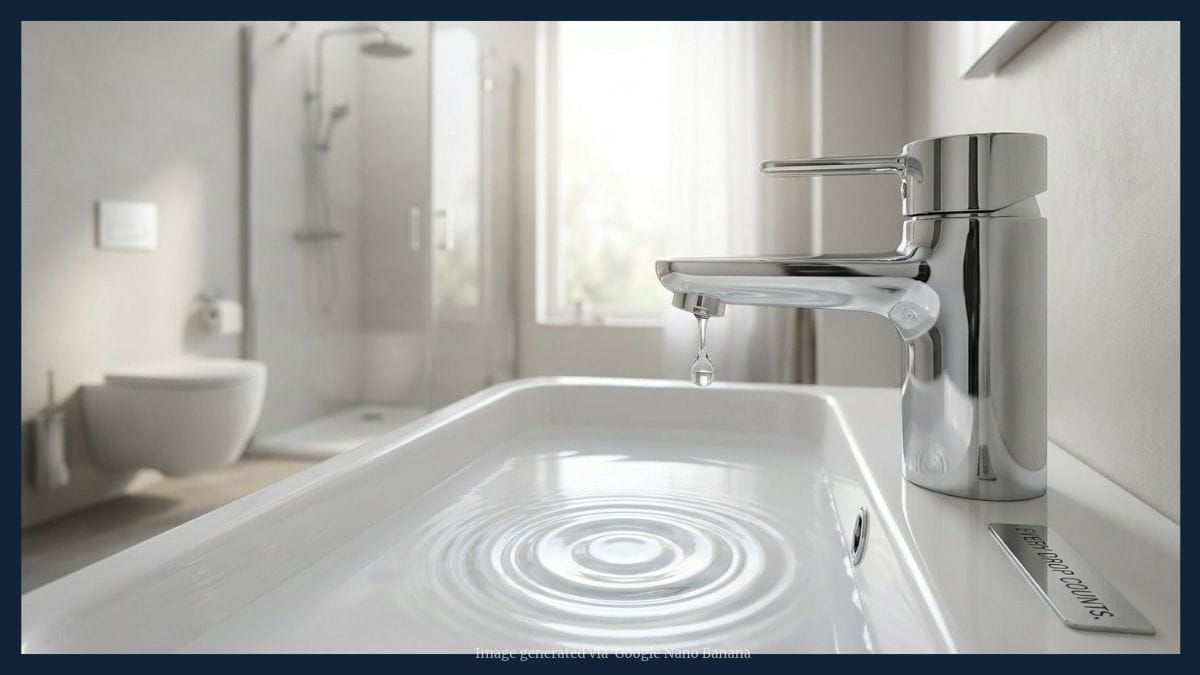
Some household fixtures use more water than others, but the biggest source of water waste is not always the fixture you expect. A toilet may account for a significant portion of indoor water use, while a leaking faucet, running toilet, or inefficient showerhead can waste water every day without being obvious.
- Running toilets can waste substantial amounts of water because they may leak continuously between flushes.
- Leaking faucets and showerheads can waste thousands of gallons annually, even when the leaks appear small.
- Older toilets may use several gallons per flush, compared with modern efficient models.
- Inefficient showerheads can use more water per minute than WaterSense-labeled models.
- Faucets waste water when left running during brushing, shaving, or dishwashing.
- Washing machines and dishwashers can waste water when inefficient models are used or when loads are run unnecessarily.
- Outdoor irrigation systems can waste large amounts of water through leaks, overspray, and poor scheduling.
The most important distinction is that high water use is not automatically water waste. A shower uses water by design, while a leaking showerhead uses water when it should not.
Toilets: One of the biggest sources of indoor water use
Toilets are among the largest water-using fixtures in a typical home. The U.S. Environmental Protection Agency estimates that toilets account for nearly 30% of average indoor household water consumption.
Older toilets can use substantially more water per flush than modern efficient models. A toilet manufactured before modern efficiency standards may use several gallons per flush, while a WaterSense-labeled toilet uses 1.28 gallons per flush or less.
However, a toilet does not need to be old to waste water. A worn flapper or faulty flush valve can allow water to leak from the tank into the bowl continuously.
How much water can a running toilet waste?
A leaking toilet can waste a significant amount of water, depending on the severity of the leak.
Some leaks are silent, meaning water flows from the tank into the bowl without producing an obvious sound. Others cause the toilet to refill periodically even when nobody has flushed.
How to check for a toilet leak
You can perform a simple dye test:
- Remove the toilet tank lid.
- Add a few drops of food coloring to the tank water.
- Do not flush.
- Wait approximately 10 minutes.
- Check whether colored water appears in the toilet bowl.
If color appears in the bowl, water is likely leaking from the tank into the bowl.
The problem may involve a worn flapper, flush valve seal, or another tank component. Replace damaged parts or contact a plumber if the toilet continues running.
Leaking faucets: Small drips can add up
A dripping faucet may appear harmless, but a leak that continues around the clock can waste a surprising amount of water.
The EPA estimates that a faucet dripping once per second can waste more than 3,000 gallons annually.
That is water being lost even when the faucet is not being used.
Common causes of faucet leaks
A dripping faucet may be caused by:
- Worn washers
- Damaged seals or gaskets
- A faulty cartridge
- Loose connections
- Corrosion
- Mineral buildup affecting the fixture
The repair depends on the faucet design and the source of the leak.
How to reduce faucet water waste
- Repair dripping faucets promptly.
- Replace worn washers, cartridges, or seals.
- Check connections beneath sinks for leaks.
- Install a WaterSense-labeled faucet or aerator when appropriate.
- Turn off the tap while brushing your teeth or shaving.
A faucet that drips once per second can waste more than 3,000 gallons per year, according to EPA WaterSense. That makes even a small leak worth investigating.
Showerheads: High flow and leaks can waste water
Showers are another major source of indoor water use.
The EPA estimates that showering accounts for nearly 17% of residential indoor water use, or approximately 40 gallons per day for the average family.
The amount of water a shower uses depends on the showerhead’s flow rate and how long the shower runs.
Standard versus efficient showerheads
| Showerhead Type | Typical Flow Rate |
|---|---|
| Standard showerhead | Up to 2.5 gallons per minute |
| WaterSense-labeled showerhead | 2.0 gallons per minute or less |
A WaterSense-labeled showerhead can reduce water use while still providing satisfactory performance.
For example, a 10-minute shower using a 2.5-gallon-per-minute showerhead uses approximately 25 gallons. A showerhead operating at 2.0 gallons per minute uses approximately 20 gallons over the same period.
Actual use depends on the showerhead’s flow rate and the time spent showering.
Do leaking showerheads waste water?
Yes. The EPA reports that a showerhead leaking at 10 drips per minute can waste more than 500 gallons annually.
Check the showerhead and its connections for dripping when the fixture is turned off. If the leak continues, inspect the connection or have the fixture repaired.
Bathroom and kitchen faucets: Water use depends on habits
Bathroom and kitchen faucets are used many times throughout the day.
The amount of water they consume depends on the flow rate and how long the water runs.
Common water-wasting habits include:
- Leaving the faucet running while brushing teeth
- Letting water run continuously while washing dishes
- Using running water to thaw frozen food
- Rinsing items longer than necessary
- Ignoring a dripping faucet
How much water can a running faucet waste?
The EPA estimates that turning off the tap while brushing your teeth can save approximately 8 gallons of water per day.
For dishwashing, letting a faucet run for five minutes can waste approximately 10 gallons.
These amounts can add up over time, especially in households with several people.
Practical ways to reduce faucet water use
- Turn off the tap while brushing your teeth.
- Use a basin when washing dishes by hand.
- Avoid running water unnecessarily while preparing food.
- Install a faucet aerator where appropriate.
- Repair dripping faucets promptly.
Washing Machines: Older models may use more water
Washing machines can use a substantial amount of water, particularly older or inefficient models.
The amount used per load varies based on the machine’s design, capacity, cycle, and settings.
A washing machine may waste water when:
- It is inefficient compared with newer models.
- Loads are run with only a few items.
- The wrong cycle is selected.
- The machine has a leaking hose or connection.
- Water continues entering the machine when it is not in use.
How to reduce washing machine water waste
- Run full loads when practical.
- Use the appropriate load-size setting.
- Choose an efficient washing machine when replacing an older model.
- Inspect supply hoses and connections.
- Repair leaks as soon as they are discovered.
Running a full load is generally more water-efficient than running several smaller loads, provided the machine is not overloaded.
Dishwashers: Running partial loads can waste water
Dishwashers use water to clean dishes, but modern efficient models may use less water than washing dishes by hand with a continuously running faucet.
The amount of water used depends on the dishwasher’s age, efficiency, cycle, and load.
How to avoid dishwasher water waste
- Run the dishwasher when it is full.
- Use an appropriate cycle for the load.
- Check the door seal for leaks.
- Inspect accessible supply and drain connections.
- Avoid unnecessary pre-rinsing if the manufacturer’s instructions do not require it.
The EPA estimates that running a dishwasher only when full can eliminate one load per week and save the average family nearly 320 gallons annually.
Outdoor faucets and irrigation systems: Water waste can be substantial
Although this article focuses on household fixtures, outdoor water systems deserve attention because they can use a large share of a home’s total water supply.
Outdoor water use accounts for more than 30% of total household water use on average, according to EPA WaterSense. In arid regions, it can reach 60%.
Outdoor water waste may occur because of:
- Broken sprinkler heads
- Leaking irrigation lines
- Poorly adjusted sprinklers
- Water spraying onto sidewalks or driveways
- Excessive watering
- Irrigation systems running during rain
How to identify outdoor water waste
Inspect your outdoor faucets and irrigation system.
Look for:
- Water pooling near sprinkler heads
- Wet areas that remain when irrigation is off
- Sprinklers spraying pavement
- Damaged hoses
- Dripping outdoor faucets
- Unusually green patches of grass
If you suspect an underground irrigation leak, a professional may be able to locate it using specialized equipment.
Which household fixtures waste the most water?
The answer depends on whether you mean normal water consumption or unnecessary water loss.
| Fixture or System | Main Source of Water Waste | What to Check |
|---|---|---|
| Toilet | Leaking flapper or inefficient older design | Silent leaks, repeated refilling, gallons per flush |
| Faucet | Dripping or excessive running | Drips, worn seals, time spent running |
| Showerhead | High flow rate or leak | Flow rate, dripping after use |
| Washing machine | Inefficient model or leaking hoses | Load settings, supply connections |
| Dishwasher | Partial loads or leaks | Load size, seals, connections |
| Irrigation system | Leaks, overspray, poor scheduling | Sprinkler heads, wet soil, watering schedule |
For many households, a running toilet is a particularly important problem to investigate. It can waste water continuously, while older toilets and high-flow showerheads may use more water during normal operation.
The best priority is to fix leaks first, then consider efficiency improvements for fixtures that use large amounts of water.
How to find out which fixtures waste water in your home
You do not need specialized equipment to begin checking your home.
Step 1: Check your water bill
Compare your recent water use with previous months. An unexplained increase may indicate a leak or a change in household water use.
Step 2: Check your water meter
Turn off water-using fixtures and appliances. Record the meter reading, wait for a period when no water is being used, and check the reading again.
If it changes, investigate whether water is flowing somewhere in the home.
Step 3: Test your toilets
Use the food coloring test described earlier to check for silent toilet leaks.
Step 4: Inspect visible plumbing
Check under sinks, around water heaters, near washing machines, and around outdoor faucets.
Step 5: Inspect irrigation
Look for broken sprinkler heads, unusual wet areas, and water spraying where it is not needed.
For a detailed walkthrough, see our article: How to Find Hidden Water Leaks Before a Drought.
Should you repair or replace a water-wasting fixture?
The best option depends on the fixture’s condition, age, efficiency, and repair cost.
| Situation | Practical Option |
|---|---|
| Faucet has a worn washer or cartridge | Repair the faucet |
| Toilet has a faulty flapper | Replace the flapper or appropriate component |
| Older toilet uses excessive water per flush | Consider an efficient replacement |
| Showerhead has a persistent leak | Repair or replace the showerhead |
| Older washing machine uses excessive water | Compare efficient replacement options |
| Irrigation system has damaged components | Repair the affected components |
A fixture does not necessarily need to be replaced just because it uses more water than a newer model. If it works properly, a repair or a simple efficiency upgrade may be sufficient.
When replacing fixtures, look for products with the EPA WaterSense label where applicable. WaterSense-labeled products are independently certified to meet EPA efficiency and performance criteria.
Frequently asked questions
Toilets are one of the largest sources of indoor water use, accounting for nearly 30% of average indoor household consumption according to the EPA. Actual water use varies by household, fixture efficiency, and usage habits.
A running toilet can be a major source of water waste because it may leak continuously. However, the amount wasted depends on the leak rate. A dripping faucet or showerhead can also waste thousands of gallons over time.
The EPA estimates that a faucet dripping once per second can waste more than 3,000 gallons annually.
Many older toilets use more water per flush than modern efficient models. Some older designs use several gallons per flush, while WaterSense-labeled toilets use 1.28 gallons per flush or less.
They can be. WaterSense-labeled showerheads use no more than 2.0 gallons per minute and are independently certified for efficiency and performance. Actual savings depend on the showerhead being replaced and household showering habits.
Check your water bill, inspect visible plumbing, test toilets for silent leaks, and monitor your water meter when no water is being used. These checks can help identify potential leaks or unexpected water consumption.
Sources and references:
