
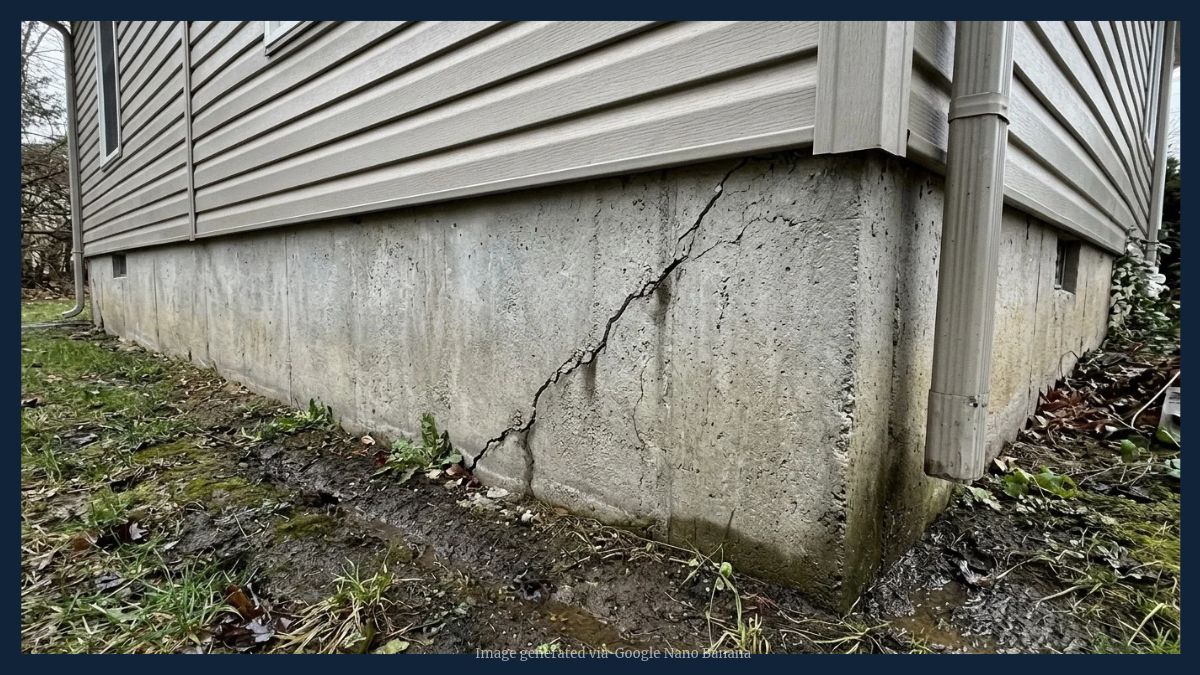
Cracks in your home’s foundation can develop for several reasons, including concrete shrinkage, normal settling, soil movement, and water pressure against foundation walls. Some are minor and remain unchanged for years, while others can indicate movement or structural damage that needs professional attention.
- Not every foundation crack indicates serious structural damage.
- Concrete shrinkage and minor settlement can produce small cracks.
- Horizontal cracks in foundation walls can indicate pressure from surrounding soil.
- Diagonal and stair-step cracks may indicate uneven foundation movement.
- Cracks that widen, leak, or show displacement deserve closer attention.
- Poor drainage and excessive moisture around the foundation can contribute to cracking.
- Filling a crack does not necessarily correct the underlying problem.
The important thing is to look beyond the crack itself. Its location, direction, width, whether the edges have shifted, and whether it is getting larger can help you decide how urgently it needs to be investigated.
What causes cracks in a foundation?
Foundation cracks usually develop when concrete, masonry, or the soil supporting the home experiences changes in moisture, pressure, or movement.
Here are some common causes.
1. Concrete shrinkage during curing
Concrete contains water that gradually evaporates as the material hardens. As it cures and loses moisture, it naturally contracts.
If this shrinkage creates more tension than the concrete can withstand, small cracks may develop. These are often thin, relatively uniform cracks that appear in poured concrete foundations.
Shrinkage cracks are not automatically structural defects. However, they can still allow moisture to enter, particularly if they extend through the foundation wall.
2. Normal foundation settlement
After construction, a house gradually transfers its weight to the soil beneath it. The ground may compress slightly as it adjusts to the load.
This process is called settlement. Minor, relatively uniform settlement can occur without causing significant structural problems.
Problems are more likely when one section of the foundation settles more than another. This uneven movement, known as differential settlement, can place stress on foundation walls and other parts of the structure.
Possible signs include:
- Diagonal cracks in foundation walls
- Stair-step cracks in brick or concrete block
- Cracks around doors and windows
- Doors or windows that suddenly become difficult to open
- Uneven floors or gaps between walls and ceilings
Settlement should be evaluated in context. A crack’s shape alone cannot establish how much movement has occurred.
3. Expansive or shifting soil
Some soils change volume as their moisture content changes.
For example, clay-rich soil can expand when it absorbs water and shrink as it dries. Repeated changes can place stress on a home’s foundation.
Depending on the soil conditions and foundation design, this movement can contribute to:
- Uneven foundation settlement
- Cracks in concrete or masonry
- Movement in foundation footings
- Cracks in interior walls and floors
The effects can be more noticeable in areas with significant seasonal moisture changes or prolonged periods of wet and dry weather.
4. Poor drainage around the house
Water accumulating around the foundation can affect the soil supporting the structure and increase pressure against below-ground foundation walls.
Common drainage problems include:
- Gutters that overflow or are clogged
- Downspouts that release water next to the foundation
- Ground that slopes toward the house
- Low areas where rainwater collects
- Poorly maintained drainage systems
Depending on the soil and site conditions, excess water can contribute to soil movement, erosion, or pressure against foundation walls.
If cracks appear alongside recurring puddles, damp basement walls, or water entering the home, investigate the drainage conditions rather than simply covering the cracks.
5. Hydrostatic pressure against foundation walls
Hydrostatic pressure is the pressure exerted by water in saturated soil.
When water accumulates in the ground surrounding a basement or below-grade foundation, it can push against the walls. If the pressure becomes excessive, the foundation may develop cracks or begin to bow inward.
Warning signs include:
- Horizontal cracks across basement walls
- Walls that appear to bulge inward
- Water seeping through cracks
- Damp areas that become worse after heavy rain
Horizontal cracks in below-grade foundation walls deserve particular attention because they can indicate lateral pressure. A structural engineer should evaluate them, especially if the wall is visibly bowing or displaced.
6. Plumbing leaks near or beneath the foundation
A leaking water supply line, drainpipe, or other underground plumbing can introduce water into the soil around or beneath a home.
Depending on the location and severity of the leak, this can soften soil, cause erosion, or contribute to uneven settlement.
Look for other possible clues:
- Unexplained increases in water usage
- Persistent damp areas near the foundation
- Water pooling without an obvious source
- Unusually wet soil in one location
- Cracks that appear alongside other signs of ground movement
A plumbing leak should be investigated and repaired before attempting to seal a related foundation crack.
7. Construction or material problems
Some foundation cracks are associated with problems during construction.
Examples include inadequate soil preparation, poorly compacted fill, unsuitable concrete, insufficient reinforcement, or foundation designs that do not adequately account for site conditions.
These issues can make a foundation more vulnerable to cracking or movement.
If cracks appear relatively soon after construction, continue to grow, or occur alongside visible structural defects, arrange an appropriate inspection.
What do different types of foundation cracks mean?
The direction and pattern of a crack can provide clues about its possible cause. However, no crack pattern should be treated as a definitive diagnosis without considering the foundation type, soil conditions, and other signs of movement.
| Crack type | Possible explanation | Recommended response |
|---|---|---|
| Hairline | Concrete shrinkage or minor movement | Photograph and monitor for changes |
| Vertical | Shrinkage or settlement | Check for widening, leakage, or displacement |
| Diagonal | Uneven settlement or movement | Arrange an inspection if new, growing, or uneven |
| Horizontal | Pressure against the foundation wall | Seek prompt professional evaluation |
| Stair-step | Movement in brick or concrete block masonry | Arrange an inspection, especially if widening |
| Multiple interconnected cracks | Several possible causes, including movement or material deterioration | Have the pattern professionally assessed |
Hairline foundation cracks
Hairline cracks are very narrow cracks that can develop as concrete cures and shrinks. They may also result from minor movement over time.
They are often less concerning when they remain unchanged, have no visible displacement, and do not allow water to enter.
However, a narrow crack should not automatically be dismissed. Monitor it for changes, particularly if it appears in a location where other signs of movement are present.
Vertical foundation cracks
Vertical cracks run up and down along a foundation wall.
They can develop from concrete shrinkage or settlement. Some remain stable, while others are associated with more significant foundation movement.
Pay attention to whether the crack:
- Becomes wider over time
- Has one side pushed forward or backward
- Allows water to enter
- Appears alongside uneven floors or sticking doors
A vertical orientation by itself does not establish whether a crack is harmless.
Diagonal foundation cracks
Diagonal cracks run at an angle across a foundation wall. They may develop when one part of the foundation moves differently from another.
The width and shape of the crack can provide additional clues. For example, a crack that becomes noticeably wider toward one end may deserve closer investigation.
Look for related signs such as uneven floors, gaps around door frames, or cracks in interior walls.
Horizontal foundation cracks
Horizontal cracks run across the foundation wall, often along a relatively straight line.
These cracks can indicate lateral pressure from soil or water outside the foundation. In some cases, the pressure can cause the wall to bow inward.
Do not assume that a horizontal crack is simply a cosmetic issue. Arrange a professional structural evaluation, especially if you can see bending, bulging, or displacement.
Stair-step foundation cracks
Stair-step cracks follow the mortar joints between bricks or concrete blocks, creating a pattern that resembles a staircase.
They may develop when masonry sections move or settle unevenly.
Check whether the crack is widening, whether individual blocks appear displaced, and whether the wall is leaning. Stair-step cracks that continue to grow should be inspected rather than covered with fresh mortar.
How can you tell if a foundation crack is serious?
There is no single visual measurement that can reliably determine whether every foundation crack is structurally significant.
Instead, consider several factors together.
1. Check whether the crack is getting wider
A crack that continues to widen or extend may indicate ongoing movement.
Take a clear photograph and record its approximate width. Repeat the measurement periodically using the same reference point.
If the crack changes noticeably, arrange a professional assessment rather than waiting for it to become larger.
2. Look for displacement
Displacement occurs when the surfaces on either side of a crack are no longer aligned.
For example, one side of a concrete crack may sit farther inward or outward than the other.
This is more concerning than a simple surface line because it suggests that the foundation material has shifted.
3. Check for water intrusion
Look for:
- Water seeping through the crack
- Damp or discolored concrete
- White, powdery deposits on the surface
- Musty odors near the foundation
- Water collecting along the basement floor
Water intrusion does not automatically mean the foundation is structurally failing, but it indicates a moisture problem that should be investigated.
4. Look for cracks elsewhere in the house
Foundation movement can sometimes affect other parts of the structure.
Check for:
- Diagonal cracks around windows and doors
- Cracks where walls meet ceilings
- Gaps between baseboards and floors
- Uneven or sloping floors
- Doors and windows that suddenly stick
- Separation between exterior steps, porches, or attached structures and the house
One isolated crack may have a different significance from several new cracks appearing around the same time.
5. Check whether the foundation wall is bowing
Stand back and look along the foundation wall rather than examining only the crack.
A wall that appears curved, bulging, or tilted inward may be experiencing pressure or structural movement.
Do not attempt to push the wall back into position or install reinforcement yourself. A qualified professional should determine the cause and appropriate repair.
How to monitor foundation cracks
If a crack appears small and there are no urgent warning signs, documenting it can help you identify whether it changes.
Monitoring does not replace an inspection when a crack appears concerning.
Step 1: Photograph the crack
Take a clear photograph that shows the entire crack and its surrounding area.
Include a ruler or measuring scale in a separate close-up photograph to help document its approximate width.
Step 2: Record its location
Write down where the crack appears, such as:
- North-facing basement wall
- Foundation corner near the garage
- Exterior wall below a window
- Concrete slab near the entrance
This makes it easier to compare photographs and observations later.
Step 3: Measure its width
Use a ruler or crack-width reference card to record the approximate width.
Measure at the same point each time. Avoid relying on visual estimates alone.
Step 4: Look for related changes
Record whether you notice water intrusion, new cracks, wall displacement, or changes in nearby doors and windows.
These details may help a structural engineer understand the problem.
Step 5: Compare photographs over time
Take follow-up photographs from approximately the same angle and distance.
If the crack widens, extends, develops displacement, or begins leaking, arrange a professional evaluation.
Do not wait for a scheduled monitoring date if the wall begins bowing or other significant warning signs appear.
What should you do when you find a foundation crack?
The right response depends on the crack’s characteristics and whether other problems are present.
For small, stable cracks
If a crack is narrow, dry, and unchanged, you can begin by documenting and monitoring it.
You should also check the surrounding area for drainage problems and other sources of moisture.
If the crack begins changing or you are uncertain about its cause, arrange an inspection.
For cracks that allow water inside
Identify where the water may be coming from.
Check gutters, downspouts, exterior grading, and nearby plumbing. Water should not repeatedly collect against the foundation.
A waterproofing professional may be able to identify the source of water intrusion and recommend suitable sealing or drainage work.
However, if the crack is also widening, displaced, or associated with a bowing wall, have the structural condition assessed before treating it as a simple waterproofing problem.
For horizontal, widening, or displaced cracks
Arrange a prompt evaluation by a licensed structural engineer or another appropriately qualified foundation professional.
Avoid simply filling the crack with sealant or mortar. Surface repairs can conceal the visible damage without correcting the pressure or movement responsible for it.
If the foundation wall is visibly bowing, appears unstable, or is accompanied by sudden major structural changes, keep people away from the affected area and seek urgent professional assistance.
How are foundation cracks repaired?
Foundation crack repairs vary depending on the material, location, cause, and severity of the damage.
A repair that works for a stable shrinkage crack may be unsuitable for a wall experiencing active movement.
Epoxy or polyurethane injection
These materials can be injected into certain cracks in poured concrete foundations.
- Epoxy injection is commonly used to bond and seal suitable cracks in concrete.
- Polyurethane injection is commonly used to seal cracks where water is entering.
These methods may be appropriate for certain stable cracks, but they do not automatically correct ongoing foundation movement or excessive external pressure.
Surface patching
Small cracks in concrete or masonry may sometimes be repaired using suitable patching materials.
This can improve the surface and help seal minor defects, but patching alone is not an appropriate solution for an unresolved structural problem.
Drainage improvements
When excess water around the foundation contributes to the problem, drainage improvements may be necessary.
Possible work includes:
- Correcting the ground slope around the house
- Repairing or extending downspouts
- Cleaning or repairing gutters
- Improving surface-water drainage
- Installing or repairing appropriate drainage systems
The correct solution depends on the property’s layout and soil conditions.
Foundation reinforcement
If a foundation wall is bowing or experiencing significant lateral pressure, reinforcement may be necessary.
Depending on the engineering assessment, repair options may include wall anchors, reinforcement straps, or other structural stabilization systems.
These systems are not interchangeable. A professional should determine which method is appropriate for the wall and the forces acting on it.
Underpinning or foundation support
If parts of the foundation are settling because the supporting soil cannot adequately carry the load, additional support may be required.
Underpinning or other foundation support methods can transfer the building’s load to more stable soil or deeper bearing material.
These are substantial repairs and should be designed around the actual cause of the settlement.
Should you hire a professional to inspect foundation cracks?
Yes, when a crack is growing, displaced, horizontal, associated with a bowing wall, or accompanied by other signs of structural movement, professional evaluation is important.
The right professional depends on what you are trying to determine.
| Professional | When to contact them |
|---|---|
| Licensed structural engineer | To assess structural movement, determine the cause of concerning cracks, and recommend appropriate repairs |
| Qualified foundation contractor | To evaluate and carry out suitable foundation repair work |
| Waterproofing specialist | To investigate water intrusion and recommend moisture-control solutions |
| Licensed plumber | To locate and repair suspected plumbing leaks near or beneath the foundation |
| Qualified home inspector | To document visible conditions and identify issues that may need further specialist evaluation |
For potentially serious structural cracks, an independent structural engineer can be a useful first point of contact because the engineer can assess the problem and recommend repairs without necessarily selling the repair work.
Ask for a written assessment that explains the suspected cause, the evidence supporting the recommendation, and whether monitoring or repair is appropriate.
Be cautious of anyone who recommends expensive foundation work based only on a quick look at one crack without evaluating the surrounding conditions.
Common mistakes to avoid when dealing with foundation cracks
Filling the crack without identifying its cause
A sealant or patch may hide the visible opening, but it cannot correct soil movement, water pressure, or an unstable foundation.
Determine why the crack developed before choosing a repair.
Assuming every vertical crack is harmless
Vertical cracks can result from concrete shrinkage, but they can also be associated with settlement or other movement.
Look at the crack’s width, condition, and changes over time.
Ignoring horizontal cracks
Horizontal cracks in below-grade foundation walls can indicate significant pressure.
Do not treat them as ordinary cosmetic cracks, particularly if the wall is bowing.
Painting over the damage
Paint or surface coatings can conceal changes that would otherwise be visible.
Photograph and document the crack before applying any repair material.
Ignoring drainage problems
Sealing a foundation crack while water continues to collect outside the wall may leave the underlying problem unresolved.
Check how rainwater moves around the property and correct drainage issues where appropriate.
Attempting structural repairs without professional guidance
Foundation reinforcement and stabilization require an understanding of the forces affecting the structure.
Incorrect repairs can fail to address the problem or make the situation more difficult to correct.
Frequently asked questions
Some foundation cracks are common. Concrete can shrink as it cures, and houses may experience minor settlement over time. However, cracks that widen, show displacement, allow water inside, or appear alongside other structural changes should be professionally evaluated.
Horizontal cracks in below-grade foundation walls are particularly concerning because they can indicate pressure from surrounding soil or water. A wall that is bowing inward, or a crack with visible displacement, also deserves prompt professional attention.
There is no universal width that separates harmless cracks from dangerous ones. A narrow crack can still be important if it is growing, leaking, or associated with displacement. Likewise, a wider but stable crack may have a different cause. Have concerning or changing cracks evaluated rather than relying on width alone.
Yes. Cracks can provide a path for groundwater or surface water to enter a basement or other below-grade space. Water intrusion should be investigated, and the source of moisture should be addressed before selecting a repair.
No. Some cracks develop from concrete shrinkage, minor settlement, or other non-structural causes. Foundation cracks alone do not prove that a house is sinking.
Heavy rain can contribute to foundation problems when it saturates surrounding soil, increases pressure against foundation walls, or exposes existing drainage problems.
Some cracks remain stable for years, while others widen as soil conditions, water pressure, or structural movement change. Monitoring can help identify changes, but a crack showing signs of active movement should not be left untreated while waiting to see what happens.
Sources and references:
