
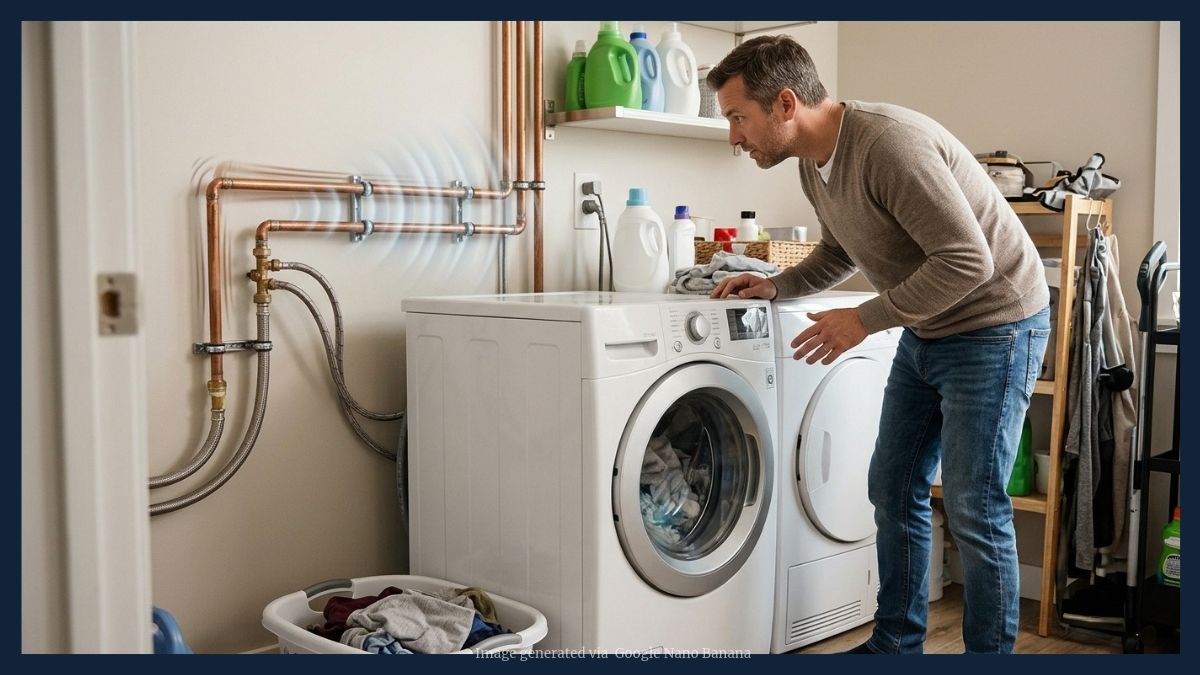
A water hammer noise in your pipes usually happens when flowing water is stopped or redirected suddenly, creating a pressure surge that travels through the plumbing system. The resulting shock wave can make pipes bang, thump, or vibrate, particularly when a faucet, toilet valve, washing machine, or dishwasher shuts off.
- Water hammer is a pressure surge caused by a sudden change in water flow.
- It commonly occurs when washing machines, dishwashers, faucets, and toilet valves shut off.
- High water pressure can increase the likelihood and severity of water hammer.
- Loose pipes can produce similar banging noises and may amplify the vibration.
- A water hammer arrestor can absorb pressure surges when correctly sized and installed.
- Repeated banging can eventually contribute to leaks or damage to plumbing components.
- Persistent, loud, or worsening noises should be investigated by a qualified plumber.
What is water hammer in a plumbing system?
Water hammer, also called hydraulic shock, is a pressure surge that occurs when moving water suddenly stops or changes direction inside a pipe.
To understand why this happens, consider what happens when you quickly turn off a faucet.
While the faucet is open, water moves through the supply pipes toward the outlet. When you close it suddenly, the moving water cannot instantly disappear. Its momentum creates a pressure wave that travels backward through the plumbing system.
That wave can make pipes vibrate or move against nearby framing, brackets, or other building materials. The resulting impact is what homeowners hear as a bang or thump.
The noise may occur:
- Immediately after turning off a faucet.
- When a washing machine stops filling.
- When a dishwasher changes its water-filling cycle.
- Shortly after a toilet finishes refilling.
- When an automatic valve shuts off.
Water hammer can occur in both hot and cold water supply lines. It is not limited to metal pipes, although the pipe material and installation can influence how noticeable the noise becomes.
Importantly, not every banging pipe is necessarily experiencing water hammer. A loose pipe can make a similar sound when water flow starts, stops, or changes.
Common causes of water hammer noise in pipes
Several plumbing conditions can contribute to water hammer. Identifying when the sound occurs is often the first step toward narrowing down the cause.
1. Fast-closing valves in household appliances
One of the most common triggers is a valve that shuts off water very quickly.
Modern washing machines and dishwashers often use electrically controlled solenoid valves. These valves open and close automatically as the appliance operates.
When a valve closes rapidly, water moving through the supply line is forced to stop abruptly. The resulting pressure surge can travel through the plumbing system and produce a noticeable bang.
You may notice this when:
- Your washing machine suddenly stops filling.
- Your dishwasher switches between operating stages.
- The water supply to an appliance shuts off automatically.
- The banging happens repeatedly during an appliance cycle.
A washing machine that has recently been replaced may also reveal a problem that was not noticeable with the previous appliance. Different valve designs and operating characteristics can change how water flow stops.
What to do: Pay attention to whether the noise happens at the same point in an appliance’s cycle. This information can help a plumber identify the likely source.
2. Faucets that shut off too quickly
Faucets can also cause water hammer, particularly models with quick-closing mechanisms.
Single-handle faucets and certain modern designs can stop water flow rapidly when their handles are moved to the closed position.
If the plumbing system has long pipe runs, high water pressure, or inadequate protection against pressure surges, the sudden change in flow may produce a banging noise.
You might notice:
- A single loud knock immediately after closing a faucet.
- Repeated thumping when operating the same faucet.
- Similar noises from several faucets around the house.
What to do: Observe whether the sound occurs when using one particular faucet or several fixtures. If the problem happens throughout the house, the underlying cause may involve the main water supply or plumbing configuration.
3. Excessively high water pressure
High household water pressure can increase the severity of pressure surges in a plumbing system.
When water moves through pipes at higher pressure and velocity, a sudden valve closure can produce a stronger hydraulic shock.
The result may be a louder bang or more noticeable pipe vibration.
Other possible signs of excessive water pressure include:
- Faucets that deliver unusually forceful water flow.
- Repeated banging when fixtures shut off.
- Dripping faucets or plumbing connections.
- Toilet fill valves that seem unusually noisy.
- Problems occurring in multiple areas of the house.
However, these symptoms do not confirm excessive water pressure. A pressure measurement is needed to establish whether the supply is above the appropriate range.
The 2021 International Plumbing Code specifies that when static water pressure inside a building exceeds 80 psi, an approved pressure-reducing valve is required under that code’s provisions. Local code adoption and requirements can vary.
What to do: Have a plumber measure your home’s water pressure and inspect the pressure regulator, if one is installed. Do not assume that installing a pressure-reducing valve is necessary without checking the actual pressure.
4. Loose or poorly supported water pipes
Sometimes, the banging noise comes from pipes physically moving rather than from the pressure surge alone.
Water flowing through a pipe creates forces that can cause movement, particularly when flow starts or stops suddenly. If the pipe is inadequately supported, it may strike nearby framing, brackets, drywall, or other surfaces.
This can produce knocking, rattling, or vibrating sounds that resemble water hammer.
Common contributing conditions include:
- Loose pipe brackets or supports.
- Pipes that move inside wall or ceiling cavities.
- Water lines that contact framing or other building materials.
- Inadequate cushioning where pipes pass through structural openings.
- Poorly secured appliance supply hoses.
The noise may appear to come from a different location than the actual problem. Sound can travel through pipes and building materials, making it difficult to identify the exact source by listening alone.
What to do: If accessible pipes or appliance hoses are visible without moving equipment or entering restricted areas, observe whether they appear to vibrate when the noise occurs. Leave concealed or inaccessible pipe supports to a plumber.
5. Missing or ineffective water hammer arrestors
A water hammer arrestor is a plumbing device designed to absorb pressure surges before they travel through the pipe system.
It typically contains a sealed air chamber separated from the water by a diaphragm or piston. When a pressure surge reaches the device, the air cushion compresses and absorbs some of the shock.
Without appropriate water hammer protection, a plumbing system may experience more noticeable pressure surges when fast-closing valves operate.
An existing arrestor may also fail to solve the problem if:
- It is incorrectly sized.
- It is installed in an unsuitable location.
- It is damaged or defective.
- The plumbing system has another underlying problem, such as excessive water pressure or poorly supported pipes.
Modern sealed water hammer arrestors are designed to maintain their cushioning function without the air chamber becoming waterlogged.
What to do: Ask a plumber whether your plumbing system needs an arrestor and whether an existing device is correctly sized and positioned.
6. Problems with a toilet fill valve
A toilet fill valve controls the water entering the tank after flushing.
When the tank reaches its intended water level, the valve closes and stops the incoming supply. If the valve closes abruptly or operates improperly, it may create a pressure surge or vibration in the supply line.
Possible signs include:
- A bang shortly after the toilet finishes refilling.
- A knocking sound near the toilet or adjacent wall.
- Repeated noise after flushing.
- A vibrating or rattling sound while the tank is filling.
A worn or malfunctioning fill valve can also create ordinary mechanical noise that is not necessarily water hammer.
What to do: Observe whether the sound occurs during the refill process or immediately after the tank finishes filling. If the noise is persistent, a plumber can inspect the fill valve and water supply.
How to tell whether the noise is water hammer or another plumbing problem
Not every plumbing noise has the same cause. The timing and character of the sound can provide useful clues.
| What you notice | Possible explanation | Recommended action |
|---|---|---|
| A loud bang immediately after closing a faucet | Water hammer | Check whether it happens with one or multiple faucets |
| Knocking when the washing machine stops filling | Fast-closing appliance valve | Note when the noise occurs during the cycle |
| A bang after the toilet finishes refilling | Toilet fill valve or water hammer | Have the valve and supply line inspected |
| Pipes rattle while water is flowing | Loose pipe supports or vibration | Arrange a plumbing inspection |
| Banging occurs when several fixtures shut off | High water pressure or a broader plumbing issue | Have household water pressure measured |
| Repeated knocking without an obvious connection to water use | Other plumbing or building-related noise | Ask a plumber to investigate |
| Banging accompanied by visible leaks | Possible damaged pipe or connection | Address the leak promptly |
The table provides clues, not definitive diagnoses. A plumber may need to inspect the plumbing system and measure water pressure to identify the actual cause.
Can water hammer damage your plumbing?
Yes. Repeated or severe water hammer can place additional stress on pipes, fittings, valves, and other plumbing components.
Each pressure surge sends a shock wave through the water supply system. The resulting movement and vibration can stress connections, especially when the plumbing is already poorly supported or operating under excessive pressure.
Potential consequences include:
- Loosened plumbing connections.
- Damaged valve seals and internal components.
- Leaking pipe joints.
- Increased wear on plumbing fixtures.
- Cracked or damaged pipes in severe cases.
- Water damage if a connection eventually fails.
Not every occasional bang will damage your plumbing. The risk depends on the pressure surge, plumbing materials, installation quality, and frequency of the problem.
However, repeated loud banging should not be ignored simply because the plumbing still appears to work normally.
Watch for leaks and water near electrical equipment. If you notice water coming from a pipe, ceiling, or wall near electrical outlets, appliances, or wiring, do not touch wet electrical equipment or enter standing water to investigate. If it is safe to do so, keep people and pets away from the affected area. Have the water supply shut off if you can safely access the appropriate valve.
If electrical equipment may be wet, have a qualified electrician assess the situation before restoring power. If there is immediate danger from electricity, smoke, or fire, leave the area and contact emergency services.
How to stop water hammer in your pipes
The correct solution depends on what is causing the pressure surge or banging noise. Installing a water hammer arrestor may help, but it is not necessarily the right first step for every home.
1. Have your household water pressure checked
If high water pressure is contributing to the problem, reducing it to an appropriate level may help prevent excessive pressure surges.
A plumber can measure static water pressure and inspect the pressure-reducing valve, if your home has one.
The International Plumbing Code uses 80 psi as the threshold above which a pressure-reducing valve is required under its applicable provisions.
Do not adjust or replace a pressure regulator based solely on the sound of banging pipes. Confirm the actual pressure first.
2. Install a properly sized water hammer arrestor
A water hammer arrestor is one of the most established solutions for pressure surges caused by fast-closing valves.
It works by providing a cushion that absorbs the shock instead of allowing the pressure wave to travel through the plumbing system unchecked.
Arrestors are commonly used near:
- Washing machine connections.
- Dishwasher supply lines.
- Certain toilet supply connections.
- Other fixtures or appliances with quick-closing valves.
The correct device depends on the plumbing configuration, fixture demand, and manufacturer installation requirements.
An arrestor that is incorrectly sized or installed too far from the source may not solve the problem effectively.
3. Secure loose pipes and supply lines
If pipe movement is contributing to the banging noise, the affected plumbing may need additional supports or appropriate cushioning.
A plumber can inspect accessible pipe runs and determine whether they need:
- Additional pipe supports.
- Replacement or adjustment of loose brackets.
- Protective cushioning where pipes pass through structural openings.
- Proper separation from nearby building materials.
This is particularly important when pipes are concealed behind walls or ceilings, where the source of the noise may not be visible.
4. Inspect faulty valves
A worn faucet valve, toilet fill valve, or appliance water valve may contribute to the problem.
A plumber can determine whether the affected valve is closing too abruptly, malfunctioning, or creating excessive vibration.
Depending on the findings, the solution may involve repairing or replacing the valve rather than modifying the entire plumbing system.
5. Have the plumbing system assessed if the noise continues
If the noise remains after addressing the suspected source, there may be another underlying issue.
A plumber may need to investigate:
- Overall household water pressure.
- Pressure regulator performance.
- Pipe sizing and configuration.
- Pipe supports and mounting.
- Water hammer arrestor placement and condition.
- Other unusual pressure fluctuations.
Avoid repeatedly replacing individual fixtures without confirming the underlying cause.
What homeowners can safely check
You do not need to dismantle your plumbing system to gather useful information. A few observations can help a plumber identify the likely source.
Safe observations
- Identify when the noise happens. Does it occur when a faucet closes, a toilet finishes refilling, or an appliance stops filling?
- Identify the affected fixtures. Determine whether the sound comes from one fixture or several areas of the house.
- Listen for the type of noise. Note whether it is a single bang, repeated knocking, rattling, or continuous vibration.
- Check visible areas for leaks. Look for water around accessible supply connections, beneath sinks, and near appliances without moving heavy equipment.
- Observe accessible pipe movement. If a pipe is visible and can be observed from a safe position, note whether it moves when water flow stops.
- Record when the problem started. Mention whether it began after replacing an appliance, plumbing work, or changes to the household water supply.
- Check your appliance instructions. Review the manufacturer’s guidance for water supply connections and installation requirements.
Do not remove wall panels, open plumbing cavities, dismantle pressurized connections, or attempt repairs on concealed supply pipes just to locate the noise. Do not disconnect appliance hoses while the water supply is pressurized.
A sudden release of water can cause flooding and property damage. If you suspect a damaged pipe or connection, stop using the affected fixture or appliance and contact a plumber.
When should you call a plumber?
A plumber should investigate persistent, loud, or worsening water hammer, especially when the noise occurs in several areas of the home.
- Pipes bang loudly whenever a fixture shuts off.
- The noise happens repeatedly during washing machine or dishwasher cycles.
- Several faucets or toilets produce the same problem.
- You suspect high household water pressure.
- Visible pipes move or vibrate significantly.
- You notice dripping connections or water stains.
- A water hammer arrestor is already installed but the problem continues.
- The noise started after plumbing modifications or appliance installation.
Treat visible leaks or signs of a burst pipe as a priority. If water is actively escaping, shut off the affected fixture or the home’s main water supply if you can safely reach it. Keep children and pets away from the affected area. If water is near electrical equipment, follow the electrical safety precautions described earlier.
Contact an emergency plumber if the leak cannot be controlled or is causing significant water damage.
Should you hire a professional?
For occasional, mild pipe noise, you can start by observing when it happens and identifying which fixture or appliance appears to trigger it.
However, installing water hammer arrestors, adjusting pressure regulators, and repairing concealed pipe supports may require plumbing knowledge and specialized tools.
A qualified plumber can:
- Measure the home’s static water pressure.
- Inspect the pressure-reducing valve.
- Identify quick-closing valves that may be triggering the pressure surge.
- Check accessible pipes for inadequate supports.
- Determine whether water hammer arrestors are necessary.
- Verify that arrestors are correctly sized and positioned.
- Inspect plumbing connections for signs of damage or leakage.
A professional inspection is particularly worthwhile when the noise is repeated, forceful, or accompanied by leaks. Correctly identifying the source can prevent unnecessary fixture replacements and help protect the plumbing system.
Homeowner checklist: What to check next
Use this checklist to organize your observations before deciding whether to call a plumber.
- Identify which faucet, toilet, appliance, or fixture triggers the noise.
- Note whether the bang happens when water starts flowing or when it stops.
- Check whether the noise occurs once or repeatedly.
- Determine whether the problem affects one fixture or several areas.
- Observe whether accessible pipes or appliance hoses visibly vibrate.
- Look for visible leaks, dripping connections, or water stains.
- Note whether the problem began after installing a new appliance or completing plumbing work.
- Check the appliance manufacturer’s water connection instructions.
- Arrange a professional water pressure measurement if high pressure is suspected.
- Contact a plumber if the banging is persistent, loud, worsening, or accompanied by leaks.
Important: Do not open walls, dismantle pressurized plumbing, or handle wet electrical equipment as part of this checklist. If you discover a potential hazard, prioritize safety and professional assistance.
Frequently asked questions
Water hammer is not usually an immediate danger to household occupants, but repeated or severe pressure surges can damage plumbing connections, valves, and pipes.
The noise may be water hammer. When you shut off a faucet quickly, moving water is forced to stop abruptly, creating a pressure wave that travels through the pipes.
High water pressure can make water hammer more severe. Higher flow velocity can increase the pressure surge when a valve closes suddenly.
A correctly sized and installed water hammer arrestor can reduce pressure surges caused by quick-closing valves.
Draining and refilling a plumbing system is sometimes suggested as a way to restore air chambers in older plumbing installations. However, this is not a reliable long-term solution for every system.
Severe pressure surges can place considerable stress on plumbing pipes and connections. Although not every water hammer event will cause a pipe to burst, repeated or unusually strong surges can contribute to damage and leaks.
Yes. Water hammer can occur in both metal and plastic plumbing systems. Pipe material, flexibility, installation, water velocity, and system pressure can influence the severity of the pressure surge and how much noise is produced.
The cost depends on the underlying cause. A straightforward arrestor installation or valve repair may be less involved than correcting high water pressure or modifying concealed plumbing supports.
Sources and references:
- Oatey, Banging Pipes: What the Pros Should Know
https://www.oatey.com/faqs-blog-videos-case-studies/blog/banging-pipes-what-pros-should-know - International Code Council, 2021 International Plumbing Code, Chapter 6: Water Supply and Distribution
https://codes.iccsafe.org/content/IPC2021P1/chapter-6-water-supply-and-distribution - Building Research Association of New Zealand (BRANZ), Water hammers and air locks in water supply pipework
https://www.branz.co.nz/design-build/articles/water-hammers-and-air-locks-in-water-supply-pipework - Watts, Water Hammer Arrestors
https://www.watts.com/dfsmedia/0533dbba17714b1ab581ab07a4cbb521/29535-source/639021120230000000/pl-wd-2604-january-19-2026
