
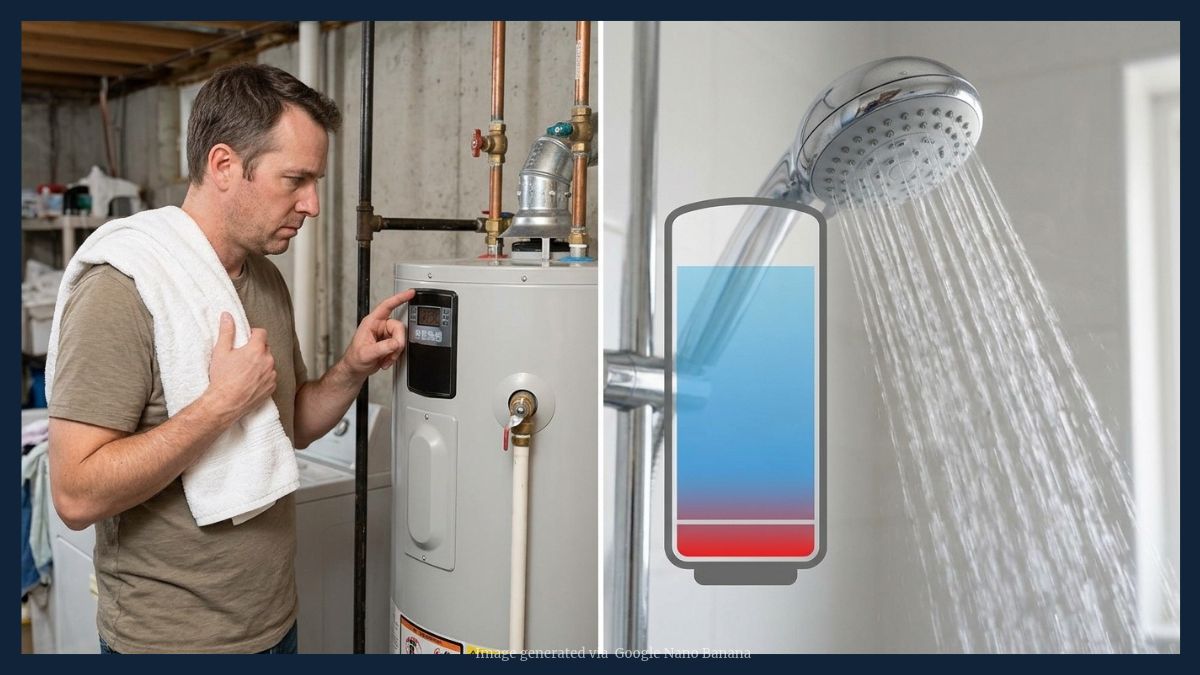
If your hot water runs out quickly, your water heater may not be storing or producing enough hot water to meet household demand. Common causes include an undersized water heater, sediment buildup, a failing heating element, a damaged dip tube, or a faulty thermostat. Problems with a gas burner, mixing valve, or plumbing connections can also reduce the amount of hot water reaching your fixtures.
- A water heater that has always run out quickly may be too small for your household’s demand.
- A sudden reduction in hot water can indicate a failed heating element, damaged dip tube, or other component problem.
- Sediment buildup can reduce efficiency and contribute to poor heating performance.
- An electric water heater with a failed lower heating element may provide only a limited amount of hot water.
- A gas water heater may struggle to recover if its burner or fuel supply is not operating properly.
- A faulty mixing valve or plumbing crossover can cause hot water to become lukewarm.
- Increasing the thermostat setting is not automatically the right solution and can increase scalding risk.
- Persistent problems should be investigated by a qualified water heater technician or plumber.
How does a water heater supply hot water?
Understanding how your water heater works can help explain why the hot water supply sometimes runs out.
Storage tank water heaters
A conventional storage water heater keeps a supply of heated water inside an insulated tank.
When you open a hot water faucet, heated water leaves through the outlet near the top of the tank. Cold water enters through a dip tube and is directed toward the bottom, where it can be heated.
The heating system then works to restore the temperature of the incoming water.
Storage water heaters are available in different capacities and may use electricity, natural gas, or propane.
When household demand exceeds the available stored hot water and the heater’s ability to recover, the water eventually becomes cooler.
Tankless water heaters
A tankless water heater works differently. Instead of storing a large volume of hot water, it heats water as it flows through the unit.
Its ability to supply hot water depends on its heating capacity and the amount of water flowing through it.
If several fixtures demand hot water simultaneously, the combined flow may exceed the unit’s capacity to heat water to the desired temperature.
A tankless system can also struggle if its burner, heating elements, flow sensor, or other components are not operating properly.
This distinction matters because the causes of insufficient hot water are not identical for tank and tankless systems.
Common reasons your hot water runs out quickly
1. Your water heater is too small for your household
An undersized water heater is one of the simplest explanations for a household that regularly runs out of hot water.
Every water heater has a limited capacity. A storage tank can only supply the amount of hot water it holds, together with the additional hot water it can produce while the supply is being used.
If your household demand exceeds that capacity, the available hot water will run out.
For example, consider a household where several people take showers one after another. The first person may have plenty of hot water, but the next person may notice that the water becomes progressively cooler.
The problem can become more noticeable when:
- More people move into the home.
- Household members begin taking longer showers.
- A larger bathtub is installed.
- A rain showerhead uses more water.
- The washing machine or dishwasher uses hot water during shower time.
- Several bathrooms are used simultaneously.
What to do: Compare your household’s hot water demand with the water heater’s storage capacity and recovery performance. If the heater has always struggled to supply enough hot water, a larger or more suitable unit may be necessary.
2. Sediment buildup inside the water heater tank
Most common with: Storage tank water heaters.
Sediment buildup can gradually reduce water heater performance.
Water naturally contains minerals and other dissolved substances. When water is heated, some minerals can separate from the water and accumulate at the bottom of the tank.
Over time, these deposits can form a layer of sediment that interferes with heat transfer.
In gas water heaters, sediment can accumulate near the bottom of the tank, where the burner transfers heat. In electric models, mineral deposits can affect the heating elements.
Possible signs include:
- Hot water runs out sooner than it used to.
- The heater makes popping, rumbling, or crackling sounds.
- The unit takes longer to reheat water.
- Water temperature becomes inconsistent.
- The heater has not received maintenance for a long time.
Sediment does not necessarily reduce the tank’s physical capacity, but heavy buildup can reduce heating efficiency and contribute to poor performance.
What to do: Have the tank inspected and serviced according to the manufacturer’s maintenance instructions. Flushing may help remove accumulated sediment, but the procedure depends on the water heater design and condition.
3. A faulty lower heating element in an electric water heater
Most common with: Electric storage tank water heaters that use upper and lower heating elements.
Many electric storage water heaters have two heating elements.
The upper element heats the upper portion of the tank, while the lower element helps heat the remaining stored water.
If the lower element fails, the heater may still produce some hot water because the upper element can continue operating. However, much of the tank may not be heated properly.
This can make the available hot water seem to disappear unusually quickly.
Possible signs include:
- You initially get hot water, but it turns cold sooner than expected.
- The problem appeared suddenly.
- The heater takes much longer to recover.
- The water temperature is inconsistent.
- The unit produces less hot water than it used to despite unchanged household usage.
A failed upper element can produce a different pattern, sometimes resulting in little or no hot water.
What to do: Have a qualified technician test the heating elements and thermostats. Replacing the defective component may restore normal heating performance.
4. A damaged or broken dip tube
Most common with: Storage tank water heaters that use a dip tube.
The dip tube directs incoming cold water toward the bottom of the storage tank.
This helps keep the incoming cold water away from the hot water stored near the top, allowing the heater to deliver usable hot water more effectively.
If the dip tube cracks, breaks, or deteriorates, cold water may enter the tank closer to the outlet instead of traveling toward the bottom.
The incoming cold water can then mix with the stored hot water prematurely.
As a result, the water coming from your faucet may become lukewarm much sooner than expected, even if the heating system is still operating.
Possible clues include:
- Hot water runs out suddenly after previously working normally.
- Water temperature drops quickly during use.
- Small white or plastic-like particles appear in faucet aerators or showerheads.
- The water heater seems to be heating normally but delivers less usable hot water.
White particles can also come from mineral deposits, so their appearance alone does not confirm a damaged dip tube.
What to do: Ask a water heater technician to inspect the dip tube and inlet assembly. If the tube is damaged, it may need replacement.
5. The water heater thermostat is set too low or malfunctioning
The thermostat controls when the water heater heats the stored water.
If the temperature setting is too low, the available hot water may feel insufficient, especially when several fixtures are used.
A malfunctioning thermostat can also prevent the heating system from maintaining the intended temperature.
Possible signs include:
- Water is never as hot as it used to be.
- The temperature changes unexpectedly.
- The heater does not seem to recover properly.
- The problem occurs even when household hot water demand is relatively low.
However, low water temperature does not automatically mean the thermostat is defective. Heating elements, burners, mixing valves, and other components can produce similar symptoms.
What to do: Check the manufacturer’s recommended temperature setting and have the thermostat tested if the temperature remains inconsistent.
Do not increase the water heater temperature excessively to compensate for insufficient hot water.
Hotter water increases the risk of scalding, particularly for children, older adults, and people with limited mobility or reduced temperature sensitivity. Water at 120°F (49°C) can cause burns with prolonged exposure, while higher temperatures can cause serious burns much faster.
Follow the manufacturer’s instructions and applicable local guidance. A qualified professional can assess whether a thermostatic mixing valve or other temperature-control measure is appropriate.
6. A problem with the gas burner or fuel supply
Most common with: Gas storage tank water heaters.
Gas water heaters use a burner to heat the water inside the tank.
If the burner does not produce enough heat, the heater may take longer to restore the stored water temperature.
Possible contributing problems include:
- A malfunctioning gas control or thermostat.
- A dirty or obstructed burner assembly.
- An ignition or pilot problem, depending on the model.
- An interrupted or inadequate gas supply.
- A combustion or ventilation problem.
You may notice:
- Hot water runs out faster than before.
- The heater takes unusually long to recover.
- The burner does not appear to operate as expected.
- The unit displays an error code or warning light.
- The water temperature remains inconsistent.
What to do: Check the manufacturer’s operating instructions and any visible status indicators. Have a qualified technician inspect the burner, ignition system, gas supply, and ventilation.
Treat a suspected gas leak or combustion problem seriously. If you smell gas, hear a hissing sound near gas piping, or suspect a leak, do not operate electrical switches, light matches, or use anything that could create a spark.
Leave the building, keep other occupants and pets away, and contact the gas utility or emergency services from a safe location. If a carbon monoxide alarm sounds, leave immediately and seek emergency assistance.
Do not attempt to repair the burner, gas valve, or venting system yourself.
7. A faulty mixing valve is diluting the hot water
A thermostatic mixing valve combines hot and cold water to deliver water at a controlled temperature.
Depending on the plumbing arrangement, a mixing valve may be installed near the water heater or at individual fixtures.
If the valve is incorrectly adjusted, malfunctioning, or damaged, too much cold water may mix with the hot supply.
The result can feel like the water heater is running out of hot water even when the tank itself still contains sufficiently heated water.
Possible signs include:
- Water is lukewarm from several hot water fixtures.
- The water heater appears to be heating normally.
- The problem affects multiple bathrooms or faucets.
- Hot water temperature changes unexpectedly.
What to do: Have a plumber inspect the mixing valve and measure the water temperature at the heater and affected fixtures. This can help determine whether the problem is inside the water heater or farther along the plumbing system.
8. A plumbing crossover is allowing cold water into the hot water line
A plumbing crossover occurs when cold water enters the hot water distribution system through an unintended connection.
This can happen when a faulty single-handle faucet cartridge, shower mixing valve, or other plumbing component allows cold and hot water to communicate when they should remain separated.
As a result, hot water may become diluted before reaching the fixture.
Possible signs include:
- Several hot water fixtures deliver lukewarm water.
- The water heater appears to be functioning normally.
- The problem started after plumbing work or a fixture replacement.
- Hot water temperature changes even when the heater has not been heavily used.
What to do: A plumber can isolate sections of the plumbing system and identify the faulty mixing component. Avoid replacing the water heater until the possibility of a plumbing crossover has been investigated.
9. The water heater is not recovering quickly enough
Recovery time is the time a water heater needs to heat incoming cold water after hot water has been used.
A storage water heater may have enough capacity for normal household use but still struggle when demand is concentrated into a short period.
For example, several showers taken close together can use stored hot water faster than the heating system can replace it.
Recovery can also slow down when:
- A heating element is failing.
- The gas burner is not operating properly.
- Sediment affects heating efficiency.
- The incoming water is colder than usual.
- The heater’s heating capacity is insufficient for the demand.
What to do: Observe how long the water takes to become hot again after the tank has been depleted. If recovery is much slower than before, arrange an inspection.
10. Your tankless water heater cannot keep up with demand
Tankless water heaters do not store a large supply of hot water. Instead, they heat water as it flows through the unit.
This means their performance depends on the amount of water flowing through the heater and the temperature increase required.
If several fixtures operate simultaneously, the combined demand may exceed the heater’s rated capacity.
For example, running a shower, washing machine, and kitchen faucet at the same time may result in reduced hot water temperature if the unit cannot heat the combined flow sufficiently.
Other possible causes include:
- Mineral scale inside the heat exchanger.
- A dirty or obstructed filter.
- A malfunctioning flow sensor.
- Burner or heating element problems.
- An error condition that reduces heating output.
What to do: Check the unit’s display for error codes and review the manufacturer’s instructions. If the problem occurs only when several fixtures operate simultaneously, have the unit’s capacity compared with actual household demand.
How to identify why your hot water runs out quickly
The pattern of the problem can help narrow down the possible cause.
| What you notice | Possible cause | Recommended next step |
|---|---|---|
| Hot water has always run out quickly | Undersized water heater or high household demand | Compare capacity with household usage |
| Hot water suddenly lasts only a few minutes | Failed heating element or damaged dip tube | Arrange a water heater inspection |
| Water gradually becomes less available over time | Sediment buildup or deteriorating components | Have the heater serviced |
| Water is lukewarm from the beginning | Low thermostat setting, faulty heating, or mixing valve problem | Check the heater and mixing system |
| Water starts hot but quickly becomes cold | Reduced usable capacity, dip tube problem, or failed lower element | Have the tank and heating system checked |
| Several fixtures deliver lukewarm water | Mixing valve or plumbing crossover | Have a plumber inspect the hot water distribution system |
| Hot water runs out only when multiple fixtures operate | Insufficient capacity or high simultaneous demand | Review heater capacity and flow requirements |
| Tankless heater temperature drops during simultaneous use | Flow demand exceeds heating capacity or unit malfunction | Check rated capacity and diagnostic codes |
| Heater makes popping or rumbling sounds | Possible sediment buildup | Arrange inspection and maintenance |
These observations are clues rather than definitive diagnoses. Several different problems can produce similar symptoms.
How to get more hot water from your water heater
The best way to improve your hot water supply depends on whether the problem comes from excessive demand, insufficient capacity, or a malfunctioning component.
1. Space out showers and high-demand activities
If several people use hot water one after another, spacing out showers can give the heater more time to recover.
You can also avoid running other hot-water-consuming appliances during periods of heavy shower use.
This may help if the heater is functioning properly but household demand is temporarily exceeding its capacity.
2. Check the water heater’s capacity
If your household regularly runs out of hot water, compare the heater’s capacity and recovery performance with your actual usage.
For storage tank systems, consider:
- Tank capacity.
- First-hour rating.
- Heating input.
- Number of household occupants.
- Shower duration and flow rate.
- Simultaneous hot water use.
The first-hour rating is particularly useful because it estimates how much hot water a storage heater can supply during the first hour of use, starting with a fully heated tank.
For tankless systems, consider the required flow rate and temperature rise.
A larger tank is not automatically the best solution. A properly sized heater should match the household’s actual demand.
3. Have the water heater inspected for sediment
If the heater is older or has not received maintenance, accumulated sediment may be affecting its performance.
A technician can determine whether the tank needs flushing or whether the sediment has become severe enough to require more extensive service.
Follow the manufacturer’s maintenance schedule because flushing procedures and recommendations vary by model.
4. Have heating elements or burners tested
A faulty heating element or burner can prevent the heater from restoring its temperature properly.
A technician can test the electrical components of an electric heater or inspect the burner and gas controls of a gas model.
Replacing a failed component may restore performance without requiring a new water heater.
5. Check for mixing valve or plumbing problems
If the water heater appears to be producing sufficiently hot water but fixtures receive lukewarm water, the problem may be in the distribution system.
A plumber can inspect:
- Thermostatic mixing valves.
- Shower cartridges.
- Single-handle faucet cartridges.
- Hot and cold water connections.
- Possible plumbing crossovers.
This helps avoid replacing a functioning water heater unnecessarily.
What homeowners can safely check
You can collect useful information before arranging a repair without opening the water heater or handling its internal components.
- Identify the water heater type. Determine whether your home has a storage tank or tankless system, and whether it uses electricity, natural gas, or propane.
- Observe how quickly the water becomes cold. Note whether it happens after a few minutes, one shower, or several consecutive showers.
- Check whether the problem affects all fixtures. Test different faucets and showers to determine whether the issue is limited to one bathroom or affects the whole house.
- Observe the recovery time. After hot water runs out, note how long it takes for the supply to become hot again.
- Check the visible status indicators. Look for warning lights, error codes, or messages on the water heater display.
- Listen for unusual sounds. Note popping, rumbling, or other noises that may indicate sediment or a component problem.
- Look for visible leaks. Inspect the floor and accessible areas around the water heater for moisture, rust, or water stains.
- Review the manufacturer’s manual. Check the unit’s rated capacity, maintenance schedule, and recommended operating settings.
- Record recent changes. Note whether the problem began after installing a new appliance, adding a bathroom, or increasing household occupancy.
Do not remove electrical access panels, touch exposed wiring, dismantle gas components, or open a hot water tank to diagnose the problem. Electric water heaters can contain dangerous electrical connections, while gas models involve combustion and ventilation hazards.
Do not drain or flush a tank unless you understand the manufacturer’s procedure and can safely manage the hot water and discharge. If you are unsure, arrange professional service.
When should you call a professional?
A water heater that consistently runs out of hot water sooner than expected should be inspected, particularly when the problem is new or getting worse.
- Hot water suddenly runs out much faster than before.
- Water remains lukewarm even after the heater has had time to recover.
- The heater makes repeated popping or rumbling noises.
- You notice visible water around the tank or connections.
- The unit displays an error code.
- You suspect a faulty heating element, thermostat, or gas burner.
- Several fixtures receive lukewarm water despite normal heater operation.
- The water heater repeatedly shuts down or trips a safety device.
Watch for signs of overheating, leaking, or combustion problems. If the water heater releases large amounts of very hot water through its temperature-and-pressure relief discharge pipe, do not block or cap the pipe. Keep people and pets away and contact a qualified technician promptly. If you smell gas or a carbon monoxide alarm sounds, leave the building and contact emergency services or the appropriate gas utility from a safe location.
Should you hire a professional?
If the issue is simply that several people are using more hot water than the system can supply, changing usage patterns may help.
However, if hot water runs out much faster than it used to, a professional inspection is worthwhile.
A qualified plumber or water heater technician can:
- Test heating elements and thermostats.
- Inspect the dip tube and inlet assembly.
- Assess sediment buildup.
- Check the burner and fuel supply on gas models.
- Inspect mixing valves and plumbing crossovers.
- Measure water temperature and assess recovery performance.
- Compare the heater’s capacity with household demand.
- Recommend repair, maintenance, or replacement.
If the heater is old, repeatedly needs repairs, or has a leaking storage tank, replacement may be more practical than continued servicing.
Homeowner checklist: What to check next
Use this checklist to organize your observations before calling a plumber or water heater technician.
- Identify whether the water heater is tank or tankless.
- Note whether it uses electricity, natural gas, or propane.
- Determine whether the problem developed suddenly or gradually.
- Record how long hot water lasts during a typical shower.
- Check whether the problem affects all hot water fixtures.
- Observe how long the heater takes to recover after hot water runs out.
- Look for visible leaks, rust, or water stains around the unit.
- Note any unusual popping, rumbling, or operating noises.
- Check for error codes or warning indicators.
- Review the manufacturer’s manual and maintenance recommendations.
- Avoid increasing the temperature excessively to compensate for insufficient hot water.
- Arrange professional testing if the problem persists or the heater shows signs of malfunction.
Important: Do not open electrical panels, dismantle gas components, or attempt internal tank repairs as part of this checklist.
Frequently asked questions
Your water heater may have insufficient capacity, a failed heating element, sediment buildup, or a damaged dip tube. If the problem is new, a component failure is worth investigating. If it has always happened, the heater may be too small for your household’s demand.
A failed lower heating element in an electric storage water heater can cause this pattern. A damaged dip tube may also allow incoming cold water to mix with stored hot water prematurely. Other possible explanations include an undersized tank or excessive demand.
Cold incoming water requires more energy to heat to the desired temperature. This can reduce the amount of hot water your system can deliver during periods of heavy use, particularly if the heater is already operating near its capacity.
Yes. Sediment can interfere with heat transfer and reduce heating efficiency. Heavy deposits may also contribute to slow recovery and unusual popping or rumbling noises.
Not automatically. Increasing the temperature can create a greater scalding risk, particularly for children and older adults. If your hot water supply is insufficient, identify the underlying cause before changing the setting. A qualified professional can assess whether the heater’s temperature setting or mixing valve needs adjustment.
Recovery time depends on the heater’s tank capacity, heating input, incoming water temperature, and how much hot water was used. Electric storage heaters generally recover more slowly than comparable gas models, but actual performance varies considerably. Check the manufacturer’s specifications for your model.
The heater may be producing some hot water without heating the entire tank properly. A failed lower heating element, sediment buildup, damaged dip tube, or insufficient capacity can all reduce the usable hot water supply.
Yes. A faulty mixing valve or shower cartridge can allow cold water to mix with the hot supply. If the problem is limited to one shower, inspect that fixture before assuming the water heater is defective.
Replacement may be appropriate when the tank itself is leaking, the unit is severely corroded, replacement parts are unavailable, or repeated repairs are becoming uneconomical. A technician can compare the condition and repair cost of the existing heater with the cost and performance of a suitable replacement.
Sources and references:
- U.S. Department of Energy, Storage Water Heaters
https://www.energy.gov/energysaver/storage-water-heaters - Portland Water Bureau, Maintaining your water heater
https://www.portland.gov/water/drinking-water-quality/troubleshooting-drinking-water-quality-home/water-heater-maintenance - A. O. Smith, Troubleshooting Guide
https://assets.hotwater.com/damroot/Original/10008/100362953.pdf - University of Hawaiʻi, Building Maintenance and Construction: Water Heating
https://pressbooks.oer.hawaii.edu/buildingmaint/chapter/water-heating/ - U.S. Department of Energy, Building Science Education: Hot Water Distribution Systems
https://bsesc.energy.gov/energy-basics/hot-water-distribution-systems
