
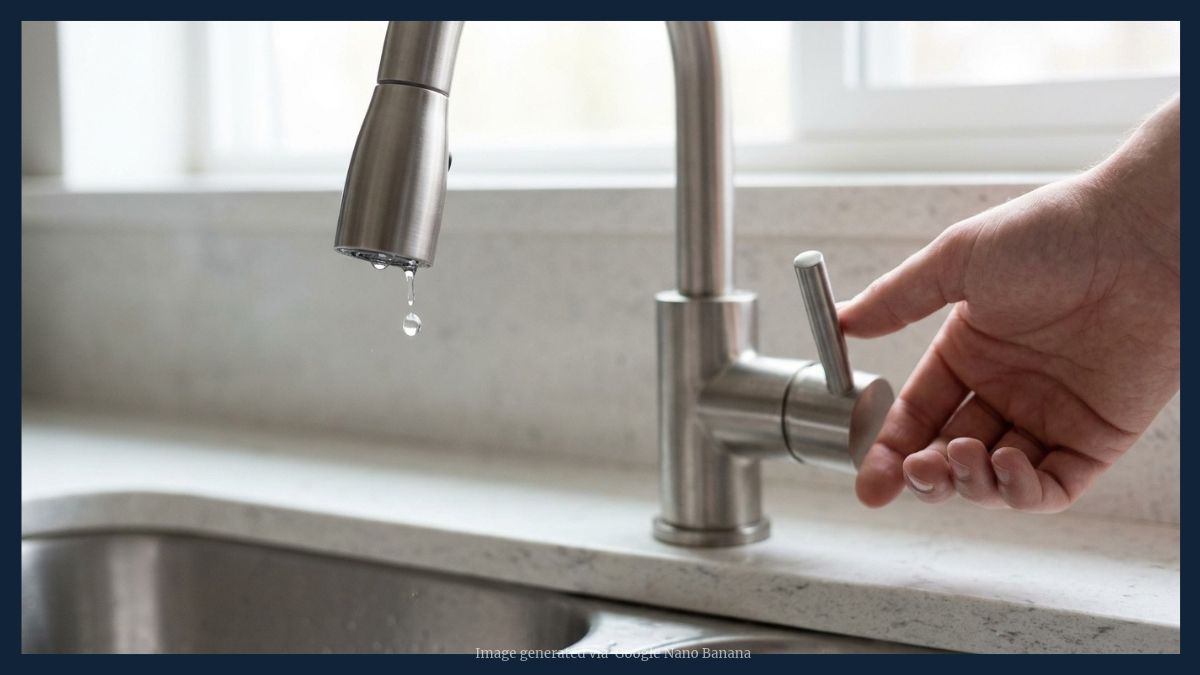
A faucet that continues dripping after you turn it off usually has a worn, damaged, dirty, or improperly seated internal component that is allowing water to pass through the valve. Depending on the faucet design, the problem may involve a rubber washer, cartridge, O-ring, valve seat, or ceramic disc assembly.
- A persistent drip from the spout usually indicates a problem with the faucet’s internal sealing components.
- Older compression faucets commonly develop worn rubber washers or damaged valve seats.
- Modern single-handle faucets often use cartridges that may need replacement.
- Water leaking around the handle or base can point to a different seal or connection problem.
- Mineral deposits and debris can interfere with proper sealing.
- A few residual drops immediately after shutoff may be normal.
- Avoid forcing the handle tighter because this can damage internal components.
- If the leak continues, inspect the faucet or arrange a professional repair.
Why does a faucet continue dripping after you turn it off?
Inside a faucet is a valve mechanism that controls the movement of water from the supply line to the spout.
When you turn the handle off, this mechanism closes the water passage. Its internal sealing surfaces must fit properly to prevent pressurized water from passing through.
Over time, those components can wear down, become damaged, or accumulate mineral deposits. Even a small gap can allow water to escape slowly, creating the familiar dripping sound.
The specific component depends on the faucet design.
For example:
- A traditional two-handle compression faucet uses rubber washers to stop water flow.
- A cartridge faucet uses an internal cartridge to control water.
- A ceramic disc faucet uses closely fitted ceramic discs.
- A ball faucet uses a rotating ball assembly with rubber seats and springs.
Understanding which type of faucet you have makes it easier to identify the likely cause and avoid replacing the wrong part.
Common reasons your faucet drips after being turned off
1. Worn or damaged rubber washer
Most common with: Traditional compression faucets.
A worn rubber washer is one of the common reasons an older faucet continues dripping after shutoff.
In a compression faucet, turning the handle closes a valve stem that presses a rubber washer against a valve seat. This creates the seal that stops water from flowing through the spout.
Every time you turn the faucet on and off, the washer experiences pressure and friction. Eventually, it may become:
- Hardened or brittle.
- Cracked or split.
- Flattened or deformed.
- Worn unevenly.
- Damaged around its edges.
When the washer can no longer sit tightly against the valve seat, water may continue passing through the small opening.
What you may notice:
- The faucet drips from the spout even when fully closed.
- You need to turn the handle farther than before to stop the water.
- The handle feels unusually tight.
- The dripping gradually becomes more frequent.
What to do: A plumber or experienced DIY homeowner may be able to replace the worn washer. However, inspect the valve seat as well. A damaged seat can prevent even a new washer from sealing correctly.
2. Worn or damaged faucet cartridge
Most common with: Single-handle cartridge faucets and some two-handle cartridge designs.
Many modern faucets use a cartridge to control water flow and, depending on the design, temperature.
The cartridge contains internal passages and sealing components that open and close as you move the handle.
Over time, its internal seals can deteriorate. The cartridge may also become damaged or affected by mineral deposits and debris.
When this happens, the cartridge may no longer close the water passage completely.
What you may notice:
- Water continues dripping from the spout after shutoff.
- The handle becomes difficult to move.
- The faucet no longer shuts off smoothly.
- The leak becomes progressively worse.
- The handle does not feel as responsive as it used to.
What to do: The cartridge may need cleaning or replacement, depending on the manufacturer’s instructions and the condition of the component. Replacement cartridges are not universal, so identify the faucet brand and model before purchasing a part.
3. Damaged or worn O-rings
Most common with: Cartridge faucets, ball faucets, and faucets with rotating spouts.
O-rings are small rubber seals used at different points inside a faucet. They help prevent water from escaping around moving components and connections.
Over time, O-rings can become brittle, flattened, cracked, or displaced.
However, the location of the leak matters.
A damaged O-ring may cause:
- Water leaking around the faucet handle.
- Moisture collecting around the base of the spout.
- Water escaping from the faucet body.
- Leakage around certain internal connections.
An O-ring is not automatically the cause of every drip from the spout. If water continues coming from the outlet after shutoff, the main valve’s sealing components may be responsible instead.
What to do: Identify where the water appears before replacing parts. A plumber can determine which seal has failed and whether the cartridge or another component also needs attention.
4. Damaged or corroded valve seat
Most common with: Compression faucets.
The valve seat is the surface against which the rubber washer presses when the faucet is turned off.
Even if you replace the rubber washer, the faucet may continue dripping if the valve seat is damaged.
Over time, the seat can develop:
- Corrosion.
- Pitting.
- Scratches.
- Mineral deposits.
- Uneven sealing surfaces.
These imperfections can leave tiny gaps between the washer and the valve seat, allowing water to pass through.
This is one reason a faucet may continue dripping shortly after a new washer has been installed.
What to do: A plumber can inspect the valve seat and determine whether it can be serviced or needs replacement. If the seat is severely damaged or part of a deteriorated faucet body, replacing the faucet may be more practical.
5. Mineral deposits or debris inside the faucet
Mineral deposits can accumulate inside faucets over time, particularly in areas with hard water.
Calcium and other mineral deposits may build up around internal components, while small particles or debris can become trapped in the valve assembly.
These deposits can interfere with the way sealing surfaces meet, preventing the faucet from shutting off completely.
Possible signs include:
- Reduced water flow.
- White or chalky deposits around the faucet.
- A handle that feels rough or stiff.
- A drip that develops gradually.
- A faucet that continues leaking after a recent water supply interruption or plumbing repair.
What to do: Clean accessible exterior mineral deposits according to the faucet manufacturer’s recommendations. If the buildup is inside the cartridge or valve assembly, a plumber may need to inspect and clean the affected components.
6. Damaged ceramic disc assembly
Most common with: Ceramic disc faucets, including many quarter-turn designs.
Ceramic disc faucets use two closely fitted ceramic discs to control water flow.
When the handle moves, the discs align or move relative to one another to open and close the water passages.
These discs are durable, but they can still become damaged. Small particles, mineral deposits, or wear may interfere with their sealing surfaces.
Possible signs include:
- A persistent drip from the spout.
- A handle that moves differently from normal.
- Reduced or irregular water flow.
- A leak that continues despite normal handle operation.
What to do: Depending on the faucet design, the ceramic disc cartridge or complete valve assembly may need replacement. Avoid forcing the handle or attempting to grind or modify the ceramic surfaces.
7. Excessively high household water pressure
High water pressure is not the usual direct explanation for a faucet that drips after shutoff, but it can aggravate existing problems with worn or damaged seals.
If your home’s incoming water pressure is higher than the plumbing system is designed to handle, it can place additional stress on fixtures and connections.
The U.S. Environmental Protection Agency’s WaterSense program recommends a household service pressure range of approximately 45 to 60 psi for good fixture performance.
Possible signs of a broader pressure problem include:
- Several faucets or fixtures developing leaks.
- Unusually forceful water flow.
- Repeated plumbing noises.
- Dripping or leaking connections.
- Problems affecting multiple areas of the home.
A single dripping faucet does not prove that household water pressure is too high.
What to do: Have the water pressure measured if multiple fixtures are affected or other pressure-related symptoms are present. A plumber can determine whether a pressure-regulating valve needs adjustment or replacement.
How to identify the source of the dripping
Before deciding what to repair, determine exactly where the water is coming from.
A faucet can leak from several locations, and each pattern points toward different components.
| What you notice | Possible cause | Recommended next step |
|---|---|---|
| Continuous dripping from the spout after shutoff | Worn washer, cartridge, valve seat, or ceramic disc assembly | Identify the faucet type and inspect its internal valve |
| A few drops immediately after shutoff, then it stops | Residual water draining from the spout | Monitor whether the dripping stops completely |
| Water leaking around the handle | Worn O-ring, stem seal, or cartridge seal | Have the handle and internal seals inspected |
| Water collecting around the base of the spout | Worn spout O-ring or seal | Inspect the spout assembly |
| Water leaking underneath the sink | Supply line, shutoff valve, or connection problem | Check for moisture and arrange repair |
| Dripping continues after replacing a washer | Damaged valve seat or incorrect replacement part | Inspect the seat and confirm the washer matches |
| Several faucets develop leaks | Possible pressure issue or multiple worn components | Have household water pressure checked |
The table provides diagnostic clues rather than confirmed diagnoses. The faucet’s design and the exact location of the leak determine which component needs attention.
Is it normal for a faucet to drip briefly after turning it off?
Sometimes, yes.
A few drops immediately after closing a faucet may simply be water remaining inside the spout or outlet. This is different from a faucet that continuously allows pressurized water to pass through its internal valve.
For example, water may collect around the aerator or inside the curved section of a faucet spout. After shutoff, that remaining water can drain out.
To distinguish residual water from a persistent leak:
- Turn the faucet off normally.
- Watch the spout for a short period.
- Observe whether the drops gradually stop.
- Check again after the faucet has been unused for several minutes.
If dripping continues or regularly returns, the faucet may not be sealing properly.
Do not assume a persistent drip is harmless just because the amount of water is small.
Can a dripping faucet waste a lot of water?
Yes. A seemingly minor drip can waste a surprising amount of water over time.
The actual amount depends on how frequently the faucet drips and how much water escapes with each drop.
The U.S. Environmental Protection Agency estimates that a faucet dripping once per second can waste more than 3,000 gallons of water annually.
That is why it is worth addressing a persistent drip rather than allowing it to continue indefinitely.
A leaking faucet can also:
- Increase household water consumption.
- Contribute to higher utility bills.
- Create persistent moisture around the sink.
- Encourage mineral staining on the fixture.
- Cause damage if water escapes onto cabinets or nearby surfaces.
Check for water escaping outside the sink or beneath the fixture. A drip from the spout normally drains into the sink, but a leak around the faucet base, supply connections, or shutoff valves can reach the cabinet and flooring.
Keep electrical appliances and extension cords away from wet areas. If water reaches electrical equipment or outlets, do not touch the wet equipment or standing water.
Keep children and pets away and contact a qualified professional. If electrical components may have become wet, have them assessed before restoring power.
How to fix a faucet that keeps dripping
The right repair depends on the faucet type and the condition of its internal components.
In many cases, replacing a worn washer or cartridge can resolve the problem without replacing the entire fixture.
1. Identify the faucet type
Start by determining what kind of faucet you have.
Common designs include:
- Compression faucet: Usually has separate hot and cold handles that tighten down to close the valve.
- Cartridge faucet: Uses an internal cartridge to control water flow, often with a smooth-moving handle.
- Ball faucet: Typically has a single handle that moves over a rounded ball-shaped control assembly.
- Ceramic disc faucet: Uses ceramic discs, often operated by a short-turn or quarter-turn handle.
The handle design can provide clues, but it does not always identify the internal mechanism. Check the manufacturer’s documentation or model information if available.
2. Shut off the water supply before repairs
Before removing a faucet handle or internal component, the water supply must be isolated.
For many sink faucets, separate hot and cold shutoff valves are located beneath the sink.
Never dismantle a faucet while its water supply is still pressurized. Water can escape suddenly and cause flooding. Close the appropriate hot and cold shutoff valves before removing internal components. If the shutoff valves are seized, leaking, or do not completely stop the water, do not force them. Use the main water shutoff only if you can operate it safely, or contact a plumber.
3. Replace a worn washer if the faucet uses one
Traditional compression faucets commonly use rubber washers.
If the washer is worn or damaged, replacing it with the correct size and type may restore the seal.
However, replacing the washer alone may not solve the problem if the valve seat is also damaged.
4. Replace a faulty cartridge
Many modern cartridge faucets use replaceable internal cartridges.
If the cartridge is damaged or its sealing components have deteriorated, replacing the complete cartridge may be the appropriate repair.
Make sure the replacement matches the faucet’s manufacturer and model. Similar-looking cartridges are not necessarily interchangeable.
5. Inspect the O-rings and other seals
If water leaks around the handle or faucet base, the problem may involve an O-ring or another external seal.
A plumber can inspect these components and determine whether they can be replaced individually.
6. Clean mineral deposits where appropriate
Exterior mineral deposits can often be cleaned using a product recommended by the faucet manufacturer.
For internal components, follow the manufacturer’s maintenance instructions. Some cartridges and ceramic disc assemblies should not be aggressively scrubbed or exposed to unsuitable cleaning chemicals.
If mineral buildup is severe, professional cleaning or replacement may be more practical.
7. Test the faucet after the repair
After the correct component has been repaired or replaced, the water supply can be restored according to the manufacturer’s instructions.
Check:
- Whether the faucet shuts off completely.
- Whether the spout continues dripping.
- Whether water escapes around the handle or base.
- Whether there is moisture beneath the sink.
- Whether the handle operates normally.
If the drip continues, the wrong part may have been replaced or another sealing surface may be damaged.
What homeowners can safely check
You can gather useful information without taking the faucet apart.
Before attempting a repair, consider these observations:
- Identify the leak location. Determine whether the water comes from the spout, handle, base, or underneath the sink.
- Check whether the dripping stops. Observe whether the water drains away shortly after shutoff or continues dripping.
- Identify the faucet design. Note whether it has one handle, two handles, a quarter-turn mechanism, or a traditional compression-style handle.
- Look for exterior mineral deposits. Check for visible white or chalky buildup around the spout and handle.
- Check the cabinet beneath the sink. Look for moisture, water stains, or corrosion around accessible supply connections.
- Check the faucet brand and model. Manufacturer information can help identify the correct replacement cartridge or seal.
- Monitor other faucets. If several fixtures are leaking, household water pressure may deserve investigation.
Do not force the handle tighter to stop the dripping. Excessive force can damage washers, valve seats, cartridges, and other internal components.
When should you call a plumber?
A dripping faucet is not usually an emergency when the water is contained inside the sink and there are no other signs of damage.
- The faucet continues dripping after a repair.
- You cannot identify the correct replacement cartridge or component.
- The handle is stuck, damaged, or unusually difficult to operate.
- The valve seat is corroded or damaged.
- Water is leaking around the faucet body.
- Shutoff valves beneath the sink are seized or leaking.
- Water is collecting inside the cabinet.
- Multiple fixtures are developing leaks.
Should you hire a professional?
For a straightforward drip caused by a worn washer or replaceable cartridge, an experienced homeowner may be able to complete the repair using manufacturer instructions and the correct parts.
However, not every faucet is designed for simple disassembly. Some fixtures have specialized cartridges, concealed fasteners, unusual valve assemblies, or corroded internal components.
A plumber can:
- Identify the faucet’s internal mechanism.
- Determine whether the washer, cartridge, O-ring, or valve seat has failed.
- Check for mineral deposits and internal corrosion.
- Replace damaged components.
- Inspect the shutoff valves and supply connections.
- Check household water pressure if several fixtures are affected.
- Recommend faucet replacement when repairing the existing fixture is no longer practical.
If the faucet body is severely corroded, cracked, or repeatedly develops leaks, replacing the complete fixture may be more economical than continuing to repair individual components.
Homeowner checklist: What to check next
Use this checklist to organize your observations before attempting a repair or contacting a plumber.
- Confirm whether the faucet drips continuously or only briefly after shutoff.
- Identify whether the water comes from the spout, handle, base, or beneath the sink.
- Determine whether the faucet has one handle or two.
- Look for visible mineral deposits around the fixture.
- Check the cabinet beneath the sink for moisture or water stains.
- Identify the faucet brand and model if possible.
- Note whether the handle feels unusually tight, loose, or difficult to operate.
- Check whether other faucets in the home are also dripping.
- Avoid overtightening the handle or forcing stuck components.
- Arrange a repair if the drip continues or water is escaping outside the sink.
Important: Do not dismantle the faucet or remove pressurized connections before isolating the water supply. If a shutoff valve is damaged or cannot be operated safely, contact a plumber.
Frequently asked questions
A few drops immediately after shutoff may be residual water draining from the spout or aerator. If the dripping stops completely, the faucet may not have a faulty valve.
A persistent drip caused by a worn washer, damaged cartridge, or deteriorated seal is unlikely to resolve itself. The affected component usually needs cleaning, repair, or replacement.
No. Forcing the handle can damage internal components, particularly the rubber washer and valve seat in compression faucets. Close the faucet normally and investigate the cause instead.
The valve seat may be damaged, corroded, or uneven. The replacement washer may also be the wrong size or type.
High water pressure can contribute to wear and aggravate existing sealing problems, but it is not automatically the cause of a dripping faucet.
Water around the handle may indicate a worn O-ring, stem seal, packing, or cartridge seal. This is different from a continuous drip from the spout, which more often involves the main shutoff mechanism.
The cost depends on the faucet type, replacement part, accessibility, and labor. Replacing a washer or cartridge may be relatively straightforward, while repairing a damaged valve seat or replacing a corroded fixture can require more work.
Not necessarily. Many faucets can be repaired by replacing an individual washer, cartridge, or seal.
Sources and references:
- U.S. Environmental Protection Agency, WaterSense: Home Maintenance
https://www.epa.gov/watersense/home-maintenance - Canada Mortgage and Housing Corporation, Basic Home Maintenance: Home Occupants’ Guide
https://publications.gc.ca/collections/collection_2017/schl-cmhc/NH15-426-2007-eng.pdf - Northwest Territories Housing Corporation, Home Maintenance Manual
https://www.nwthc.gov.nt.ca/sites/nwthc/files/resources/student_manual_nwthc_-_march_2021_1.pdf - U.S. Environmental Protection Agency, WaterSense Technical Reference Manual for WaterSense Labeled Homes
https://www.epa.gov/system/files/documents/2023-08/ws-homes-TechnicalReferenceManual.pdf
