
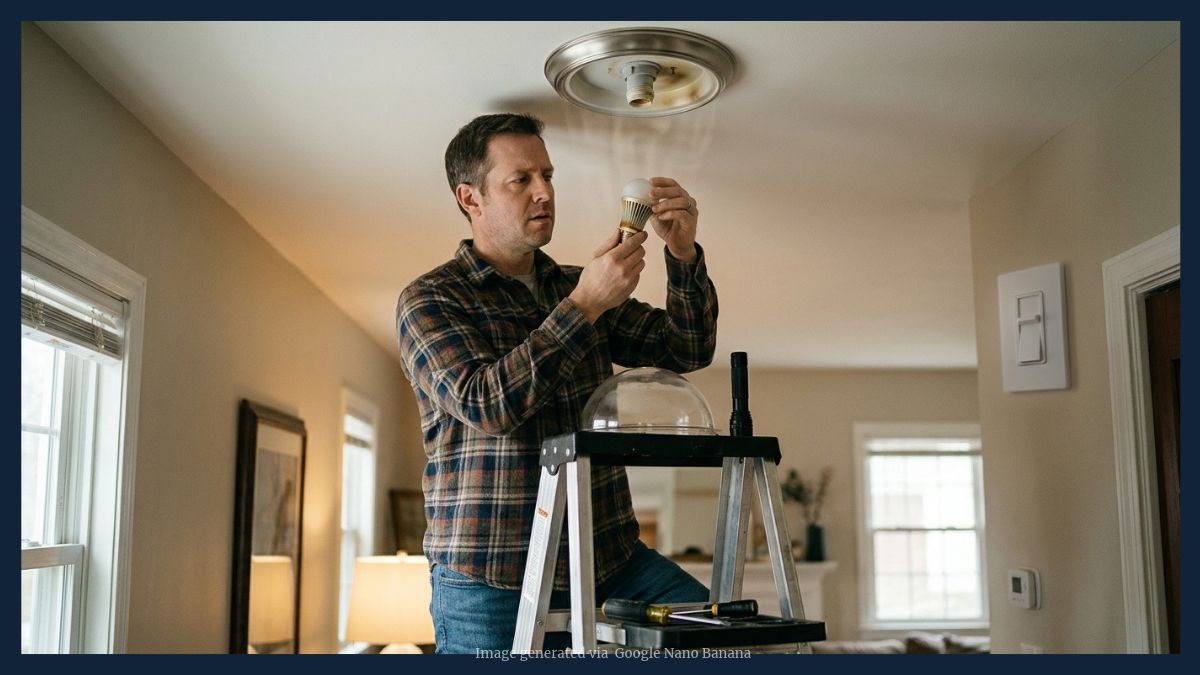
Light bulbs that burn out much sooner than expected may be affected by excessive heat, incompatible dimmer switches, incorrect bulb specifications, vibration, or problems with the electrical fixture. If bulbs repeatedly fail in the same location, the fixture or socket deserves attention. If several lights throughout the house fail prematurely, a broader electrical problem may be involved.
The pattern of failure is an important clue. If only one fixture repeatedly destroys bulbs, investigate that fixture first. If multiple fixtures experience the same problem, have the electrical system assessed.
- Heat is a major factor in premature LED bulb deterioration.
- LED bulbs need to be compatible with enclosed fixtures and dimmer switches.
- A loose or damaged socket can cause intermittent contact, flickering, and premature bulb failure.
- Incorrect voltage or electrical supply problems may shorten bulb life.
- Frequent switching can affect some bulb types more than others.
- Repeated failures across different fixtures deserve an electrical inspection.
- Never ignore burning smells, sparks, smoke, or unusually hot electrical fittings.
A light fixture that produces sparks, crackling sounds, smoke, a burning odor, or visible scorching may have an electrical fault. Stop using it. If you can safely identify and switch off the appropriate circuit breaker without approaching a dangerous fixture, do so. Do not touch exposed wiring, remove the fixture, or attempt internal electrical repairs. Contact a licensed electrician. If there is an active fire or smoke emergency, leave the area and contact emergency services.
Excessive heat inside the light fixture
Excessive heat is one of the most common reasons certain bulbs fail prematurely, particularly when LED bulbs are installed in fixtures that cannot dissipate heat properly.
Although LEDs use less electricity and produce less heat than traditional incandescent bulbs, they still generate heat within their electronic components. The bulb’s heat sink and surrounding fixture must allow that heat to escape.
When heat accumulates, it can accelerate the deterioration of the LED components and internal driver electronics. This can shorten the bulb’s useful life or cause it to stop working altogether.
Why enclosed fixtures cause problems
Some ceiling lights, recessed fixtures, decorative lamps, and enclosed outdoor fittings restrict airflow.
When a bulb operates inside a poorly ventilated space, heat can accumulate around it. An LED bulb that is not designed for enclosed fixtures may deteriorate faster than its advertised lifespan suggests.
Signs that heat may be the problem
- Bulbs fail repeatedly in the same enclosed fixture.
- The fixture becomes unusually hot during operation.
- LED bulbs gradually lose brightness or stop working prematurely.
- Bulbs installed in open fixtures last considerably longer than those in enclosed ones.
What homeowners should do
Check the bulb packaging or manufacturer’s specifications to determine whether the bulb is rated for enclosed fixtures.
If the fixture requires an enclosed-fixture-rated bulb, use one that explicitly meets that requirement. Also check that the bulb’s physical size and wattage or power specifications are appropriate for the fixture.
Do not remove covers or modify the fixture to improve ventilation unless the manufacturer specifically permits the change.
Incorrect bulb wattage or specifications
Using an incompatible bulb can affect its performance and lifespan.
Traditional fixtures often specify a maximum wattage. Installing an incandescent bulb that exceeds this limit can produce more heat than the fixture is designed to handle.
For example, a fixture rated for a maximum 60-watt incandescent bulb should not be fitted with a 100-watt incandescent bulb.
LED bulbs complicate this comparison because they use considerably less electrical power while producing similar light output. A 9-watt LED may provide approximately the same brightness as a traditional 60-watt incandescent bulb, depending on the product.
However, this does not mean every LED bulb is automatically suitable for every fixture.
What to check
Look at the fixture label and bulb packaging for:
- Maximum permitted wattage.
- Required voltage.
- Bulb base and physical dimensions.
- Whether the bulb is suitable for enclosed fixtures.
- Whether the bulb is compatible with the fixture’s lighting controls.
Do not confuse a bulb’s actual wattage with its incandescent-equivalent brightness rating.
For LED bulbs, actual wattage describes electricity consumption. Lumens indicate light output.
Using a bulb with the correct specifications helps prevent compatibility problems and unnecessary heat buildup.
Incompatible dimmer switches
A dimmer switch allows homeowners to adjust light output, but not every bulb is designed to work with a dimming system.
This is particularly important with LED lighting.
Older dimmer switches were often designed for incandescent bulbs. Some may not operate correctly with newer LED bulbs, even if the bulbs physically fit the sockets.
An incompatible combination can cause:
- Flickering.
- Buzzing or humming.
- Inconsistent brightness.
- Difficulty adjusting light output.
- Premature bulb failure.
How to identify a dimmer compatibility problem
Consider whether the bulb failures occur mainly in rooms with dimmer switches.
Other useful clues include:
- The light flickers when dimmed.
- The bulb works normally at full brightness but behaves erratically at lower settings.
- Several replacement bulbs experience similar problems.
- The bulb packaging does not identify it as dimmable.
What homeowners should do
Check whether the bulb is specifically labeled as dimmable. Then confirm that the dimmer switch is compatible with that type of LED bulb.
Some dimmers have minimum load requirements or compatibility limitations. A bulb that works with one dimmer may not work properly with another.
If the problem continues, an electrician can check the dimmer, wiring, and lighting circuit.
Loose or damaged socket contacts
A light bulb needs reliable electrical contact with the socket to operate properly.
If the socket is worn, damaged, corroded, or loose, the electrical connection may become intermittent.
This can cause the light to flicker, turn on and off unexpectedly, or fail prematurely.
In some cases, a loose electrical connection can produce heat or electrical arcing. This is more serious than an ordinary bulb problem.
Common signs of a socket problem
- Replacement bulbs fail repeatedly in the same socket.
- The light flickers even after installing a new bulb.
- The bulb sometimes works after being disturbed but stops again.
- The socket shows discoloration, corrosion, or visible damage.
- There is a burning odor, buzzing, or crackling sound.
What homeowners should do
Start by recording which fixture is affected and how frequently the bulbs fail.
Never attempt to bend socket contacts, scrape corrosion from an energized socket, insert tools into the socket, or repair internal wiring yourself. Before any permitted bulb replacement, switch off the light and allow the bulb to cool. If the socket appears damaged, discolored, or loose, stop using the fixture and have it inspected by a licensed electrician.
A damaged socket may need repair or replacement. Replacing the bulb alone will not correct the underlying electrical problem.
Voltage fluctuations or electrical supply problems
Light bulbs are designed to operate within a specified voltage range.
When the voltage supplied to a bulb is consistently too high or fluctuates significantly, its performance and lifespan may be affected.
Incandescent bulbs can experience increased filament stress when operated above their rated voltage. LED bulbs also rely on electronic driver components that regulate the power supplied to the light-emitting diodes.
Although many LED drivers include protective circuitry, this does not make them immune to poor power quality or electrical faults.
Signs of a possible voltage problem
- Bulbs in several rooms fail unusually quickly.
- Lights become brighter or dimmer unexpectedly.
- Lights flicker when large appliances start.
- Some lights behave inconsistently even after bulb replacement.
- Electrical problems affect multiple fixtures at the same time.
A single bulb failure does not prove that the household voltage is abnormal. However, repeated failures across different locations make an electrical assessment more worthwhile.
What homeowners should do
Record when the lights flicker, dim, or become unusually bright. Note whether the behavior happens when an air conditioner, refrigerator, pump, or another large appliance starts.
Do not attempt to measure or adjust household electrical voltage by opening electrical panels or handling live wiring.
Lights that suddenly become unusually bright or dim across multiple rooms can indicate a potentially serious supply or wiring problem, including a loose neutral connection. Stop using sensitive appliances if it is safe to do so, and contact a licensed electrician or your electric utility promptly. Do not open the electrical panel or attempt to tighten connections yourself. If there is smoke, burning, or an active fire, leave the area and call emergency services.
An electrician can assess the supply voltage, wiring connections, and electrical panel to determine whether the problem originates inside the home or from the incoming electrical supply.
Vibration or physical movement
Vibration can shorten the lifespan of certain light bulbs, especially incandescent bulbs.
Traditional incandescent bulbs produce light using a thin tungsten filament. When the bulb is operating, the filament becomes extremely hot and relatively fragile. Repeated movement or vibration can increase the likelihood of filament damage.
This can be a concern in:
- Ceiling fans with light fittings.
- Garage door lighting.
- Workshops with vibrating machinery.
- Outdoor fixtures exposed to repeated movement.
- Fixtures mounted near equipment that produces vibration.
LED bulbs do not contain the same fragile filament, so they are generally less susceptible to this particular problem. However, repeated vibration can still affect the electrical connections or internal components of a poorly secured fixture.
What homeowners should do
Check whether the affected fixture is installed near a source of repeated movement.
For ceiling fans, use bulbs specifically designed or rated for fan applications when required by the manufacturer.
If a fixture itself appears loose or moves excessively, have it inspected and secured properly. Do not attempt to tighten electrical mounting components while the fixture is energized.
Defective or low-quality light bulbs
Sometimes the bulb itself is the problem.
Manufacturing defects, poor-quality electronic components, or inadequate thermal management can cause a bulb to fail earlier than expected.
This can happen with incandescent, fluorescent, and LED products, although the failure mechanisms differ.
For example, an LED bulb may stop working because its internal driver fails even when its LED chips still function.
Signs of a defective bulb
- A newly installed bulb fails after a short period.
- Bulbs from the same package repeatedly fail.
- The same bulb works normally in one compatible fixture but not another.
- The fixture has no obvious signs of overheating or damage.
What homeowners should do
Purchase bulbs from reputable manufacturers and check the product specifications before installation.
For LED bulbs, look for the expected rated life, warranty information, dimming compatibility, and suitability for the intended fixture.
If a bulb fails unusually early, retain the packaging and purchase information. The manufacturer or retailer may offer a replacement under its warranty.
Why LED bulbs sometimes fail earlier than expected
LED bulbs are generally designed to last much longer than traditional incandescent bulbs, but their advertised lifespan should not be interpreted as a guarantee that every bulb will operate for that exact period.
According to ENERGY STAR, LED useful life is generally expressed in terms of lumen depreciation. This measures how much light output decreases over time rather than simply counting the hours until a bulb stops working.
For example, an L70 rating represents the point at which the light output has fallen to 70% of its initial level.
An LED bulb may therefore become noticeably dimmer before it stops producing light.
Common reasons LED bulbs fail early
| Possible cause | How it affects the bulb |
|---|---|
| Excessive heat | Accelerates deterioration of electronic components |
| Enclosed fixture incompatibility | Restricts heat dissipation |
| Incompatible dimmer | Can cause flickering and operating problems |
| Poor-quality driver | May cause sudden failure even when LED chips remain functional |
| Electrical supply problems | Can stress internal electronic components |
| Manufacturing defect | May result in premature failure |
A bulb that suddenly stops working is not necessarily suffering from normal LED aging. Its driver, electrical connection, or another component may have failed.
How to determine why your light bulbs keep burning out
Instead of replacing bulbs repeatedly without investigating, look for a pattern.
The location, bulb type, fixture design, and symptoms can help narrow down the possible cause.
Troubleshooting comparison
| What you notice | Possible explanation | Recommended next step |
|---|---|---|
| Only one fixture repeatedly burns out bulbs | Damaged socket, defective fixture, or excessive heat | Have the fixture inspected |
| Several bulbs fail in enclosed fixtures | Heat buildup or incompatible bulbs | Check enclosed-fixture ratings |
| LED bulbs flicker on dimmer switches | Incompatible dimmer or bulb | Verify compatibility |
| Lights flicker or change brightness throughout the home | Voltage or wiring problem | Arrange an electrical assessment |
| Incandescent bulbs fail in a vibrating fixture | Filament damage | Use a suitable vibration-rated bulb |
| New bulbs from one package fail quickly | Possible manufacturing defect | Contact the manufacturer or retailer |
| Bulbs fail after being installed in a fixture with visible damage | Socket or fixture fault | Stop using the fixture and call an electrician |
A useful diagnostic approach: One fixture or the whole house?
This distinction can help homeowners decide what to investigate first.
If only one fixture is affected:
Focus on the fixture itself. Check the bulb specifications, enclosed-fixture compatibility, dimmer arrangement, and visible signs of socket damage. A recurring problem in one location is more suggestive of a local issue than a whole-house voltage problem.
If several fixtures are affected:
Consider broader electrical causes. Voltage irregularities, wiring faults, or problems with the electrical supply may affect more than one light.
An electrician can determine whether the issue involves individual circuits, the electrical panel, or the incoming supply.
What homeowners can safely do
There are several basic checks that may help identify why bulbs are failing. However, homeowners should limit their investigation to ordinary bulb replacement, visual observations, and manufacturer-approved maintenance.
Safe checks to perform
- Record which rooms and fixtures experience repeated bulb failures.
- Check the bulb packaging for the correct voltage and wattage.
- Confirm whether the bulb is rated for enclosed fixtures.
- Check whether the bulb is labeled as dimmable when used with a dimmer switch.
- Observe whether the light flickers, buzzes, or changes brightness.
- Look for visible discoloration, cracks, or damage on the outside of the fixture.
- Keep records of replacement dates and bulb brands.
- Check the fixture manufacturer’s instructions for compatible bulbs.
What homeowners should avoid
Do not remove electrical covers, dismantle sockets, handle exposed wires, or attempt to repair internal fixture connections unless you are qualified to perform that work. Never insert metal objects into a socket or attempt to adjust its contacts while connected to power. Switch off the appropriate circuit before any permitted work, and use a licensed electrician for electrical repairs.
If a bulb breaks, do not handle broken glass with bare hands. If it is a compact fluorescent lamp (CFL), follow the applicable cleanup and disposal guidance because CFLs contain a small amount of mercury.
When should you call an electrician?
Repeated bulb failure is not always an emergency, but certain symptoms indicate that a fixture or electrical system needs professional attention.
- Bulbs repeatedly fail in the same fixture despite using compatible replacements.
- Several fixtures experience unusually short bulb life.
- Lights flicker or change brightness without an obvious explanation.
- You hear buzzing or crackling from a socket, switch, or fixture.
- A fixture shows signs of scorching or heat damage.
- A bulb socket appears damaged or corroded.
- The problem continues after checking bulb specifications and dimmer compatibility.
If you notice smoke, sparks, a burning smell, or visible arcing, stop using the affected fixture immediately. If it is safe to do so, switch off the circuit breaker. Do not touch the fixture or attempt repairs. For an active fire, evacuate and call emergency services.
Should you hire a professional?
If the same fixture repeatedly burns out bulbs, an electrician can inspect the socket, wiring connections, switch, and fixture condition.
If bulbs are failing throughout the home, the electrician may also check supply voltage, circuit connections, and the electrical panel. Depending on the findings, the utility company may need to investigate a problem on its side of the electrical supply.
Hiring an electrician is particularly worthwhile when there are signs of overheating, damaged connections, or unusual brightness changes. These conditions should not be treated as ordinary bulb maintenance.
If the issue appears limited to a defective bulb and the fixture operates normally, contacting the bulb manufacturer or retailer may be sufficient.
Homeowner checklist: Investigating frequent light bulb failures
Use this checklist to organize observations before replacing more bulbs or arranging an inspection.
- Identify which fixtures experience repeated bulb failures.
- Record how long each replacement bulb lasts.
- Check whether the affected bulbs are incandescent, CFL, or LED.
- Verify the correct voltage and wattage specifications.
- Check whether the fixture is enclosed or poorly ventilated.
- Confirm that the bulb is rated for enclosed-fixture use when necessary.
- Check whether the bulb and dimmer switch are compatible.
- Note any flickering, buzzing, or unexpected brightness changes.
- Look for visible damage or discoloration without dismantling the fixture.
- Check whether other lights in the home experience similar problems.
- Keep receipts and warranty information for recently purchased bulbs.
- Arrange an electrician’s inspection if failures continue or warning signs appear.
Frequently asked questions
It depends on the bulb type, product quality, and operating conditions. Traditional incandescent bulbs generally have shorter rated lives than modern LED bulbs. Many residential LED products advertise rated lifetimes of approximately 15,000 to 25,000 hours or more, although actual performance varies.
Yes. A damaged socket, loose electrical connection, poor heat dissipation, or incompatible lighting control can contribute to premature bulb failure.
Yes. Operating a bulb above its rated voltage can shorten its lifespan. Incandescent bulbs are particularly sensitive to overvoltage, while LED driver electronics can also be affected by electrical supply problems.
They can, but their normal aging process is usually gradual. LED bulbs typically lose brightness over time. However, their internal electronic driver or other components can fail suddenly, causing the bulb to stop working.
Longer operating hours generally use up more of a bulb’s rated operating life. However, frequent switching and operating temperature affect different bulb types in different ways.
The room itself may not be the problem. The affected fixtures may share a particular issue, such as enclosed housings, incompatible dimmers, damaged sockets, or a circuit-related electrical fault.
Not necessarily. Replacing every bulb without identifying the underlying cause may waste money and leave a fixture or electrical problem unresolved.
Sources and references:
- ENERGY STAR, Learn About LED Lighting
https://www.energystar.gov/products/learn-about-led-lighting - U.S. Department of Energy, Purchasing Energy-Efficient Light Bulbs
https://www.energy.gov/cmei/femp/purchasing-energy-efficient-light-bulbs - Philips Hue, Do LED Bulbs Burn Out?
https://www.philips-hue.com/en-us/explore-hue/faq/bulbs/do-led-bulbs-burn-out - General Electric Lighting, Lighting FAQ
https://www.gelighting.com/lighting-faq - Eaton, Understanding LED Component and System Lifetime
https://origin-edge.eaton.com/us/en-us/products/lighting-controls/hazardous-area-lighting/led-component-and-system-lifetime.html - Idaho Power, Lighting
https://idahopower.com/savings-rebates/savings-for-your-home/tips-and-resources/energy-saving-tips/lighting/
