
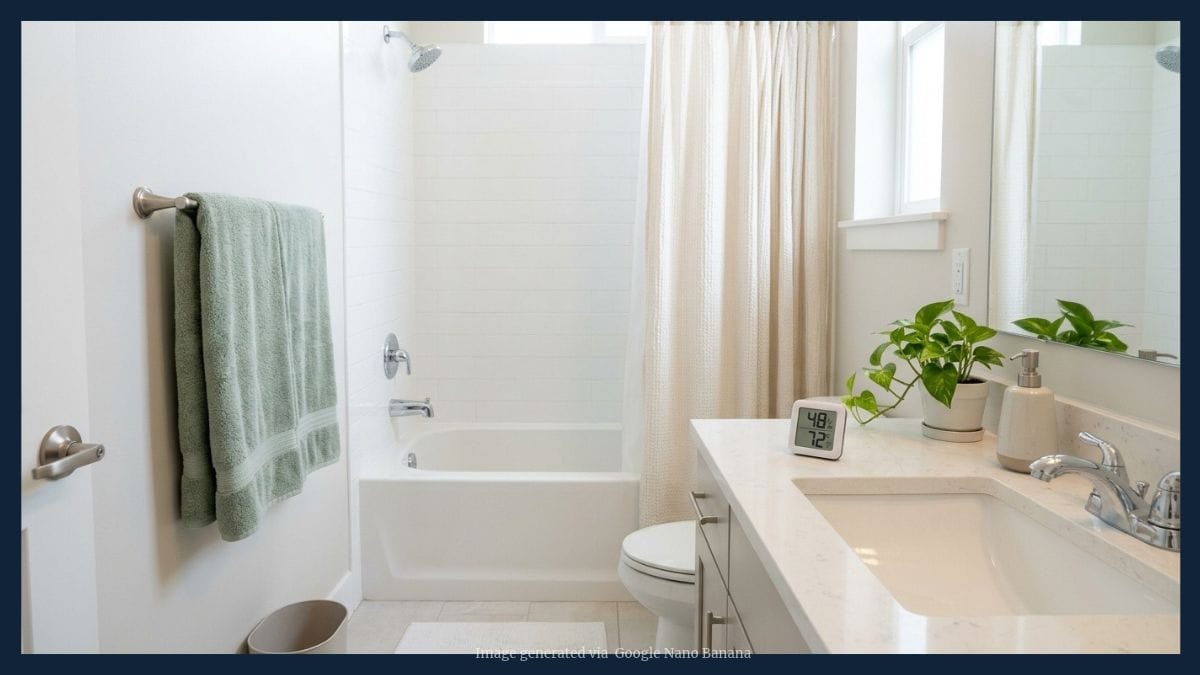
Cleaning removes the mildew you can see and reach, but a musty smell can stay when moisture is still present or the source is somewhere you have not cleaned. University of Georgia Extension notes that mildew can return whenever dampness climbs back toward about 60 percent relative humidity, which can leave homeowners in a never-ending cycle of cleaning the same surfaces. So treat a lingering musty smell as a clue about moisture, not only about dirt, and the job becomes finding where the moisture is coming from or staying.
- A musty smell is a clue about moisture. If cleaning does not fix it, the moisture source or the hidden spot has probably not been dealt with.
- Damp towels, bath mats, and shower curtains are common culprits that are easy to overlook.
- Check where your exhaust fan actually vents and how long you run it. Extension and building-science guidance points to venting outdoors and running it well after the shower ends.
- A rotten-egg or sulfur smell is a different problem from a musty one. It can come from a dry drain trap, and in rare cases from a gas leak, which is an emergency.
- Never mix cleaning products, and do not open walls to look for mold yourself.
Read this before you clean again.
First, never mix cleaning products. Georgia’s public health department warns that bleach mixed with vinegar or any acid can release chlorine gas, bleach mixed with ammonia produces chloramine gas, and many toilet, glass, and drain cleaners contain acids or ammonia. It advises mixing bleach with nothing but plain water, using products in a well-ventilated area, and wearing protective gear.
Second, a rotten-egg smell is not always sewer gas. Natural gas is odorized to smell that way, and the federal pipeline safety agency says that if you smell it, you should make sure gas appliances are off, leave the area, avoid light switches and phones near the leak, and call 911 from a safe distance. Third, do not cut into walls, ceilings, or tub surrounds to look for mold yourself. Fourth, if water is near the exhaust fan, lights, or outlets, do not touch them, and call an electrician.
Why cleaning alone often does not fix a musty bathroom
A musty smell is the one most people associate with mildew. A University of Georgia Extension article says removing accessible surface deposits of mildew may clear up the odor, which also means that if the smell survives your cleaning, some of the mildew may be somewhere you did not reach, or the dampness that feeds it is still there. The same article says mildew usually starts to grow when relative humidity stays around 60 percent and the temperature is 60 degrees Fahrenheit or higher. A bathroom after a hot shower can easily spend time in that range if the air has nowhere to go.
That is why the causes below are mostly about moisture and hidden spots. They are listed roughly from the most common and easiest to check to the ones that need a professional.
Common causes of a musty bathroom that cleaning does not fix
1. Humidity stays high after showers
EPA suggests keeping indoor humidity below 60 percent, ideally between 30 and 50 percent. A bathroom with a weak fan, no fan, or a fan that runs only while someone is in the shower can stay damp long after the steam is gone.
Ventilation details matter. The Building America Solution Center, a Department of Energy-supported resource run by Pacific Northwest National Laboratory, says a bathroom fan should vent outdoors, not into an attic, crawlspace, or the space between floors. A fan that dumps its air into one of those enclosed spaces can move the moisture without removing it from the house. For how long to run it, guidance varies: Mississippi State University Extension suggests airing the room out for 30 minutes after a hot bath or shower by opening a window or running the fan, and Building America recommends leaving the fan on for an hour after showering for effective humidity control.
2. Damp towels, bath mats, and shower curtains
Soft items hold water, and they tend to stay damp. A University of Kentucky Cooperative Extension fact sheet says damp towels and bath mats attract mildew, that shower curtains are quite susceptible, and that curtains should be laundered often following the care label. It also advises leaving shower doors and curtains open after use so the walls can dry. Mississippi State Extension adds that piles of wet cloth will be ruined by mildew and that you should hang towels up right away and spread the shower curtain out so it dries faster.
If the smell is strongest near the towel rack, hamper, or bath mat, start here.
3. Hidden and hard-to-clean spots
The Kentucky fact sheet notes that kitchens and bathrooms have hidden areas where mold and mildew often live, including around window frames and sills, under sinks, and where the tub or shower meets the floor. Those are spots people skip when they clean.
Another factor is what the mold feeds on. Mississippi State Extension says soap scum and dirt are food for mold, which is one reason a quick wipe may not be enough and a scrub may be.
4. A slow leak or wet materials behind surfaces
If moisture is coming from inside a wall, under the tub, or around plumbing, wiping the surface will not help. EPA advises fixing plumbing leaks promptly and says mold usually will not grow if wet materials are dried within 24 to 48 hours. That is a guideline, not a guarantee, and it is why a leak that stays active or goes unnoticed for a while is a bigger concern than a one-time spill.
A slow leak does not always leave a puddle, so a persistent musty smell with no visible source is a reason to check for one. You can run a quick test without opening anything. Read your water meter, wait two hours with no water in use, and read it again. A change suggests a leak somewhere on the system, though it does not tell you where. Check, by looking only, under the sink, around the tub and shower edges, and at the base of the toilet for stains, soft spots, or damp materials.
Hidden mold is a separate question. EPA notes that investigating mold in hidden spaces can release spores and suggests considering an experienced professional.
5. Drain traps and sewer gas, which smell different
Musty and sewer smells are often confused, but they have different sources. A Colorado State University-Pueblo facilities procedure explains that drain traps, which are normally filled with water, form a seal between the building’s sewer line and the venting system. If the water dries out, sewer gas can come up, and the smell is often described as sulfur-like. It can be traced to a dry sink trap or unused floor drain, and the university’s guidance is to run or pour water into drains regularly, at least once a week.
A Utah water reclamation director quoted in local news offers the same quick check: run water for about a minute in tubs, showers, sinks, and floor drains that are not used often. The same report cites the Wisconsin Department of Health describing hydrogen sulfide and ammonia as the most concerning parts of sewer gas, noting that hydrogen sulfide smells like rotten eggs even at low concentrations and can irritate the eyes and respiratory system. If refilling the trap does not fix the smell, the report advises contacting a plumber or landlord.
- Musty smell strongest near the shower or tub, worse after showers > high humidity or mildew on shower surfaces, caulk, or the curtain may be involved
- Musty smell returns within days of cleaning > the moisture source or a hidden spot has probably not been addressed
- Smell strongest near towels, bath mats, the hamper, or the curtain > damp fabrics may be involved
- Smell strongest under the sink or near the base of the tub or toilet, or stained or soft materials there > a leak or hidden moisture may be involved
- Rotten-egg or sulfur smell from one drain, especially in a rarely used bathroom > a dry drain trap may be involved
- Rotten-egg smell near gas appliances or not tied to any drain > treat as a possible gas leak and follow the safety steps above
- Dark growth on caulk, grout lines, or the ceiling > mildew where moisture lingers may be involved
- Water meter reading changes with all water off > a leak somewhere in the plumbing may be involved
These clues point toward possibilities. They do not confirm a cause, and more than one source can be at work at once.
Safe steps to narrow it down
Do these in order, and stop and call a professional at any step if something looks or smells unsafe.
- Handle safety first. If you smell rotten eggs and cannot tie it to a drain, or you smell gas, follow the safety box. Do not clean while you are unsure what the smell is.
- Find where the smell is strongest. Sniff near the shower, tub, vanity, toilet, each drain, the hamper, towels, and the curtain. The strongest spot is often the best clue.
- Deal with the soft items. Wash or replace the bath mat, towels, and shower curtain, following their care labels. Hang towels so they dry between uses.
- Dry the surfaces. The Kentucky and Florida extension fact sheets recommend wiping or squeegeeing shower walls after showering and keeping the curtain or door open so surfaces dry.
- Check the fan. Confirm you have one, that it moves air, and where the duct ends. Run it during and after showers.
- Measure humidity. A small humidity meter placed in the bathroom shows how long humidity stays elevated after a shower and whether it falls into EPA’s suggested range.
- Look at the hidden spots, without dismantling anything. Use a flashlight to look under the sink and along tub, shower, and window edges for stains, soft spots, or dark growth.
- Refill unused drain traps. Run water for a minute or so in every tub, shower, sink, and floor drain, especially in a bathroom nobody uses.
- Run the two-hour water meter test described above.
- Track the result. Note whether the smell fades after the soft items are washed, the surfaces are dry, and the fan is running longer. If it does not, the source may be hidden.
- Hang towels right after use and avoid leaving them in a pile or on the floor.
- Keep the shower curtain and glass door open after showers so the walls can dry.
- Run the exhaust fan every shower and give it time to clear the air after you finish.
- Wash bath mats and curtains regularly, following the label.
- Wipe with a damp cloth rather than a soaking wet one, and dry the area afterward.
Fixes and prevention
The right fix depends on what the checks turn up.
- High humidity: Make sure the fan vents outdoors and run it long enough to clear the air. A dehumidifier can also help, since University of Georgia Extension notes that in some cases the answer to excess moisture is simply buying one. Treat it as a supplement, not a repair for a leak.
- Damp fabrics: Wash or replace them, and change how they are stored and dried.
- Mildew on surfaces: Clean visible mildew and dry the area fully. Advice on products varies across extension sources, with some suggesting bleach, others vinegar or baking soda, and Georgia’s public health department warning never to combine them. Follow the label of whatever product you use, never mix products, and ventilate well. EPA also advises not to paint over mold, and says that if you clean it without fixing the moisture problem it will most likely return.
- Leaks and wet materials: A plumber fixes the source, and damaged materials may need replacing.
- Dry drain traps: Refill them, and run water in rarely used drains regularly. If the smell stays, a plumber can look at venting and the drain line.
DIY or professional?
Reasonable to handle yourself: washing soft items, drying surfaces, running the fan longer, measuring humidity, refilling unused drain traps, looking (not cutting) at accessible hidden spots, and running the water meter test.
- You smell gas or an unexplained rotten-egg odor (leave and call 911 or your gas utility from a safe place).
- The water meter test suggests a leak (plumber).
- The smell stays after refilling drain traps, or you suspect a venting or sewer line problem (plumber).
- You see stained, soft, or crumbling materials, or the smell persists after you have dealt with fabrics, surfaces, humidity, and drains (a contractor or mold professional).
- Mold covers a large area. EPA says homeowners can often handle mold on less than about 10 square feet, but larger areas or heavy water damage call for more caution. If you have health concerns, EPA suggests consulting a health professional before cleanup.
- You suspect mold inside a wall or ceiling. EPA notes that investigating hidden mold can release spores.
- Water is near the fan, light, or outlets (electrician).
- If you smell gas or an unexplained rotten-egg odor, leave and call from a safe distance. Do not clean first.
- Never mix cleaners, and ventilate while you work.
- Wash or replace towels, mats, and the shower curtain, and let surfaces dry after every shower.
- Confirm the fan vents outdoors, and run it during and after showers.
- Run water in every unused drain, then run the two-hour water meter test.
- If the smell persists, call a plumber or other qualified pro to look for a hidden source.
FAQs
Cleaning removes surface mildew, but the moisture that feeds it may still be there, and the mildew may be in places you did not reach. University of Georgia Extension notes that mildew can return whenever dampness returns, so the cleaning alone may only buy a short break.
Not necessarily. A musty smell is a common sign of mildew or mold, but it does not prove either, and it does not tell you where the moisture is. Checking soft items, humidity, hidden spots, and leaks is more useful than guessing.
Sometimes, but a drain problem usually smells different. Dry traps are associated with a sulfur or rotten-egg smell, not a damp, earthy one. Running water in unused drains is a safe first check.
They may cover the smell for a while, but they do not remove the moisture or the mildew behind it. University of Georgia Extension notes that removing accessible mildew may clear the odor, and that mildew returns when dampness does.
Sources differ. Mississippi State University Extension suggests 30 minutes, and Building America recommends an hour for effective humidity control. The important points are to run it during and after the shower and to confirm it vents outdoors.
A musty smell that persists after you have dealt with fabrics, surfaces, humidity, and drains, along with stains or soft materials, is worth having inspected. EPA notes that disturbing hidden mold can release spores, so do not open walls yourself.
Sources and references:
- EPA, A Brief Guide to Mold, Moisture, and Your Home (2012 reprint): https://www.epa.gov/sites/default/files/2016-10/documents/moldguide12.pdf
- EPA, Mold Cleanup in Your Home: https://www.epa.gov/node/59549 and EPA, Mold Course Chapter 4, Dry Quickly: https://www.epa.gov/node/58595
- EPA WaterSense, Fix a Leak Week (two-hour meter check): https://www.epa.gov/node/288682
- University of Georgia Extension, tips on removing and preventing mold and mildew: https://fieldreport.caes.uga.edu/uga-extension-provides-tips-on-removing-and-preventing-mold-and-mildew/
- University of Kentucky Cooperative Extension, Preventing Mold and Mildew in the Kitchen and Bath: https://exclusives.ca.uky.edu/sites/exclusives.ca.uky.edu/files/fcs011802.doc
- University of Florida IFAS Extension, Keeping It Clean: Controlling Mildew (archival copy): https://journals.flvc.org/edis/article/download/131682/135288/236887
- Building America Solution Center (PNNL), Bathroom Exhaust Fans: https://basc.pnnl.gov/resource-guides/bathroom-exhaust-fans
- Colorado State University-Pueblo, Preventing Odors from Dry Sink Traps (facilities procedure): https://www.csupueblo.edu/facilities-management/_doc/ehs-017-preventing-odors-from-dry-sink-traps-sop.pdf
- KPCW, Household odors during summer could stem from unused drains (quotes a water reclamation director and cites the Wisconsin Department of Health): https://www.kpcw.org/summit-county/2023-07-19/household-odors-during-summer-could-stem-from-unused-drains
- PHMSA, Recognizing and Responding to Pipeline Emergencies: https://primis.phmsa.dot.gov/stakeholder-comms/emergencyresponse
