
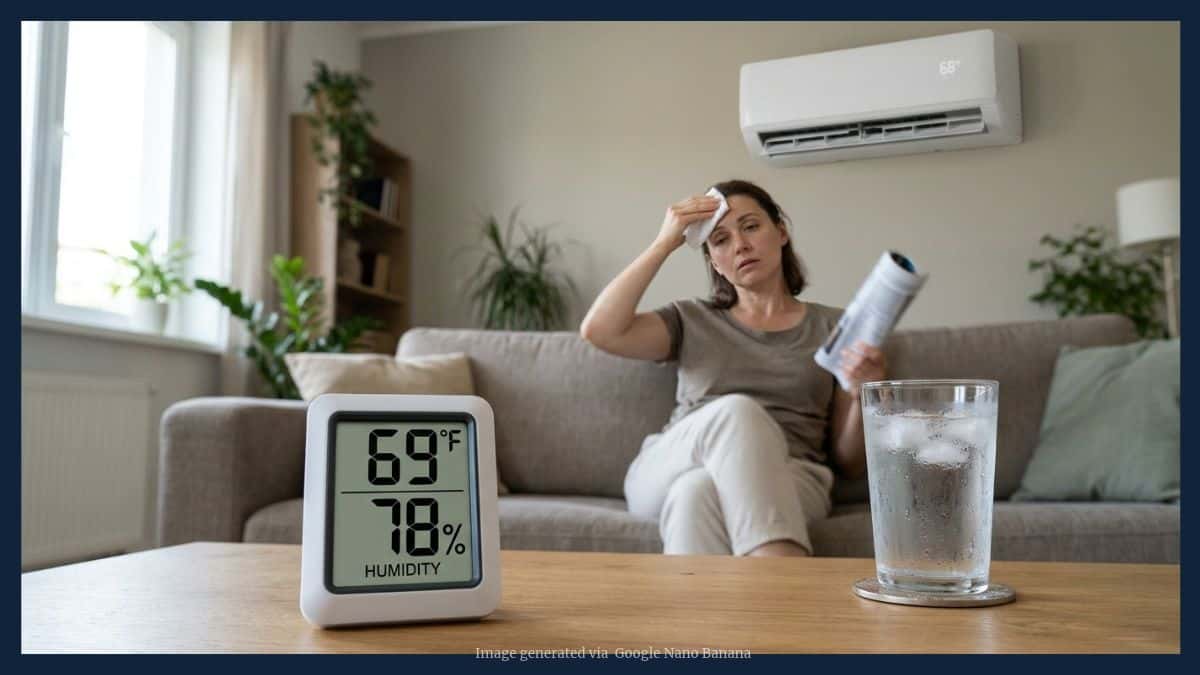
If your house feels sticky, clammy, or damp even while the air conditioner is running, the problem may be that your AC is cooling the air without removing enough moisture. This can happen when the system runs for very short periods, the thermostat fan is set incorrectly, airflow is restricted, the condensate drain is blocked, or humid outdoor air is entering the home.
- A cool room is not necessarily a dry room.
- Indoor humidity should be measured rather than judged by temperature or comfort alone.
- An oversized AC can cool too quickly and remove less moisture than expected.
- A thermostat fan setting of ON may contribute to humidity problems on some systems; AUTO is generally a sensible setting to try.
- Clean filters, unobstructed condensate drainage, and appropriate system maintenance help support normal operation.
- A dehumidifier may help when the moisture load exceeds what the AC can remove.
- Persistent humidity, condensation, and musty odors deserve attention because excess moisture can encourage mold growth.
What should indoor humidity be when the AC is on?
Relative humidity (RH) describes how much water vapor is in the air compared with the maximum amount the air can hold at its current temperature.
The EPA recommends keeping indoor relative humidity below 60%, ideally between 30% and 50% if possible. The appropriate level can vary with the climate, building conditions, and occupant comfort.
Use a digital hygrometer to check the humidity in the rooms where you notice the problem.
| Relative humidity reading | What it may mean | What to do |
|---|---|---|
| 30%–50% | Within the EPA’s preferred general range | Maintain normal moisture control and monitor comfort |
| 51%–59% | Above the preferred range, but still below 60% | Check whether readings rise during the day and reduce unnecessary moisture sources |
| 60% or higher | Elevated humidity that warrants attention if persistent | Investigate moisture sources, AC performance, ventilation, and dehumidification |
| Readings that keep rising | Moisture may be entering or being produced faster than it is removed | Track patterns and investigate the cause |
These are practical reference ranges, not a diagnosis of your AC. A single reading may not reflect conditions throughout the home or over an entire day.
Measure humidity in more than one room if possible. A bedroom, basement, bathroom, and living room can have different moisture conditions.
Why does my house feel humid with the AC running?
Several problems can produce the same combination of cool air and uncomfortable humidity. Use the signs below to narrow down what to check.
The air conditioner is too large for the house
An air conditioner with more cooling capacity than the home needs can cool the indoor air very quickly. The thermostat may reach its target temperature and switch the system off before it has removed enough moisture.
This is known as short-cycling when the system repeatedly runs for brief periods and shuts down.
You might notice:
- The room reaches the thermostat’s set temperature quickly.
- The AC turns on and off frequently.
- The house feels cool but sticky.
- Humidity remains high even though the equipment appears to cool normally.
Air conditioners need operating time for moisture to condense on the evaporator coil and drain away. ENERGY STAR explains that properly sized systems generally provide better humidity control because they can run longer cycles.
What to do: Ask an HVAC professional to evaluate the equipment’s capacity against the home’s actual cooling needs. Proper sizing should account for factors such as the local climate, insulation, windows, air leakage, and building layout.
Do not assume that every short cycle means the AC is oversized. Thermostat placement, control settings, equipment faults, and other conditions can also cause frequent cycling.
The thermostat fan is set to on instead of auto
Many central air-conditioning systems let you choose between ON and AUTO for the indoor blower fan.
- ON: The fan runs continuously, including when the compressor is not actively cooling.
- AUTO: The fan generally runs when the system calls for heating or cooling, subject to the equipment’s controls.
After a cooling cycle, the evaporator coil can remain wet. On some systems, continued airflow across that coil can cause some retained moisture to evaporate back into the air stream.
This can make the house feel more humid than expected.
What to do: If your thermostat has these options, try setting the fan to AUTO and observe whether humidity and comfort improve. Follow your system’s manual, particularly if you use special ventilation or air-circulation settings.
If the fan setting makes no difference, investigate other possible causes rather than assuming the thermostat is responsible.
The air filter is dirty or restricting airflow
A dirty air filter can reduce airflow through the indoor unit. Depending on the system and the severity of the restriction, this can reduce cooling performance and contribute to evaporator-coil freezing.
A frozen coil cannot operate normally to cool and dehumidify the home. When the ice melts, water may also create a drainage problem if the system cannot handle it properly.
Warning signs include:
- Weak airflow from supply vents.
- A filter covered in dust.
- Cooling that has become less effective.
- Ice visible on accessible AC components or refrigerant lines.
What to do:
- Turn off the system if you suspect the coil is frozen.
- Check the filter according to the manufacturer’s instructions.
- Replace or clean it if necessary, using the correct filter type and size.
- If ice is present or returns, arrange professional service.
Do not chip ice off the coil or continue operating the system in an attempt to force it to cool. A frozen coil can indicate airflow or refrigerant problems that need proper diagnosis.
The condensate drain is blocked
When an air conditioner removes moisture, the water it collects should flow into a drain pan and through a condensate drain line.
If the drain becomes blocked, water may accumulate or overflow. Some systems have safety switches that shut the equipment down when drainage problems occur.
Look for:
- Water around the indoor unit.
- A full or overflowing drain pan, if safely visible.
- Water stains near the air handler.
- A musty odor close to the unit.
- An AC that has stopped cooling unexpectedly.
A blocked drain does not always cause high humidity throughout the home, but it can indicate a problem with moisture removal and may lead to water damage.
What to do: Check only the accessible areas identified in the owner’s manual. If water is leaking, avoid touching electrical components and arrange service. Do not remove equipment panels or pour chemicals into the drain unless the manufacturer specifically permits the procedure.
The evaporator coil is dirty, frozen, or not operating properly
The evaporator coil is the indoor component that absorbs heat from the air. Moisture can condense on its cold surface as warm indoor air passes over it.
If the coil is dirty, iced over, or affected by a mechanical or refrigerant problem, the system may not cool and dehumidify as intended.
Possible clues include:
- Poor cooling despite the system running.
- Reduced airflow.
- Ice on the indoor unit or refrigerant lines.
- Unusual changes in operating behavior.
- Humidity that remains high despite normal thermostat settings.
These symptoms can have several causes. Low refrigerant, for example, cannot be confirmed just by looking at the equipment or feeling the air from a vent.
What to do: Replace or clean the filter if appropriate, but leave coil cleaning, refrigerant checks, and internal repairs to a qualified HVAC technician.
Humid outdoor air is entering the house
Even a properly functioning AC can struggle if humid air enters faster than the system can remove its moisture.
Possible entry points include:
- Gaps around exterior doors and windows.
- Leaky or poorly sealed ductwork.
- Open doors and windows during humid weather.
- Uncontrolled outdoor-air ventilation.
- Gaps around pipes, cables, and other penetrations.
The issue may be more noticeable in hot, humid weather or in homes with weak air sealing.
What to do: Check weatherstripping and visible gaps around doors and windows. Have suspicious ductwork inspected by a qualified professional. Do not seal intentional ventilation openings without understanding their purpose, especially where combustion appliances or required ventilation systems are involved.
Cooking, bathing, and other activities are adding moisture
Everyday household activities can release substantial water vapor into indoor air.
Common sources include:
- Hot showers and baths.
- Boiling water and uncovered cooking pots.
- Drying clothes indoors.
- Running a clothes dryer that vents improperly.
- Indoor humidifiers.
- Wet mopping or carpet cleaning.
- Numerous people occupying a small, poorly ventilated room.
The AC may be operating normally but still be unable to keep up with the home’s moisture load.
What to do: Use bathroom exhaust fans during showers and afterward, run kitchen exhaust ventilation when cooking, and ensure that dryers vent outdoors where required and appropriate. Avoid adding moisture with a humidifier unless it is needed.
In humid weather, opening windows can bring more moisture inside. Ventilate when outdoor conditions are favorable and consistent with your home’s ventilation needs.
The AC does not run Long enough to remove moisture
Air conditioners remove moisture as part of the cooling process. If the weather is relatively mild, the home has little heat gain, or the thermostat is satisfied quickly, the AC may not run enough to remove the moisture entering the home.
This can happen even when the equipment is not faulty.
For example, a humid day with moderate temperatures may create less demand for cooling than a hot afternoon. The AC may run less frequently even though outdoor moisture levels remain high.
What to do: Measure humidity over time. If the AC rarely runs and indoor humidity remains high, consider whether the home needs better moisture control or a dedicated dehumidifier. An HVAC professional can help determine the appropriate solution.
The house has a separate moisture problem
Not every humidity problem originates in the AC. Water may be entering the building or accumulating in concealed areas.
Investigate other sources if you notice:
- Musty smells that persist after the AC has been serviced.
- Damp walls, ceilings, or baseboards.
- Condensation on windows or cold pipes.
- A humid basement or crawl space.
- Plumbing leaks.
- Water pooling near the foundation.
- Humidity that is consistently higher in one part of the home.
What to do: Look for plumbing leaks, exterior water entry, drainage problems, and signs of condensation. Repair the moisture source rather than relying only on air conditioning or a dehumidifier.
What to check first
| What you notice | Possible cause | First step |
|---|---|---|
| House is cool but still sticky | Poor moisture removal or excessive moisture load | Measure humidity and review the AC’s operating pattern |
| AC turns on and off frequently | Oversizing, thermostat, or control issue | Record cycle behavior and request an HVAC assessment if persistent |
| Indoor fan runs even when cooling stops | Fan set to ON or a control setting | Check the thermostat and owner’s manual |
| Weak airflow from vents | Dirty filter, airflow restriction, or system fault | Inspect the filter and check for ice |
| Water around the indoor unit | Blocked drain, overflow, or another leak | Keep clear of electrical hazards and arrange inspection |
| Ice on the indoor unit or refrigerant lines | Airflow or refrigerant problem, among other causes | Turn off cooling and contact an HVAC technician |
| Humidity spikes after showers or cooking | Indoor moisture sources | Use appropriate exhaust ventilation |
| Humidity is worse during humid weather | Outdoor air infiltration or a high moisture load | Check obvious gaps and assess dehumidification needs |
| Musty smell or damp wall surfaces | Possible concealed moisture or mold | Investigate leaks and damp materials |
| One room is more humid than others | Uneven airflow, local moisture, or room-specific conditions | Compare readings and inspect local moisture sources |
These patterns help guide troubleshooting but do not confirm a diagnosis on their own.
How to check whether your AC is removing humidity
You can gather useful information before calling an HVAC technician.
Step 1: Measure indoor relative humidity
Use a digital hygrometer to record the relative humidity in the room where the problem is most noticeable.
Place the device away from direct supply airflow, direct sunlight, cooking steam, and other immediate sources of heat or moisture.
Record:
- The room temperature.
- The relative humidity.
- Whether the AC is running.
- The time of day.
- Whether doors or windows are open.
- Whether showers, cooking, or other moisture-producing activities recently occurred.
Repeat the measurements at different times. A pattern over several hours is more useful than one isolated reading.
Step 2: Check the thermostat settings
Confirm that the system is set to COOL when cooling is required and check whether the indoor fan is set to ON or AUTO.
If you switch the fan to AUTO, observe whether the humidity improves. Keep any manufacturer-required ventilation or circulation settings in mind.
Avoid repeatedly lowering the temperature to compensate for humidity. That can make rooms uncomfortably cold without solving the underlying problem.
Step 3: Inspect the air filter
Follow the manufacturer’s instructions for locating and checking the filter.
If it is dirty, replace or clean it as directed. Use the correct size and type for your system. A filter that is too restrictive for the equipment can also affect airflow.
If the filter is clean but airflow is still weak, the cause may be deeper in the system.
Step 4: Look for visible drainage or ice problems
From a safe position, look for water around the indoor unit or visible ice on accessible components.
Do not open electrical panels, handle wet wiring, or dismantle the AC to investigate. If you see ice, a leak, or an overflowing drain pan, arrange qualified service.
Step 5: Compare different rooms
Take humidity readings in more than one room, particularly if the problem is concentrated in a bedroom, basement, or room with exterior walls.
If one room is consistently more humid, investigate local sources, airflow differences, and potential water intrusion.
Step 6: Record the ac’s operating pattern
Notice whether the system runs in long cycles or repeatedly starts and stops after only brief operation.
Short cycles can be a clue to oversizing or a control problem, but cycle duration alone is not enough to diagnose the system. Weather, thermostat placement, system design, and operating conditions all matter.
Step 7: Review the findings
If the filter and thermostat settings are appropriate but humidity remains high, give your measurements and observations to an HVAC professional.
This information can help narrow the investigation and reduce the risk of paying for a repair that does not address the actual cause.
How to reduce humidity when the AC is running
The best solution depends on whether the moisture problem comes from the AC, outdoor air, or indoor moisture sources.
Start with simple, safe checks
- Measure humidity with a hygrometer.
- Check the thermostat’s fan setting.
- Replace or clean the air filter according to the manufacturer’s instructions.
- Use bathroom and kitchen exhaust fans when appropriate.
- Avoid unnecessary indoor clothes drying or humidifier use.
- Keep windows and exterior doors closed when outdoor air is hot and humid, unless ventilation requirements or other conditions call for a different approach.
- Look for obvious water leaks and damp building materials.
These steps can help identify or reduce common sources of excess moisture.
Arrange AC maintenance when needed
If the problem continues, a qualified HVAC technician can inspect:
- Evaporator coil condition.
- Condensate drain and drain pan.
- Airflow and blower operation.
- Refrigerant-related performance issues.
- Thermostat operation and cycling.
- Duct leakage.
- Whether the system is correctly sized for the home.
Ask for an explanation of the measured findings and the recommended repair. A technician should distinguish between an equipment problem and a moisture load that exceeds the system’s capacity.
Consider a dehumidifier
A dehumidifier may be useful when indoor humidity remains high despite normal AC operation.
It can be particularly helpful when:
- Outdoor air is consistently humid.
- The home has a basement or other damp area.
- The AC does not run enough to remove the required moisture.
- The moisture load is greater than the AC can manage.
A portable unit can address a particular room, while a whole-house dehumidifier can be integrated into a home’s moisture-control strategy.
Choose equipment based on the space, moisture load, and manufacturer’s specifications. Ensure that condensate is drained safely and that the unit is maintained according to its instructions.
A dehumidifier should not be used as a substitute for repairing plumbing leaks, roof leaks, or other sources of water intrusion.
Do not assume a colder thermostat setting Will fix it
Lowering the thermostat can increase cooling demand, but it is not a reliable solution to every humidity problem. It may leave the home too cold while failing to address moisture entering through leaks, ventilation, or other sources.
The right fix depends on the cause.
Can high indoor humidity cause mold?
Yes. Persistent moisture can create conditions that support mold growth, particularly when dampness affects drywall, wood, insulation, carpets, or other materials.
The EPA recommends keeping indoor humidity below 60%, ideally between 30% and 50% if possible. These ranges help guide moisture management, but no single humidity reading guarantees that mold will or will not grow.
Watch for:
- Musty odors.
- Condensation on windows or walls.
- Damp or discolored surfaces.
- Peeling paint or wallpaper.
- Mold-like growth near windows, bathrooms, or exterior walls.
If you find water-damaged materials, address the moisture source and dry the affected area promptly. The EPA advises drying wet or damp materials within 24 to 48 hours after a leak or spill to help prevent mold growth in many situations.
If mold is extensive, hidden behind walls, or associated with contaminated water, consider qualified professional help.
When should you call an hvac professional?
- The house remains humid after checking basic settings and replacing a dirty filter.
- The AC frequently starts and stops.
- Cooling performance has declined.
- Ice forms on the indoor unit or refrigerant lines.
- Water leaks from the AC or the condensate system.
- Airflow remains weak despite a clean filter.
- You suspect an oversized system or a duct problem.
- Indoor humidity remains persistently high.
A professional should evaluate the equipment and the building conditions rather than assume that the AC itself is always the cause.
What about a musty smell or damp walls?
If the AC smells musty, or you notice damp walls, ceiling stains, or swollen baseboards, investigate potential moisture problems beyond the cooling system.
An HVAC inspection may be appropriate, but plumbing, roofing, drainage, or building-envelope problems may require a different specialist.
Frequently asked questions
Your AC may be lowering the temperature without removing enough moisture. Possible reasons include short cycling, fan settings, restricted airflow, drainage problems, or a high indoor moisture load. Measure humidity and investigate the system rather than lowering the thermostat further.
For many systems, AUTO is a sensible choice when the goal is to avoid continuous blower operation between cooling cycles. On some systems, a fan set to ON can return some moisture from the wet evaporator coil to the indoor air. Follow the equipment manual if your system has special ventilation or circulation controls.
Yes. An oversized unit may cool the house quickly and shut off before removing enough moisture. This can contribute to short cycling and poor humidity control. Proper sizing requires an assessment of the home’s cooling load rather than simply choosing a larger unit.
The system may not be removing enough moisture, or humid air may be entering faster than it can be removed. Possible causes include a dirty or frozen coil, restricted airflow, drainage issues, duct leaks, excessive indoor moisture, or a system that needs professional attention.
It may increase the amount of cooling, but it does not reliably solve every humidity problem. If the system is faulty or moisture is entering from elsewhere, a colder setting may not address the cause.
It can. A dehumidifier may help when the AC cannot keep humidity at a comfortable level, especially when the system does not run long enough or the home has a high moisture load. Fix water leaks and other moisture sources first.
The EPA recommends keeping indoor relative humidity below 60%, ideally between 30% and 50% if possible. A brief reading at 60% does not establish that damage has occurred, but persistently high humidity warrants investigation and moisture control.
Rooms can differ in airflow, insulation, exposure to outdoor conditions, occupancy, and moisture sources. Measure humidity in both spaces, check whether vents are obstructed, and investigate local issues such as condensation or water intrusion.
A dirty filter can restrict airflow and interfere with AC performance. Depending on the system, this may contribute to coil freezing or reduced cooling and moisture removal. Check the filter as directed by the manufacturer, and seek service if airflow or humidity problems persist.
When cooling stops, the system stops actively condensing moisture from the air. Indoor humidity may rise as moisture from people, cooking, bathing, outdoor air, and damp materials continues to enter the room. If humidity rises sharply or remains high, investigate the moisture load and AC performance.
Sources and references:
- U.S. Environmental Protection Agency — Mold Course, Chapter 2: Where and Why Mold Grows https://www.epa.gov/mold/mold-course-chapter-2
- U.S. Environmental Protection Agency — A Brief Guide to Mold, Moisture and Your Home
https://www.epa.gov/mold/brief-guide-mold-moisture-and-your-home - ENERGY STAR — Right-Sized Air Conditioners
https://www.energystar.gov/ia/home_improvement/home_sealing/RightSized_AirCondFS_2005.pdf - U.S. Department of Energy, Pacific Northwest National Laboratory — Whole-House Dehumidification
https://basc.pnnl.gov/resource-guides/whole-house-dehumidification - U.S. Environmental Protection Agency — Ten Things You Should Know About Mold
https://www.epa.gov/mold/ten-things-you-should-know-about-mold
