
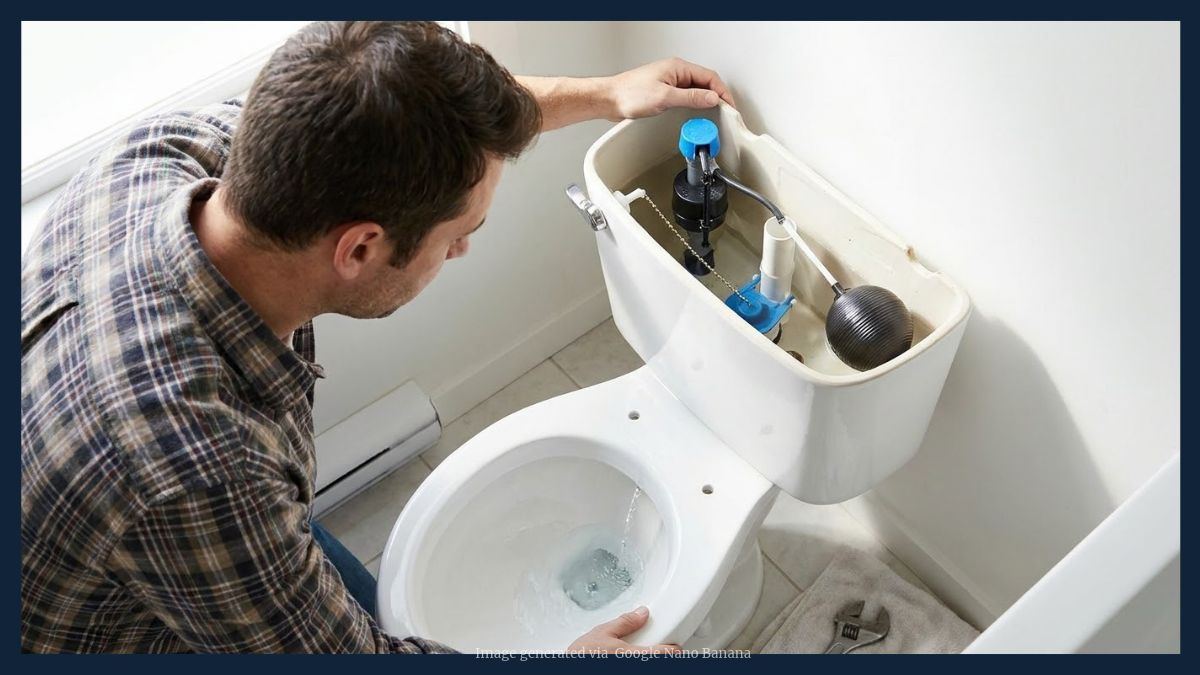
A toilet usually keeps running after flushing because the flapper or flush valve seal is not closing properly, the float is set too high, or the fill valve is failing to shut off. A tangled flush chain or incorrectly positioned refill tube can also prevent the toilet from completing its normal refill cycle.
- Worn or leaking flapper: Water escapes from the tank into the bowl, causing the toilet to refill repeatedly.
- Incorrect float height: The tank fills beyond its intended water level and sends excess water into the overflow tube.
- Faulty fill valve: The valve cannot shut off the incoming water properly.
- Tangled or incorrectly adjusted chain: The flapper cannot close completely after flushing.
- Incorrectly positioned refill tube: Water may be directed improperly, affecting the refill system.
Most conventional gravity-flush toilet problems can be diagnosed by inspecting the tank. However, concealed, pressure-assisted, and electronic toilet systems may require model-specific instructions or professional assistance.
Common reasons your toilet keeps running after flushing
A toilet has a simple operating cycle: flushing releases water from the tank, the tank refills, and the fill valve shuts off when the water reaches its intended level.
If one of the tank components fails to work properly, water may continue moving through the system instead of stopping after the refill cycle.
Here are the most common causes.
1. The flapper is worn or not sealing properly
The flapper is a rubber or plastic seal located at the bottom of many conventional toilet tanks. It covers the opening between the tank and the toilet bowl.
When you flush, the flapper lifts to release water into the bowl. Once the flush is complete, it should fall back into place and create a watertight seal.
Over time, the flapper can become:
- Brittle or cracked from age.
- Warped or misshapen.
- Covered in mineral deposits or debris.
- Damaged by certain in-tank cleaning products.
- Misaligned with the flush valve opening.
When the flapper cannot seal properly, water slowly leaks from the tank into the bowl. The fill valve then activates to replace the lost water.
This can create a repeating cycle in which the toilet refills even though nobody has flushed it.
Signs of a faulty flapper:
- The toilet occasionally starts refilling on its own.
- You hear a faint trickling sound even when the toilet is not being used.
- The toilet runs intermittently rather than continuously.
- Food coloring added to the tank eventually appears in the bowl.
What to do:
Inspect the flapper for visible damage, dirt, or mineral buildup. If it is dirty, cleaning the sealing surface may help. If the rubber is deteriorated, warped, or no longer seals properly, replacement is usually the more reliable solution.
Make sure the replacement flapper is compatible with your toilet’s flush valve.
2. The float is set too high
The float controls how much water enters the tank. As the tank fills, the float rises and signals the fill valve to stop supplying water.
If the float is positioned too high, the water level may rise above the intended limit and spill into the overflow tube.
The overflow tube is designed to prevent the tank from overflowing onto the floor. However, water continuously entering this tube can make it seem as though the toilet never finishes refilling.
Signs of an incorrectly adjusted float:
- Water continues flowing into the overflow tube.
- The tank water level reaches or rises above the top of the overflow tube.
- The fill valve keeps running even after the tank appears full.
- Lowering the float slightly causes the water to stop at a lower level.
What to do:
Check whether your toilet has a float cup or an older float-ball assembly.
Many modern float cups have an adjustment screw or clip that allows you to change the shutoff height. Older ball-style assemblies may have a different adjustment mechanism.
Lower the float gradually, following the toilet manufacturer’s instructions. The water should stop filling below the top of the overflow tube, at the level specified for your toilet.
Do not force or bend plastic components that are not designed to be adjusted.
3. The fill valve is faulty
The fill valve controls the flow of water into the tank after flushing. It works with the float to determine when the tank has received enough water.
If the fill valve becomes worn, clogged with sediment, or damaged, it may fail to shut off properly.
This can cause water to continue entering the tank even when the water level has reached its intended height.
Mineral deposits and debris can also interfere with the valve’s internal components.
Signs of a faulty fill valve:
- A continuous hissing or running sound comes from the tank.
- Water keeps entering the tank after it should be full.
- The toilet takes unusually long to refill.
- Adjusting the float does not stop the water.
- The toilet continues running even after the visible debris has been cleaned.
What to do:
First, check whether the float moves freely and whether debris is visibly interfering with the fill valve.
Some fill valves can be cleaned according to the manufacturer’s instructions. If cleaning and adjustment do not resolve the problem, replacing the valve may be necessary.
Use a replacement compatible with your toilet model. If you are unfamiliar with the water connections or the valve assembly, consider hiring a plumber.
4. The flapper chain is tangled or incorrectly adjusted
The chain connects the toilet handle’s lifting arm to the flapper.
When you press the handle, the chain lifts the flapper so water can leave the tank. After flushing, the chain should allow the flapper to fall back into place.
Problems occur when the chain is too tight, too loose, or caught on another component.
For example:
- A chain that is too short may prevent the flapper from closing completely.
- A chain that is tangled may hold the flapper open.
- A chain that is excessively loose may get trapped underneath the flapper.
Even a small gap can allow water to leak continuously into the bowl.
Signs of a chain problem:
- The toilet keeps running immediately after flushing.
- The handle feels stuck or does not return properly.
- The toilet stops running when you jiggle the handle.
- The flapper appears to be held slightly above its sealing position.
What to do:
Inspect the chain and make sure it moves freely when you operate the handle.
Adjust its length so there is a small amount of slack when the flapper is closed. It should not be so tight that it holds the flapper open or so loose that it gets trapped underneath.
If the chain is damaged or badly corroded, replace it.
5. The refill tube is incorrectly positioned
The refill tube is a small flexible tube connected to the fill valve. It directs water into the overflow tube during the refill cycle, helping replenish the water in the toilet bowl.
If the tube is disconnected, positioned incorrectly, or pushed too far down into the overflow tube, it can interfere with the toilet’s operation.
An incorrectly installed refill tube can also create a siphoning problem in certain configurations.
Signs of a refill tube problem:
- The tube is hanging loose inside the tank.
- The tube has been pushed deep into the overflow tube.
- The tube is not secured in its intended position.
- The toilet has been recently repaired or had its fill valve replaced.
What to do:
Check the tube’s position and compare it with the manufacturer’s installation instructions.
The tube should discharge into the overflow tube through the appropriate clip or fitting. It should not be inserted deeply into the overflow tube.
If the tube or its clip is damaged, replace the affected component.
How to identify why your toilet keeps running
You do not need to replace every component to find the problem. Start by observing what happens inside the tank after a flush.
These checks are intended for conventional gravity-flush toilets with accessible tank lids. If you have a pressure-assisted, concealed, or electronic toilet, consult the manufacturer’s instructions before opening or servicing the system.
Step 1: Remove the tank lid and inspect the components
Carefully lift the tank lid and place it on a stable, protected surface. Ceramic lids can be heavy and break if dropped.
Locate the following components:
- Flapper: The seal at the bottom of the tank.
- Fill valve: The assembly that supplies water to the tank.
- Float: The component that rises with the water level.
- Overflow tube: The vertical tube that prevents the tank from overfilling.
- Chain: The connection between the handle and flapper.
- Refill tube: The small tube that directs water into the overflow tube.
Look for tangled chains, damaged seals, loose tubes, or visible mineral buildup.
Step 2: Flush the toilet and watch the refill cycle
Flush the toilet once and observe what happens as the tank refills.
Pay particular attention to the water level and whether water continues flowing into the overflow tube.
Use these observations to narrow down the possible cause:
| What you notice | Possible cause |
|---|---|
| Water continues flowing into the overflow tube | Float set too high or faulty fill valve |
| Water level looks normal, but the toilet keeps refilling occasionally | Leaking flapper or flush valve seal |
| Toilet stops running when you jiggle the handle | Chain or handle adjustment problem |
| Flapper does not settle flat after flushing | Tangled chain, damaged flapper, or misalignment |
| Water keeps entering despite a correctly adjusted float | Faulty or obstructed fill valve |
| Refill tube is loose or incorrectly positioned | Refill tube installation problem |
Step 3: Perform a toilet dye test
A dye test can help determine whether water is leaking from the tank into the bowl.
You will need a few drops of food coloring or a toilet leak-detection dye tablet.
Follow these steps:
- Make sure the toilet has finished refilling.
- Add several drops of food coloring to the tank water.
- Do not flush the toilet.
- Wait approximately 10 minutes.
- Check the water inside the toilet bowl.
What the results mean:
- Color appears in the bowl: Water is leaking from the tank into the bowl, often because the flapper or flush valve seal is not sealing properly.
- No color appears: The dye test did not detect a tank-to-bowl leak during the test. If the toilet is still running, investigate the fill valve, float, or other components.
Flush the toilet after the test to clear the dye and reduce the chance of staining.
The U.S. Environmental Protection Agency recommends dye testing as a way to identify toilet leaks in its WaterSense technical guidance.
How to fix a toilet that keeps running after flushing
Once you have identified the likely cause, you can decide whether a simple adjustment or component replacement is appropriate.
Before working inside a conventional toilet tank, locate the shutoff valve on the water supply line near the toilet. Turn it clockwise to shut off the water when performing repairs that require draining or disconnecting components.
Do not force a stuck shutoff valve. If it leaks or will not operate properly, contact a plumber.
| Problem | Possible solution | DIY difficulty |
|---|---|---|
| Dirty or worn flapper | Clean or replace the flapper | Easy |
| Tangled chain | Untangle or adjust chain length | Easy |
| Float set too high | Adjust float height | Easy to moderate |
| Faulty fill valve | Clean or replace the fill valve | Moderate |
| Incorrect refill tube position | Reposition or replace the tube | Easy |
| Damaged flush valve seat or assembly | Repair or replace the affected assembly | Moderate to difficult |
Replacing a worn flapper
If the flapper is damaged or no longer seals properly, replacing it is often a straightforward repair.
- Turn off the toilet’s water supply.
- Flush the toilet to empty most of the water from the tank.
- Disconnect the chain from the handle arm.
- Remove the old flapper from its mounting points.
- Install a compatible replacement.
- Reconnect the chain, leaving a small amount of slack.
- Turn the water supply back on.
- Allow the tank to refill and check whether the flapper seals properly.
Flush the toilet several times to confirm that the new flapper opens and closes correctly.
Adjusting the float
If water is flowing into the overflow tube, the float may need adjustment.
- Check the manufacturer’s instructions for your fill valve.
- Identify the float adjustment mechanism.
- Lower the float slightly using the adjustment screw or clip, if provided.
- Flush the toilet and allow the tank to refill.
- Check whether the fill valve stops before water reaches the top of the overflow tube.
Repeat the adjustment gradually if necessary.
Avoid setting the water level too low. The tank still needs enough water for the toilet to flush effectively.
Cleaning or replacing the fill valve
If the fill valve appears to be obstructed by debris, cleaning may restore normal operation.
However, the cleaning procedure varies between fill valve designs.
Before removing or opening the valve, follow the manufacturer’s instructions. Some models require the water supply to be shut off and the valve cap to be removed carefully.
If the valve remains noisy, leaks, or fails to shut off after cleaning, replacement may be necessary.
A fill valve replacement involves working with the water supply connection underneath the tank. If you are unsure how to disconnect and reseal the connection properly, have a plumber perform the repair.
Can a running toilet increase your water bill?
Yes. A running toilet can waste a significant amount of water because the leak may continue for hours or even days without being noticed.
The amount wasted depends on the size of the leak and how quickly water escapes from the tank.
A small leak may be difficult to notice, while a more severe problem can send a continuous stream of water into the bowl.
You may notice the problem through:
- An unexplained increase in your water bill.
- A toilet that refills even when nobody has used it.
- Continuous trickling or hissing sounds.
- Water moving inside the bowl when the toilet has not been flushed.
The U.S. Environmental Protection Agency notes that a constantly running toilet can waste more than 200 gallons of water per day in its educational leak-detection material. Actual water loss varies depending on the toilet and the severity of the leak.
Repairing the problem promptly can help reduce unnecessary water consumption and prevent avoidable increases in your utility bill.
When should you call a professional plumber?
Many running toilet problems involve accessible tank components, but not every repair is suitable for DIY work.
- The toilet continues running after replacing the flapper and adjusting the float.
- The fill valve cannot be adjusted or replaced without difficulty.
- The flush valve assembly or its sealing surface is damaged.
- Water is leaking around the base of the toilet.
- The shutoff valve is stuck, damaged, or leaking.
- The tank has cracks or visible structural damage.
- You have a concealed, pressure-assisted, or electronic toilet system that requires specialized servicing.
A plumber can inspect the entire flushing mechanism, identify the actual source of the problem, and replace the necessary components without relying on trial and error.
Should you hire a professional?
For a simple chain adjustment or compatible flapper replacement, professional service may not be necessary if you are comfortable working with basic toilet components.
However, a persistent running toilet can involve more than one damaged part. Replacing the wrong component may temporarily change the symptoms without resolving the underlying problem.
If the toilet continues running after basic troubleshooting, a professional inspection can help determine whether the fill valve, flush valve assembly, or another component needs attention.
When requesting a repair estimate, ask whether the inspection, replacement parts, labor, and any follow-up testing are included.
Frequently asked questions
A toilet normally needs time to refill after flushing. However, if it continues running well beyond its usual refill cycle, the fill valve may be obstructed or faulty, the float may be incorrectly adjusted, or water may be escaping through a leaking flapper.
This often indicates a problem with the handle mechanism or flapper chain. The chain may be tangled, too tight, or caught underneath the flapper.
This is commonly called phantom flushing. It happens when water slowly leaks from the tank into the bowl, eventually lowering the tank water level enough to activate the fill valve.
Sometimes. A tangled chain, incorrectly positioned refill tube, or float set too high may only require adjustment.
A toilet that continues running can usually still flush, but the problem should not be ignored. It can waste water and may become more difficult to repair if damaged components deteriorate further.
If the toilet continues running and you cannot identify or resolve the problem, turning off its individual water supply can prevent further water waste.
Sources and references:
Use these sources to support the technical details and verify product-specific repair instructions.
- Kohler: Toilet occasionally leaking or running – Explains how flapper seals, chain adjustment, and tank water levels can cause intermittent running.
- Kohler: Toilet constantly leaking or running – Covers fill valve debris, overflow problems, and corrective actions.
- Kohler: How to fix a running toilet – Provides a manufacturer troubleshooting process for inspecting and adjusting toilet tank components.
- U.S. Environmental Protection Agency: WaterSense technical sheet – Free of water leaks – Includes a toilet dye-test procedure for detecting leaks.
- Portland Water District: How do I know if my toilet is leaking? – Explains common signs of toilet leaks and how to perform a dye test.
