
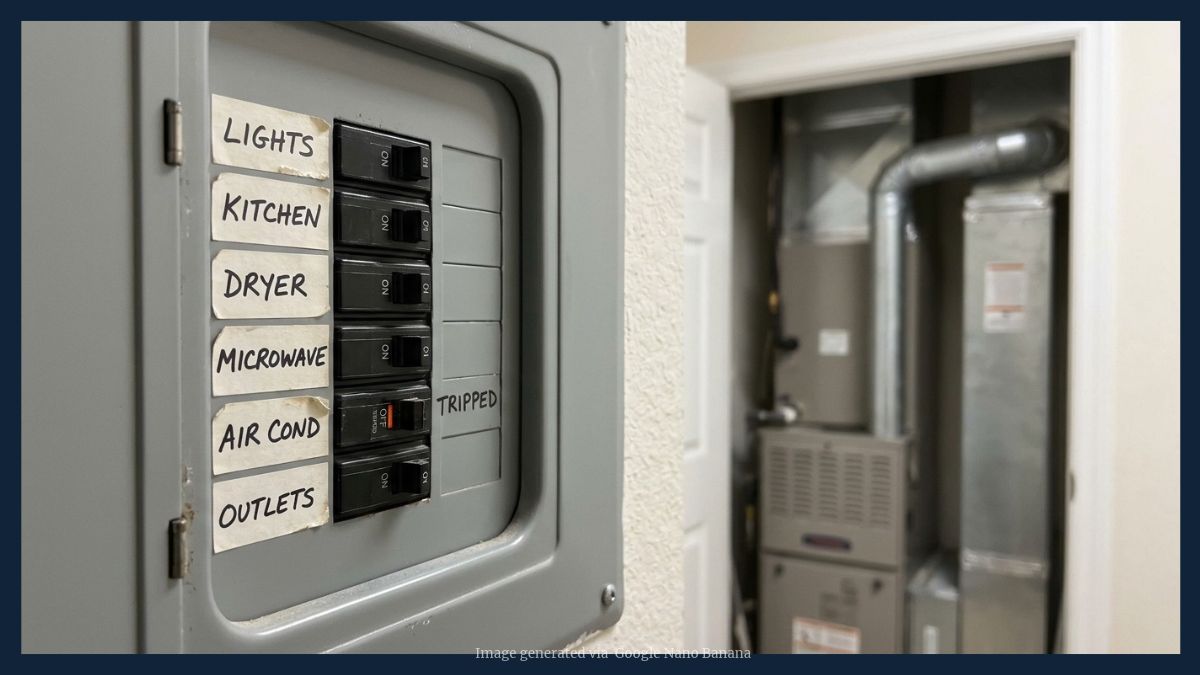
A circuit breaker that trips when an appliance starts may be responding to a temporary surge in electrical current, an overloaded circuit, a short circuit, or a fault in the appliance or wiring. Motors and compressors, such as those in refrigerators, air conditioners, washing machines, and pumps, can draw more current during startup than they use while running.
- Some appliances draw a brief surge of current when their motors or compressors start.
- This temporary demand is called inrush current or startup current.
- A breaker that trips immediately may be responding to startup current, a short circuit, or another electrical fault.
- A breaker that trips after several minutes may indicate sustained overload or overheating.
- An appliance that repeatedly trips the same breaker may have an internal electrical or mechanical problem.
- A breaker that trips even when the appliance is not operating may indicate a circuit or wiring issue.
- Do not repeatedly reset the breaker or install a higher-rated replacement.
- A qualified electrician or appliance technician should investigate recurring trips.
The timing of the trip provides an important clue. A breaker that switches off immediately when an appliance starts may be responding to a high startup current or an electrical fault. If it trips after the appliance has been running for a while, sustained overloading or overheating may be involved. Repeated tripping should never be dismissed as normal, even when it happens with the same appliance every time.
Do not repeatedly reset a circuit breaker that trips when an appliance starts. The breaker may be responding to an overload, short circuit, ground fault, or another electrical problem. Stop using the appliance and arrange an inspection if the problem recurs. Never replace the breaker with one rated for a higher current, bypass its protective function, or hold it in the ON position. If you notice smoke, sparks, a burning smell, or a hot electrical panel, keep away and seek appropriate emergency assistance.
High startup current from motors and compressors
One of the most common explanations for a breaker tripping when an appliance starts is a temporary increase in electrical current.
This is known as inrush current or startup current.
Some appliances contain electric motors or compressors that require additional current to begin operating. Once the motor reaches its normal operating speed, its current demand generally decreases.
This difference between starting current and normal running current can sometimes cause a protective device to trip.
Why do appliances draw more current when starting?
An electric motor needs enough electrical energy to overcome its initial resistance to movement and begin rotating.
During startup, the motor can draw substantially more current than it uses once it reaches normal operating speed.
The same general issue can occur with compressors, pumps, fans, and certain electronic power supplies.
The amount of startup current and how long it lasts depend on the appliance design, motor type, mechanical load, and electrical supply.
Which appliances commonly have startup surges?
Examples include:
- Air conditioners.
- Refrigerators and freezers.
- Washing machines.
- Water pumps.
- Well pumps.
- Garage door openers.
- Air compressors.
- Some power tools.
An air conditioner, for example, may draw a brief surge when its compressor starts. A water pump may also require additional current to begin moving water.
When does startup current become a problem?
A temporary current surge should normally be accommodated by a correctly designed electrical installation.
However, problems can occur when:
- The circuit is already carrying a substantial load.
- The protective device is unsuitable for the appliance and installation.
- The appliance has a motor or compressor problem.
- The electrical supply is unstable.
- The starting current is unusually high or lasts longer than expected.
A breaker that trips every time an appliance starts should not automatically be blamed on normal startup current. An electrician may need to measure the starting current and assess the circuit.
The circuit is already overloaded
Another common explanation is that the appliance is starting on a circuit that is already carrying too much electrical load.
A circuit supplies power to one or more outlets, lights, and appliances. Each circuit has a rated capacity that should not be exceeded.
When several appliances operate at the same time, their combined electrical demand can approach or exceed that capacity.
If another appliance then starts and briefly draws additional current, the breaker may trip.
Example of an overloaded household circuit
Imagine a household circuit supplying:
- A microwave.
- A refrigerator.
- A toaster.
- Several smaller kitchen appliances.
If several devices are operating together, starting another appliance may push the circuit beyond its permitted load.
The same issue can occur in laundry areas, garages, kitchens, and rooms where several high-demand appliances share a circuit.
Signs that an overloaded circuit may be responsible
- The breaker trips when several appliances are operating.
- The problem occurs more frequently during busy household periods.
- The breaker stays on when certain appliances are not being used.
- Multiple outlets or devices lose power when the breaker trips.
- The problem began after another appliance was added to the circuit.
These clues can help an electrician investigate whether the combined electrical demand is too high.
Do not solve a recurring overload by installing a breaker with a higher current rating. The breaker must be appropriate for the wiring and circuit it protects. An oversized breaker may allow wiring to overheat without disconnecting the power when it should. Have an electrician assess the circuit capacity and determine whether the load needs to be redistributed or a properly designed dedicated circuit is necessary.
The appliance has an electrical or mechanical fault
Sometimes, the circuit breaker is doing exactly what it is designed to do: disconnecting power because the appliance has developed a fault.
An appliance with damaged wiring, a failing motor, or a defective electrical component may draw excessive current when switched on.
The problem may appear immediately at startup because that is when the appliance first energizes the affected component.
Common appliance faults that can cause breaker trips
Damaged motor
A motor with damaged windings or internal components may draw abnormal current or fail to start properly.
Compressor problems
Refrigerators and air conditioners contain compressors that can develop electrical or mechanical faults. A compressor that struggles to start may cause repeated trips.
Damaged power cord or plug
Cracked insulation, damaged conductors, or a faulty plug can create electrical problems when the appliance is connected.
Internal short circuit
A damaged component or wire inside an appliance may create an unintended electrical path, causing a protective device to disconnect power.
Mechanical obstruction
A motor may struggle to start if the equipment it drives is obstructed or mechanically binding. This can increase the time it takes to reach normal operating conditions.
Signs that the appliance may be faulty
- The same appliance repeatedly trips the breaker.
- The appliance makes unusual humming, buzzing, or grinding sounds.
- The motor struggles to start.
- The appliance operates intermittently.
- The plug or cord shows visible damage.
- A burning or hot-plastic smell is present.
- The appliance has recently become noisier or less effective.
An appliance fault becomes more likely when the problem consistently occurs with one particular device, although the circuit itself may still need inspection.
Stop using an appliance that repeatedly trips a breaker, produces a burning smell, emits smoke, or has a damaged cord or plug. Do not open the appliance housing or attempt to repair its internal wiring. Keep children and pets away from damaged equipment. Arrange an inspection by a qualified appliance technician or electrician, depending on the suspected fault.
A short circuit or ground fault
A short circuit occurs when electrical current takes an unintended low-resistance path. This can cause a sudden increase in current and make a circuit breaker trip almost immediately.
A ground fault occurs when current escapes its intended path and flows toward ground through an unintended route.
Both conditions can cause protective devices to disconnect power, although the specific device that trips depends on the electrical system and the type of fault.
What can cause a short circuit?
Possible causes include:
- Damaged appliance wiring.
- Deteriorated electrical insulation.
- Crushed or pinched power cords.
- Loose or damaged electrical connections.
- Internal appliance component failure.
- Moisture reaching electrical components.
What can cause a ground fault?
A ground fault may develop when damaged insulation or moisture allows electrical current to escape its normal path.
It can occur in appliances, wiring, outdoor electrical equipment, and areas where electrical devices are exposed to moisture.
Signs of a short circuit or ground fault
- The breaker trips immediately when the appliance is switched on.
- A protective device trips when a particular appliance is connected.
- There are visible signs of cord or plug damage.
- The appliance has been exposed to water.
- You notice burning smells, sparks, or unusual electrical sounds.
Not every immediate trip is a short circuit. Startup current can also cause an immediate trip under certain conditions. An electrician can determine which type of fault is involved.
Do not continue switching an appliance on and off to see whether the breaker trips again. If an appliance or electrical connection is wet, visibly damaged, or producing sparks, do not touch it. Keep away from the equipment and have it inspected. If there is smoke or fire, leave the area and contact emergency services.
The circuit breaker is weak, damaged, or unsuitable
Circuit breakers are designed to disconnect power when electrical current exceeds specified limits or when certain faults occur.
However, breakers can deteriorate or become damaged. A faulty breaker may trip unexpectedly or fail to tolerate normal operating conditions.
The breaker may also be unsuitable for the type of load or electrical installation.
Why might a breaker become defective?
Possible reasons include:
- Age-related deterioration.
- Repeated exposure to excessive electrical current.
- Heat damage.
- Damaged internal components.
- Poor electrical connections at the panel.
- Previous installation or selection errors.
A breaker that trips immediately when an appliance starts may also be responding to a startup surge that exceeds its instantaneous trip threshold.
This does not automatically mean the breaker is defective or incorrectly rated. The electrician needs to consider the appliance, circuit wiring, breaker characteristics, and applicable requirements together.
Signs of a possible breaker problem
- The breaker trips under loads it previously handled without difficulty.
- The breaker feels unusually warm.
- There is discoloration around the breaker or panel.
- The breaker does not remain securely in its operating position.
- Several unexplained trips occur without an obvious change in electrical demand.
A breaker that has tripped repeatedly should be assessed rather than replaced based only on its apparent age.
Do not remove the electrical panel cover, touch internal breaker connections, or attempt to replace a breaker yourself. Electrical panels may contain energized components even when an individual circuit is switched off. If the panel is hot, smells burnt, or shows signs of damage, keep away and arrange urgent professional assistance.
Loose or deteriorated wiring connections
Electrical connections can become loose or deteriorate over time.
A poor connection may increase electrical resistance and generate localized heat. Depending on the fault, it can also cause intermittent power, voltage problems, or abnormal electrical behavior when an appliance starts.
For example, an appliance may require a substantial current surge at startup. A weak connection may not handle that demand reliably.
What can cause wiring connections to deteriorate?
- Poor initial installation.
- Improperly secured terminals.
- Corrosion.
- Overheating.
- Physical damage.
- Aging electrical components.
Signs of a possible wiring problem
- The breaker trips when different appliances are used.
- Lights flicker when an appliance starts.
- Outlets or switches feel unusually warm.
- Buzzing or crackling comes from electrical equipment.
- There is a burning smell near the panel or an outlet.
- The problem occurs intermittently.
A loose connection should not be treated as a simple inconvenience. It can create a localized overheating hazard even if the breaker does not trip.
An electrician may need to inspect the panel, circuit connections, outlets, and relevant wiring to determine whether the problem extends beyond the appliance.
Why does the timing of the trip matter?
One of the most useful clues is how quickly the breaker switches off after the appliance starts.
The timing can help distinguish between a brief current surge, a sustained overload, and an immediate electrical fault.
| When the breaker trips | Possible explanation | What it may indicate |
|---|---|---|
| Immediately when the appliance starts | High startup current or short circuit | A current surge or an immediate electrical fault |
| After a brief delay | Startup current lasting too long or an emerging fault | A motor struggling to start or an electrical problem |
| After several minutes | Sustained overload or overheating | Excessive operating current or a deteriorating connection |
| Only when other appliances are operating | Combined electrical demand | Possible circuit overload |
| Only when one particular appliance starts | Appliance fault or startup-current issue | The appliance and its circuit need assessment |
| Even when the appliance is not running | Wiring, circuit, or protective-device problem | A fault elsewhere in the electrical installation |
These are general diagnostic clues, not definitive diagnoses. The type of protective device also matters.
For example, a standard overcurrent breaker, a ground-fault circuit interrupter (GFCI), and an arc-fault circuit interrupter (AFCI) respond to different electrical conditions. If the device that trips is a GFCI or AFCI, the cause may involve leakage current or an arc fault rather than ordinary startup current.
What should you do if a breaker trips when an appliance starts?
The safest response is to stop using the appliance and determine whether the problem needs an electrician, an appliance technician, or both.
Do not repeatedly reset the breaker to keep the appliance running.
1. Stop using the appliance
If the breaker trips when an appliance starts, leave the appliance switched off.
Do not continue trying to operate it to see whether the breaker will remain on the next time.
If the appliance has a damaged cord, plug, unusual smell, or visible signs of overheating, do not touch the damaged components.
2. Identify which breaker or protective device tripped
If you can safely view the electrical panel without removing its cover, note which device switched off.
Record whether it is:
- A standard circuit breaker.
- A GFCI-protected breaker or receptacle.
- An AFCI breaker.
- A combined protective device.
This information can help the electrician understand what type of electrical fault may have occurred.
Do not open the panel or touch internal components.
3. Record which appliance was operating
Write down the appliance involved and what it was doing when the breaker tripped.
For example:
- An air conditioner starting its compressor.
- A refrigerator starting after a pause.
- A washing machine beginning its cycle.
- A pump starting to move water.
- A power tool being switched on.
Also note whether other appliances were operating at the same time.
4. Look for visible warning signs without touching anything
From a safe distance, observe whether:
- The appliance cord appears damaged.
- The plug has discoloration.
- The outlet or switch looks scorched.
- There is a burning smell.
- The electrical panel shows visible damage.
- The appliance makes unusual sounds.
Do not remove covers or handle electrical components to investigate.
5. Arrange the appropriate professional inspection
An electrician can assess the circuit, wiring, breaker, and electrical supply.
An appliance technician may need to inspect the appliance’s motor, compressor, internal wiring, or other components.
If the appliance consistently causes a breaker to trip, it should remain out of use until the problem has been identified.
When should you hire a professional?
A breaker that trips repeatedly when an appliance starts needs professional attention.
The appropriate professional depends on where the fault is located.
- The breaker trips with multiple appliances.
- Several outlets or lights are affected.
- The electrical panel shows signs of heat damage.
- The breaker trips even when the appliance is not operating.
- You notice buzzing, crackling, or a burning smell around outlets or the panel.
- The circuit appears unable to support its normal household load.
- The breaker trips repeatedly without an obvious appliance fault.
- The same appliance repeatedly causes the breaker to trip.
- The appliance struggles to start.
- The motor or compressor makes unusual noises.
- The appliance has become less effective.
- The problem started after the appliance developed other operating problems.
- The power cord or appliance housing shows signs of damage.
In some cases, both professionals may be needed. An appliance technician can assess the device, while an electrician can determine whether the circuit and protective devices are suitable.
Should you hire a professional?
Yes, if the breaker trips repeatedly or the cause is uncertain.
A professional should determine whether the problem involves normal startup demand, an overloaded circuit, a defective appliance, or an electrical fault.
Ask the electrician to assess the circuit capacity, breaker suitability, wiring condition, and appliance starting current where appropriate. If the appliance appears faulty, arrange a separate inspection before using it again.
Do not accept a recommendation to install a higher-rated breaker simply to prevent tripping without first confirming that the circuit wiring and installation are designed for that rating.
Homeowner checklist: Breaker trips when an appliance starts
Use this checklist to record what happened before arranging an inspection.
- Identify the appliance that was operating when the breaker tripped.
- Note whether the breaker tripped immediately or after a delay.
- Record whether the appliance was starting a motor or compressor.
- Note whether other appliances were operating at the same time.
- Identify which breaker or protective device switched off, if visible.
- Record whether the problem has happened more than once.
- Note any unusual humming, buzzing, or grinding from the appliance.
- Look for visible damage to the appliance cord or plug without touching damaged components.
- Look for discoloration around the outlet or switch from a safe distance.
- Note any burning smell, smoke, or unusual warmth.
- Keep the appliance switched off until the cause is identified.
- Arrange an electrician’s inspection if the circuit or breaker may be involved.
- Arrange an appliance technician’s inspection if the appliance appears faulty.
- Do not repeatedly reset the breaker or replace it with a higher-rated device.
Important: This checklist is for observation and documentation only. It is not an instruction to open the electrical panel, test wiring, or repeatedly operate a suspect appliance.
Frequently asked questions
An immediate trip may be caused by a high startup-current surge, a short circuit, or another electrical fault. Appliances with motors and compressors can draw additional current during startup, but a recurring trip needs investigation to determine whether the current surge is expected or whether something is defective.
An air conditioner may draw a temporary surge of current when its compressor starts. If the circuit is already heavily loaded, the compressor is struggling to start, or there is a wiring or electrical fault, the breaker may trip. A qualified HVAC technician or electrician can determine whether the problem is in the air conditioner or its electrical supply.
The refrigerator compressor may draw additional current during startup. If the breaker trips repeatedly at that moment, possible explanations include an overloaded circuit, a faulty compressor, a damaged electrical component, or a circuit problem. The refrigerator should be inspected rather than repeatedly restarted.
Not without identifying the cause. The breaker may be responding correctly to a startup surge, overload, short circuit, or faulty appliance. A defective breaker is also possible, but replacing it without investigating the circuit could leave the underlying problem unresolved.
Sources and references:
- U.S. Consumer Product Safety Commission (CPSC), Guide to Home Wiring Hazards
https://www.cpsc.gov/s3fs-public/518.pdf - Schneider Electric, “How Do You Determine Why a Thermal-Magnetic Breaker Nuisance Trips?”
https://www.se.com/us/en/faqs/FA232232/ - Schneider Electric, “How Does a Thermal Magnetic Trip Unit Work?”
https://www.se.com/au/en/faqs/FA90910/ - Electrical Safety Office, Queensland Government, “Switch on to Electrical Safety”
https://www.electricalsafety.qld.gov.au/electrical-safety-outside-home/switch-electrical-safety - IEEE Technology Navigator, “Inrush Current”
https://technav.ieee.org/topic/inrush-current/ - Centers for Disease Control and Prevention (CDC), National Institute for Occupational Safety and Health (NIOSH), Electrical Safety: Safety and Health for Electrical Trades
https://www.cdc.gov/niosh/docs/2009-113/pdfs/2009-113.pdf
