
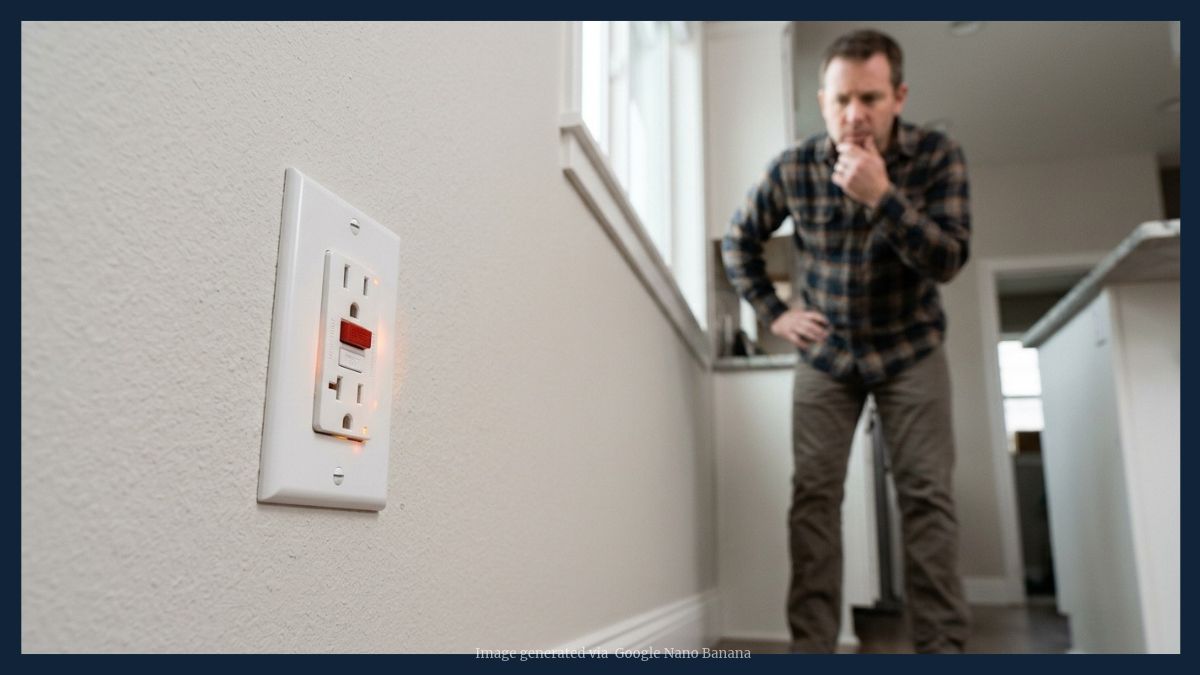
A GFCI outlet that keeps tripping is usually detecting an electrical current leak, also called a ground fault. Common causes include moisture inside an outlet or electrical box, a faulty appliance, damaged wiring, a problem with another outlet on the same protected circuit, or a worn-out GFCI device.
- GFCI stands for ground-fault circuit interrupter. It helps protect people from electric shock.
- A GFCI trips when it detects an imbalance between outgoing and returning electrical current.
- Moisture, faulty appliances, damaged wiring, and worn-out outlets are common causes.
- The problem may be at another outlet or device protected by the same GFCI.
- A GFCI that trips with nothing plugged into its receptacle may still have a fault elsewhere on the circuit.
- Do not repeatedly reset the outlet or bypass its protection.
- If the cause is unclear or the GFCI continues tripping, have a qualified electrician inspect it.
What is a GFCI outlet and why does it trip?
A ground-fault circuit interrupter, or GFCI, is an electrical safety device designed to reduce the risk of electric shock.
Unlike a standard outlet, a GFCI continuously monitors the electrical current flowing through a circuit. Under normal conditions, the current traveling out through the hot conductor should closely match the current returning through the neutral conductor.
If the device detects a difference, it assumes that some current may be escaping through an unintended path. That path could involve damaged insulation, water, an appliance, or a person.
The GFCI quickly interrupts power to reduce the risk of serious electric shock.
This is why a GFCI that repeatedly trips should not simply be reset without investigating the cause. The device may be responding correctly to an electrical problem.
7 common reasons a GFCI outlet keeps tripping
1. Moisture inside or around the outlet
Moisture is a common reason GFCI outlets trip, particularly in bathrooms, kitchens, garages, basements, and outdoor locations.
Water can create an unintended path for electrical current. If moisture reaches electrical contacts, wiring connections, or connected equipment, the GFCI may detect a ground fault and shut off power.
Possible sources include:
- Rain entering an outdoor electrical box
- Condensation inside an outlet enclosure
- Water splashing near a kitchen or bathroom receptacle
- Leaking pipes or plumbing connections
- Sprinklers spraying an outdoor outlet
- Damp extension cords or electrical equipment
An outdoor GFCI that trips after rain may have a damaged weatherproof cover, a poorly sealed enclosure, or moisture inside connected equipment.
What to do: Stop using the affected outlet. Do not touch or open a wet electrical enclosure, and do not attempt to dry its internal components with a hair dryer or other appliance. Have an electrician inspect the outlet and enclosure before restoring power.
2. A faulty appliance is causing a ground fault
Sometimes the GFCI is functioning properly, but an appliance connected to it has an electrical fault.
Appliances contain wiring, insulation, motors, heating elements, and electronic components. If any of these deteriorate or become damaged, a small amount of current may escape its intended path.
Examples of equipment that may cause a GFCI to trip include:
- Washing machines
- Refrigerators and freezers
- Dishwashers
- Hair dryers
- Electric kettles
- Water pumps
- Power tools
- Outdoor electrical equipment
A faulty appliance may trip the GFCI immediately when plugged in or only when a particular function starts operating.
For example, an appliance with a damaged heating element or motor may cause a trip when that component activates.
What to do: If the appliance and surrounding area are completely dry and there are no signs of damage, unplugging equipment may help identify whether an appliance is involved. Do not touch wet, damaged, hot, or sparking equipment. Do not reconnect a suspected faulty appliance to test it again. Have the appliance inspected or repaired before using it.
3. Damaged electrical wiring or insulation
Electrical wiring is protected by insulation that prevents current from escaping its intended path.
Over time, insulation can deteriorate because of age, excessive heat, physical damage, pests, or poor installation. Wiring may also become damaged during renovation work or when nails and screws penetrate a wall.
When current escapes through damaged insulation, the GFCI may detect the imbalance and trip.
Possible warning signs include:
- Repeated GFCI trips without an obvious appliance-related cause
- Flickering lights
- Burning or unusual electrical odors
- Buzzing or crackling sounds
- Discolored outlets or switches
- Other electrical devices behaving inconsistently
A wiring fault does not always produce visible damage. The problem may be concealed inside a wall, junction box, or electrical enclosure.
What to do: Do not remove the outlet cover or attempt to inspect wiring inside the wall. Leave the affected circuit unused and arrange for an electrician to locate the fault.
4. Another outlet or device on the same circuit has a problem
One reason GFCI troubleshooting can be confusing is that the problem may not be located at the outlet that keeps tripping.
A GFCI receptacle can be wired to protect additional outlets and devices farther along the same circuit. These are commonly called downstream outlets.
For example, a GFCI outlet in a garage may also protect another receptacle farther down the wall. If the second receptacle or something connected to it develops a ground fault, the first GFCI may trip.
This can happen even when nothing is plugged directly into the GFCI outlet itself.
What to do: Notice which other outlets or devices lose power when the GFCI trips. This information can help an electrician identify the protected circuit. Do not remove outlet covers or attempt to trace wiring connections yourself.
5. The GFCI outlet is worn out or defective
Like other electrical components, GFCI receptacles can deteriorate over time.
The internal sensing mechanism, switching components, and electrical connections may eventually fail. A damaged or aging GFCI may trip unexpectedly, refuse to reset, or fail its built-in test.
However, it is important not to assume that the outlet is defective simply because it keeps tripping. It may be detecting a genuine ground fault elsewhere on the circuit.
What to do: If the GFCI continues tripping after an electrician has ruled out other problems, the device may need replacement. Use a properly rated replacement installed according to the manufacturer’s instructions and applicable electrical requirements.
6. Multiple devices are contributing to cumulative leakage current
Some electrical equipment naturally produces small amounts of leakage current through its internal components and filters.
When several devices are connected to the same GFCI-protected circuit, their leakage currents can accumulate. In certain situations, the combined leakage may be enough to cause the GFCI to trip.
This may be more noticeable when several electronic devices, motors, or appliances operate simultaneously.
It does not necessarily mean that every connected appliance is defective. However, the circuit needs to be assessed to determine whether an individual device or the combined leakage is responsible.
What to do: Make a note of which devices were operating when the trip occurred. An electrician can measure leakage current and determine whether an appliance, circuit condition, or combination of equipment is responsible.
7. Incorrect wiring or an installation problem
A GFCI may trip repeatedly because of incorrect wiring or a problem introduced during installation or electrical repairs.
Examples include:
- Incorrect connections at the GFCI’s LINE and LOAD terminals
- A neutral connection shared or connected improperly
- An unintended connection between neutral and ground downstream
- Damaged wiring during renovation work
- Incorrect replacement or installation of an electrical device
These problems can cause the GFCI to detect an imbalance even when no obvious appliance fault is present.
What to do: Do not attempt to rearrange wiring or move conductors between terminals. Have a qualified electrician inspect the installation and correct any wiring errors.
How to tell what may be causing the GFCI to trip
The timing and circumstances of a trip can provide useful clues. However, these patterns are not definitive diagnoses.
| When the GFCI trips | Possible explanation |
|---|---|
| After rain or water exposure | Moisture inside an outlet, electrical box, cord, or connected equipment |
| When a specific appliance is connected | Faulty appliance, damaged cord, or electrical leakage |
| When an appliance starts running | Possible motor, compressor, heating element, or wiring fault |
| Immediately after pressing RESET | Persistent ground fault, downstream wiring problem, or defective GFCI |
| With nothing plugged directly into the outlet | Fault elsewhere on the protected circuit or a failing GFCI |
| Randomly during normal use | Intermittent wiring fault, moisture, equipment leakage, or defective device |
| After electrical work or renovation | Possible wiring or installation problem |
Use these observations to describe the problem to an electrician rather than trying to confirm the cause through repeated testing.
What should you do when a GFCI outlet keeps tripping?
A repeatedly tripping GFCI should be treated as a potential electrical safety issue.
Step 1: Stop using the affected outlet
Do not continue using the outlet or repeatedly press RESET to restore power.
If an appliance is connected, do not touch it if there is moisture, visible damage, heat, smoke, or sparking. Keep people away from the affected area.
Step 2: Switch off the circuit if it is safe
If you can safely identify and reach the corresponding circuit breaker, switch it off.
Do not approach an electrical panel that is smoking, sparking, hot, visibly damaged, or surrounded by water. Move away and contact emergency services if there is an immediate fire or electrical hazard.
Step 3: Look for visible warning signs from a safe distance
Without touching or opening the outlet, check for obvious signs such as:
- Cracked or discolored outlet covers
- Melted plastic
- Water around the outlet
- Burning smells
- Smoke or sparks
Do not remove the faceplate or insert tools into the receptacle.
Step 4: Make a note of what happened before the trip
Record whether the GFCI tripped after rain, when a particular appliance was operating, or after using water nearby.
Also note whether other outlets or devices lost power at the same time.
These observations can help an electrician narrow down the source without requiring you to perform electrical tests.
Step 5: Arrange an electrical inspection
If the GFCI continues to trip, refuses to reset, or has no obvious explanation, contact a qualified electrician.
The electrician can inspect the receptacle, test the protected circuit, check connected equipment, and identify whether the problem is caused by moisture, wiring, an appliance, or the GFCI itself.
Why does my GFCI outlet keep tripping with nothing plugged in?
A GFCI can trip even when nothing is plugged directly into its receptacle.
There are several possible explanations:
- A downstream outlet has a fault: Another outlet protected by the GFCI may have damaged wiring, moisture, or faulty connected equipment.
- The circuit wiring is damaged: Current may be escaping through deteriorated insulation or an incorrect connection.
- Moisture is present elsewhere: Water inside another outlet box, junction box, or connected electrical enclosure may cause a ground fault.
- The GFCI is defective: Its internal components may be failing and causing repeated trips.
The absence of a plugged-in appliance does not prove that the circuit is safe.
If the GFCI trips with nothing connected directly to it, do not keep resetting it. Have an electrician inspect the entire protected circuit.
Why won’t my GFCI outlet reset?
A GFCI that refuses to reset may still be detecting a fault or may not be receiving power correctly.
Possible reasons include:
- An active ground fault is still present.
- Moisture remains inside the outlet or connected equipment.
- A downstream outlet or device has an electrical problem.
- The circuit breaker has tripped.
- The GFCI itself has failed.
- There is an installation or wiring problem.
Some GFCI devices also include self-testing features that prevent them from resetting or supplying power when the device detects an internal failure.
Do not force the RESET button or replace the GFCI with a standard outlet to restore power. The underlying cause needs to be identified first.
Can one GFCI outlet control multiple outlets?
Yes. A single GFCI receptacle can provide ground-fault protection to other outlets connected downstream.
This arrangement is common in residential electrical systems. It allows one GFCI device to protect several receptacles rather than requiring a separate GFCI at every location.
For example, a GFCI in a bathroom may protect another outlet farther along the same circuit, depending on how the electrical system is wired.
When the GFCI trips, all outlets protected by it may lose power.
If several outlets suddenly stop working, look for a tripped GFCI device in the area. If resetting it does not restore power or it trips again, stop and arrange professional inspection.
When should you call an electrician?
- The GFCI repeatedly trips without an obvious explanation.
- It trips immediately after being reset.
- It will not reset.
- It trips when nothing is plugged directly into it.
- Other outlets on the same circuit also lose power.
- You notice buzzing, crackling, burning smells, or discoloration.
- The outlet has been exposed to water.
- The problem began after electrical repairs or renovation work.
Treat smoke, sparks, flames, or visible melting as an urgent hazard. Move away, leave the area if necessary, and contact emergency services or the fire department.
What will an electrician check?
An electrician may:
- Inspect the GFCI receptacle for physical damage and signs of overheating.
- Test whether the GFCI operates correctly.
- Check the wiring connections and circuit configuration.
- Inspect downstream outlets and electrical enclosures.
- Test connected appliances and equipment when appropriate.
- Measure leakage current to identify possible ground faults.
- Replace defective components or repair damaged wiring.
The electrician should identify the reason for repeated tripping rather than simply replacing the outlet and assuming the problem is solved.
Can you replace a GFCI outlet with a regular outlet?
No. Replacing a GFCI with a standard outlet simply to stop repeated tripping removes an important layer of electrical protection.
GFCI protection is required in certain locations under U.S. electrical safety rules, including many areas where electricity and water may come into contact. Requirements depend on the location, installation, and applicable code edition.
If the GFCI is defective, it should be replaced with an appropriate GFCI device. If it is detecting a genuine electrical fault, that fault must be corrected rather than bypassed.
Never tape down the RESET button, disable the device, or install a standard receptacle as a workaround.
Frequently asked questions
A GFCI may trip when it detects a ground fault, including one caused by a faulty appliance or moisture. However, repeated or unexplained tripping should not be considered normal. The cause should be investigated.
Yes. Rainwater can enter a damaged or poorly sealed outdoor electrical box and create an unintended path for current. Damaged weatherproof covers, seals, cords, or connected equipment may also contribute.
A refrigerator may have an electrical fault involving its compressor, wiring, insulation, or other internal components. It may also produce leakage current that contributes to a trip. Do not repeatedly reconnect the refrigerator to test it. Have the appliance and electrical circuit assessed.
GFCIs are primarily designed to reduce the risk of electric shock by detecting ground faults. They can also interrupt certain electrical conditions that might otherwise contribute to overheating or fire.
Follow the manufacturer’s instructions for testing. Many manufacturers recommend testing GFCI receptacles monthly using the built-in TEST and RESET buttons.
Moisture and condensation can contribute to ground faults, particularly when water reaches electrical components or connected equipment. High humidity alone does not prove that an outlet will trip, but damp conditions can increase the risk of moisture-related electrical problems.
No. Repeatedly resetting a GFCI without identifying the cause can expose people to an unresolved electrical hazard. Stop using the affected outlet and arrange an inspection if the problem continues.
Sources and references:
