
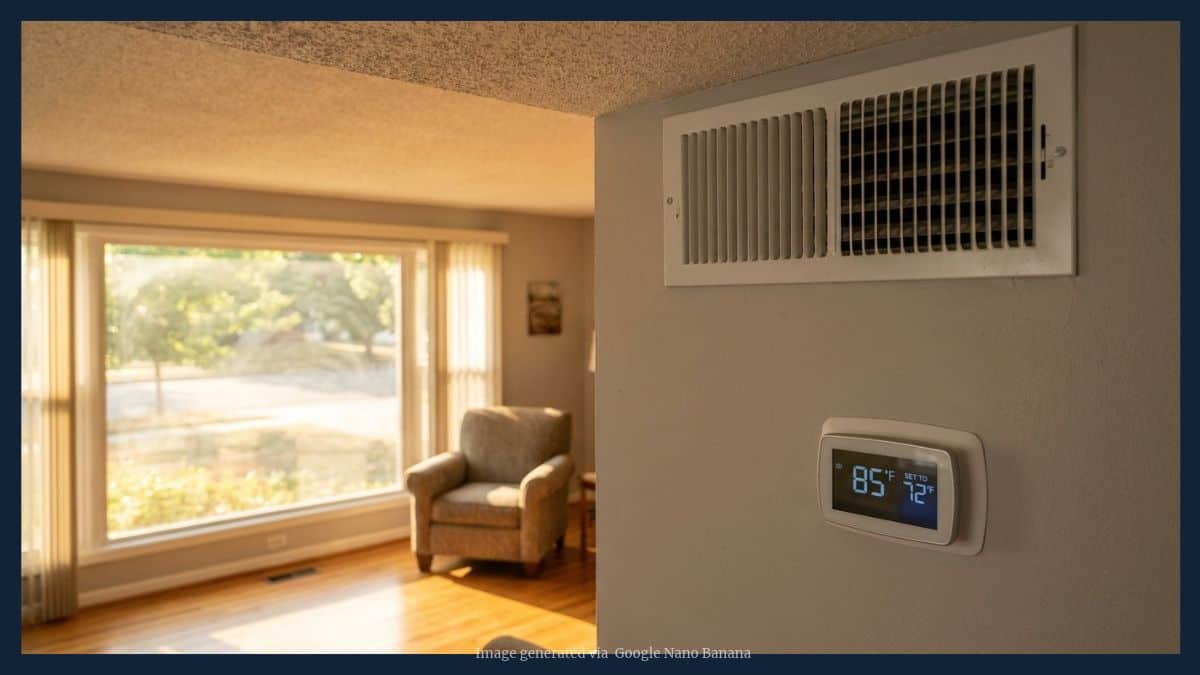
If your AC runs continuously but your house stays warm, the problem could be a dirty air filter, incorrect thermostat setting, blocked outdoor unit, frozen evaporator coil, refrigerant leak, or malfunctioning HVAC component. Sometimes the air conditioner is working but cannot keep up with the heat entering your home.
An air conditioner that runs without cooling the house may have restricted airflow, incorrect thermostat settings, dirty coils, a refrigerant problem, leaking ductwork, or a failing component. Check the thermostat, replace a dirty disposable filter with the correct type, and make sure supply vents and the outdoor unit are not blocked. If you see ice on the refrigerant lines or indoor coil, turn cooling off and arrange an inspection. Do not open electrical panels or attempt refrigerant repairs yourself.
Why is my AC running but not cooling?
Turn off cooling if you see ice on the indoor coil or refrigerant lines, hear unusual electrical buzzing or grinding, or smell something burning. Do not touch exposed wiring, open electrical compartments, chip ice off the coil, or attempt to add refrigerant. If you see smoke or suspect an electrical fire, leave the affected area and contact emergency services as appropriate.
1. The thermostat settings are incorrect
Before assuming the AC is broken, check the thermostat. A setting that looks correct at first glance can cause the system to run in a way that does not cool the house as expected.
For example, the thermostat may be set to Fan On instead of Auto. In Fan On mode, the indoor blower can continue circulating air even when the compressor is not actively cooling. The air coming from the vents may then feel less cool between cooling cycles.
The temperature setting may also be too high, the system may be in the wrong operating mode, or a thermostat sensor may be reading the room incorrectly.
Signs to look for:
- The thermostat is set to Fan On.
- The system is set to Heat or Fan instead of Cool.
- The displayed room temperature does not match how the room feels.
- The AC runs, but the air from the vents is not consistently cool.
- The thermostat display is blank or shows a warning.
What to do:
- Set the thermostat to Cool.
- Set the fan to Auto, if that option is available.
- Lower the target temperature a few degrees below the current room temperature.
- Check whether the thermostat display shows a cooling demand or an error.
- Consult the thermostat manual if the settings do not respond as expected.
Give the system time to respond according to the manufacturer’s instructions. Some systems have built-in compressor delays that prevent immediate restarting.
If the thermostat is set correctly but the house continues to warm up, investigate the other possible causes below.
2. The air filter is dirty or clogged
A dirty air filter can restrict airflow through a central air-conditioning system. When insufficient air passes through the indoor coil, cooling performance may decline and the coil may become cold enough to freeze under certain conditions.
The system may continue running because the thermostat is still calling for cooling, even though the restricted airflow prevents it from cooling the house effectively.
ENERGY STAR recommends checking HVAC filters monthly during periods of heavy use and replacing them when dirty. The appropriate replacement interval depends on the filter, equipment, household conditions, and manufacturer’s instructions.
Signs of a dirty filter:
- Airflow from several supply vents feels weaker than usual.
- The filter is visibly covered in dust.
- Some rooms take longer to cool than before.
- The AC runs for extended periods without reaching the thermostat setting.
- Ice appears on the indoor coil or refrigerant line.
A dirty filter is one possible explanation for weak airflow, but it is not the only one. A blower problem, blocked return grille, dirty coil, or duct restriction can produce similar symptoms.
What to do:
- Turn the system off before accessing the filter, following the manufacturer’s instructions.
- Locate the filter in the return-air grille, air handler, or designated filter compartment.
- Inspect the filter and replace it if it is disposable and dirty.
- If it is reusable, clean it only as instructed by the manufacturer and allow it to dry completely before reinstalling it.
- Install the correct size and type, following the equipment manufacturer’s recommendations.
Do not install a filter with a higher resistance than the system is designed to handle simply because it promises more filtration.
If airflow does not improve after replacing a dirty filter, the system may have another restriction or mechanical problem.
3. The outdoor unit is blocked or dirty
Central air conditioners need to release heat outdoors. The outdoor condenser unit contains a coil and fan that help transfer heat from the refrigerant into the outdoor air.
If the outdoor unit cannot move enough air, the AC may struggle to remove heat from the house. The indoor system can continue operating while cooling performance drops.
Leaves, grass clippings, weeds, dirt, and objects placed too close to the unit can obstruct airflow. A dirty condenser coil or malfunctioning outdoor fan can also reduce performance.
Signs to look for:
- The outdoor unit is surrounded by vegetation or stored items.
- Leaves or debris cover parts of the unit.
- The outdoor fan is not operating when the system should be cooling.
- The house remains warm even though the indoor blower is running.
- Cooling performance has gradually declined.
Do not assume the unit is defective just because the fan is not running at a particular moment. Some systems have operating delays or controls that affect when components run.
What to do:
Check the area around the outdoor unit from a safe distance. Remove loose debris and vegetation that you can reach without opening the equipment or bending the fins. Follow the manufacturer’s required clearance distances.
Keep grass clippings, stored items, and other obstructions away from the unit. Do not dismantle the condenser, spray water into electrical compartments, or attempt to repair the fan motor or capacitor.
If the coil appears heavily clogged, the fan is not operating when it should, or the system makes unusual noises, contact an HVAC technician.
4. The evaporator coil is frozen
A frozen evaporator coil can prevent an AC system from cooling properly, even while the blower continues to run.
The evaporator coil is the indoor component that absorbs heat from the air passing through it. Under certain conditions, its temperature can fall below freezing, allowing ice to accumulate. That ice further restricts airflow and interferes with heat transfer.
Restricted airflow from a dirty filter is one possible trigger. Other causes include a dirty evaporator coil, blower problems, or an issue with the refrigerant circuit.
Signs of a frozen coil:
- Ice is visible on the refrigerant line near the indoor unit.
- Airflow from the vents becomes weak.
- The AC runs but the indoor temperature keeps rising.
- Water appears around the indoor unit after the ice melts.
- Cooling performance declines suddenly.
Ice is a clue, not a complete diagnosis. You cannot reliably determine the underlying cause from the ice alone.
What to do:
Turn off the cooling function if you find ice. If your system has a separate Fan mode and the manufacturer’s instructions allow it, running the fan without cooling may help thaw the coil. Otherwise, leave the system off and arrange professional service.
Never chip away ice or use a heat gun, open flame, or other direct heat source. Do not keep restarting the cooling cycle while the coil remains frozen.
Once the ice has melted, a technician may need to check the filter, blower, evaporator coil, and refrigerant system to determine why freezing occurred.
5. The AC has a refrigerant leak or refrigerant problem
Refrigerant circulates through the air conditioner and transfers heat between the indoor and outdoor coils. If the system has an incorrect refrigerant charge or a leak, its ability to cool the house can be reduced.
A refrigerant problem may cause long run times, poor cooling, or ice on the indoor coil. However, these symptoms can also occur with airflow restrictions and other faults.
Refrigerant is not normally consumed like fuel. If a system repeatedly needs refrigerant added, the technician should investigate whether a leak or another problem is present.
Signs that may point to a refrigerant problem:
- The AC runs for long periods but produces inadequate cooling.
- Ice forms on the indoor coil or refrigerant lines.
- Cooling performance has declined despite a clean filter.
- A technician identifies a leak or abnormal refrigerant measurements.
Do not diagnose low refrigerant based on warm air alone. Proper diagnosis requires appropriate equipment and measurements.
What to do:
Arrange an HVAC inspection if refrigerant trouble is suspected. A qualified technician can assess system performance, check for leaks, repair the underlying issue when necessary, and charge the system according to manufacturer specifications.
Do not buy refrigerant for a do-it-yourself recharge or open refrigerant lines. Refrigerants can present safety risks, and improper servicing can damage equipment.
The U.S. Environmental Protection Agency advises homeowners to have technicians locate and repair refrigerant leaks rather than repeatedly topping off a leaking system.
6. Leaking or damaged ductwork is losing cool air
Your AC may be cooling the air properly at the indoor unit while much of that conditioned air fails to reach the rooms.
In a ducted system, air travels through supply ducts to the rooms and returns through return ducts to the equipment. Leaks, disconnected joints, damaged insulation, or restricted ducts can reduce airflow and make cooling uneven.
Duct problems are particularly worth considering when the AC seems to cool one area reasonably well but leaves other rooms hot.
Signs of a ductwork problem:
- Some rooms are consistently warmer than others.
- Airflow is weak from particular vents.
- You notice damaged or disconnected ductwork in an accessible area.
- The system runs for long periods without cooling the whole house.
- Certain rooms become uncomfortable when the AC is operating.
Uneven temperatures do not automatically prove a duct leak. Insulation, sun exposure, closed dampers, room layout, and equipment sizing can produce similar symptoms.
What to do:
Check that supply and return vents are open and not blocked by furniture, rugs, or curtains. Look for visible damage to accessible ductwork without entering unsafe attic or crawl spaces.
Do not seal ductwork with ordinary cloth-backed household duct tape. Use suitable materials and methods for HVAC duct sealing, or have a qualified professional perform the work.
If several rooms have poor airflow, ask an HVAC technician to inspect the duct system and verify airflow. Fixing duct leaks or restrictions may improve comfort without replacing the entire air conditioner.
7. The AC cannot keep up with the heat load
Sometimes the AC is operating, but the amount of heat entering the house exceeds what the system can remove under the current conditions.
This can happen during unusually hot weather, especially in a home with substantial sun exposure, poor insulation, leaky windows, or inadequate shading. Heat from cooking, appliances, and other indoor sources can add to the load.
An undersized system may also struggle to maintain the desired temperature. However, you should not conclude that the unit is too small simply because it runs continuously.
Signs the system may be struggling with the heat load:
- The indoor temperature rises during the hottest part of the day.
- The house cools more effectively in the evening.
- Rooms with large sunny windows are warmer than shaded rooms.
- The AC has difficulty maintaining the set temperature during extreme heat.
- Cooling problems persist despite normal airflow and maintenance.
What to do:
Close blinds or curtains on sun-exposed windows during the hottest part of the day. Keep exterior doors and windows closed while cooling, unless ventilation is specifically needed for safety or another reason. Reduce unnecessary indoor heat from cooking and appliances when practical.
Check for obvious gaps around doors and windows, and address insulation or weatherstripping problems where appropriate.
If the system consistently cannot maintain comfortable temperatures, ask an HVAC professional to evaluate its capacity, airflow, ductwork, and the home’s heat load. A properly performed load calculation is more reliable than choosing a larger unit based only on square footage.
8. A blower, compressor, capacitor, or other component is failing
An air conditioner has several electrical and mechanical components that must work together to cool the home. A failure in one component may allow some parts of the system to run while preventing effective cooling.
For example, the indoor blower may circulate air even if the compressor is not operating. Alternatively, a failed capacitor, motor, control board, or other component may prevent the outdoor equipment from operating correctly.
Clues that a component may be failing:
- The indoor blower runs, but the outdoor unit appears inactive.
- The outdoor unit repeatedly starts and stops.
- You hear unusual buzzing, clicking, grinding, or rattling.
- The circuit breaker trips repeatedly.
- The system suddenly stops cooling after working normally.
These symptoms do not identify a specific failed component. Electrical faults can be dangerous, and similar symptoms can arise from different causes.
What to do:
Check the thermostat and look for a clearly identified tripped breaker only if you can do so safely. If a breaker trips again, do not keep resetting it. Leave the system off and arrange professional service.
Do not remove electrical access panels, touch capacitors, bypass safety switches, or attempt to test live components. Capacitors can retain a dangerous electrical charge even after equipment is switched off.
If the system is making unusual electrical noises or has a burning smell, stop operating it and seek professional help.
What your AC symptoms May mean
Use these observations to decide what to check next. They are clues, not confirmed diagnoses.
| What You Notice | Possible Causes | Recommended Next Step |
|---|---|---|
| Weak airflow from most vents | Dirty filter, blocked return, blower issue, or frozen coil | Check the filter and visible airflow obstructions |
| Normal airflow but warm air | Thermostat issue, outdoor unit problem, or refrigerant fault | Verify settings and inspect the outdoor unit from a safe distance |
| Ice on refrigerant lines | Restricted airflow or refrigerant-system problem | Turn cooling off and arrange an inspection |
| One room is much warmer than others | Duct issue, closed vent, sun exposure, or insulation problem | Check vents and accessible ductwork |
| Outdoor unit is not operating | Control issue, electrical fault, or compressor-related problem | Check thermostat settings; call a technician if it persists |
| AC struggles only during extreme heat | High heat load, system capacity, or maintenance issue | Reduce heat gain and monitor performance |
| Breaker trips or burning smell occurs | Possible electrical fault | Stop using the system and seek qualified help |
What to check before calling an hvac technician
Work through this checklist without opening sealed equipment compartments or performing electrical repairs.
- Confirm the thermostat is set to Cool and the fan is set to Auto, if appropriate.
- Check the thermostat temperature setting and displayed room temperature.
- Inspect the air filter and replace it if dirty.
- Make sure supply and return vents are not blocked.
- Check the outdoor unit for obvious debris or vegetation blocking airflow.
- Look for visible ice on refrigerant lines or accessible parts of the indoor unit.
- Note whether the outdoor unit appears to operate when cooling is requested.
- Record unusual noises, repeated shutdowns, or breaker trips.
- Note whether the problem affects the entire house or only certain rooms.
- Stop troubleshooting and contact a professional if you find ice, electrical warning signs, or persistent poor cooling.
When you contact the technician, explain what you observed and when the problem began. This information can help narrow down the diagnosis.
When should you call an hvac professional?
Some problems can be addressed through basic homeowner maintenance, but others require testing and repair by a qualified technician.
- The AC continues blowing warm air after you verify the thermostat and filter.
- Ice forms repeatedly on the indoor coil or refrigerant lines.
- The outdoor fan or compressor does not appear to operate correctly.
- You suspect a refrigerant leak.
- Airflow remains weak after replacing a dirty filter.
- The system repeatedly trips a circuit breaker.
- Unusual electrical noises or burning smells occur.
- Cooling performance has declined significantly or the equipment cycles abnormally.
If the system has stopped cooling during very hot weather and someone in the home is experiencing symptoms of heat illness, prioritize getting that person to a cooler location and seeking medical assistance as appropriate. Do not wait for an HVAC repair before addressing a heat-related emergency.
How to prevent your AC from running without cooling
Routine maintenance can help reduce the risk of airflow restrictions and other avoidable problems.
Check the air filter regularly
Inspect the filter monthly during heavy-use periods and replace or clean it according to the manufacturer’s instructions. Homes with pets, construction dust, or heavy system use may need more frequent attention.
Keep the outdoor unit clear
Remove loose leaves and vegetation from around the outdoor unit, and maintain the clearances specified by the manufacturer. Have heavily soiled coils professionally cleaned when needed.
Schedule preventive maintenance
A qualified technician can inspect coils, check airflow, evaluate electrical components, assess refrigerant performance, and identify developing problems before they cause a complete loss of cooling.
ENERGY STAR recommends annual pre-season checkups and regular filter maintenance to help HVAC equipment operate efficiently.
Address uneven cooling early
If one room is consistently warmer, do not automatically lower the thermostat throughout the house. Check the vent, return-air path, sun exposure, and visible insulation or duct issues first.
Persistent uneven cooling may require an airflow assessment or a review of the home’s heating and cooling load.
Do not ignore repeated refrigerant problems
If a technician repeatedly adds refrigerant, ask whether the system has been checked for leaks and whether the underlying cause has been addressed. Repeatedly topping off a leaking system is not a substitute for proper diagnosis and repair.
Frequently asked questions
Possible causes include a dirty filter, restricted airflow, dirty coils, refrigerant problems, leaking ducts, high outdoor temperatures, or inadequate system capacity. Check basic settings and airflow first. If the system still cannot maintain the set temperature, arrange a professional assessment.
The indoor blower may be operating without effective cooling, or the system may be removing heat too slowly. Check the thermostat, filter, and vents. If the air remains warm, the outdoor unit is not operating normally, or ice appears, further troubleshooting may be needed.
If the AC is running but not cooling, start with safe checks such as the thermostat and filter. Turn off cooling if you see ice on the coil or refrigerant lines. Stop using the system if there is a burning smell, repeated breaker trips, or unusual electrical noise. Contact a qualified technician when the cause is not obvious.
Yes. A clogged filter restricts airflow and can reduce cooling performance. In some circumstances, restricted airflow can contribute to a frozen evaporator coil. Replacing a dirty filter may help, but persistent problems require further investigation.
Not necessarily. Warm air can result from thermostat settings, an outdoor-unit problem, restricted airflow, a compressor issue, or a refrigerant problem. A qualified technician should diagnose the cause before adding refrigerant.
There is no single time that applies to every home. Cooling time depends on the outdoor temperature, indoor starting temperature, humidity, system capacity, insulation, airflow, and heat entering the house. If the temperature does not gradually move toward the set point under normal conditions, investigate further rather than relying on a fixed time estimate.
Sources and References:
- ENERGY STAR. “Heat & Cool Efficiently.” Guidance on air-filter maintenance and HVAC efficiency.
https://www.energystar.gov/saveathome/heating-cooling - ENERGY STAR. “Maintenance Checklist.” Guidance on HVAC maintenance, coils, airflow, and refrigerant checks.
https://www.energystar.gov/saveathome/heating-cooling/maintenance-checklist - U.S. Department of Energy. “HomeCooling101.” Consumer guidance on common air-conditioning problems, including dirty filters, thermostat issues, and refrigerant problems.
https://www.energy.gov/sites/default/files/2016/11/f34/HomeCooling101.pdf - U.S. Environmental Protection Agency. “Homeowners and Consumers Frequently Asked Questions.” Guidance on refrigerant leaks and professional servicing.
https://www.epa.gov/ods-phaseout/homeowners-and-consumers-frequently-asked-questions - U.S. Environmental Protection Agency. “Refrigerant Safety.” Overview of refrigerant-related safety risks.
https://www.epa.gov/snap/refrigerant-safety
