
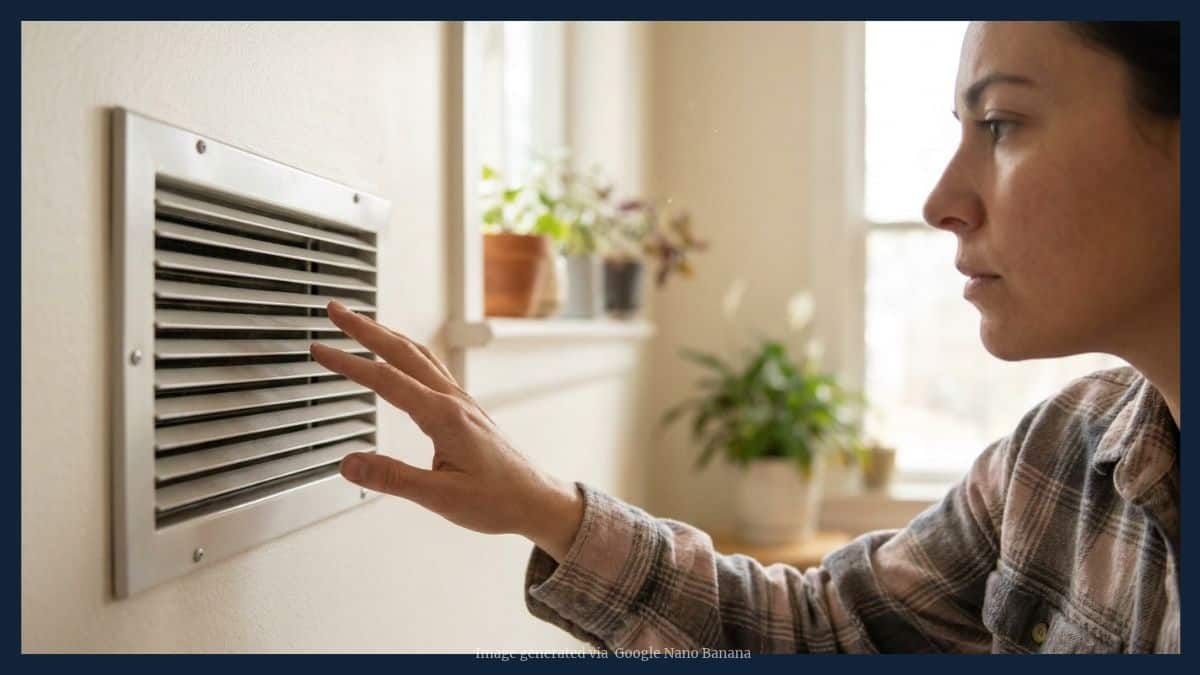
Weak airflow from your vents usually means something is restricting the air moving through your HVAC system, preventing the blower from moving enough air, or stopping air from reaching certain rooms. Common causes include a dirty air filter, blocked vents, restricted return airflow, damaged ductwork, a dirty indoor coil, or a blower problem.
- Weak airflow throughout the house may indicate a dirty filter, restricted return air, a dirty coil, or a blower problem.
- Weak airflow in one room is more consistent with a local duct restriction, a closed damper, or a room-specific airflow issue.
- A dirty air filter is one of the simplest causes to check and correct.
- Closing multiple vents is not a reliable way to redirect air and may worsen system pressure problems.
- Ice on the indoor unit, repeated system shutdowns, or electrical burning odors warrant prompt attention.
- A qualified HVAC technician can measure airflow and duct pressure to identify problems that visual checks cannot confirm.
Why is there weak airflow from my vents?
Your heating, ventilation, and air conditioning (HVAC) system relies on a blower to move air through a filter, across heating or cooling components, and into a network of ducts. The conditioned air then reaches individual rooms through supply vents, while return vents allow air to travel back toward the equipment.
When airflow becomes weak, something may be restricting this path, reducing the blower’s performance, or allowing air to escape before it reaches the room.
The first clue is where the problem occurs. If nearly every vent is weak, investigate system-wide causes. If only one or two vents are affected, a local duct or distribution problem is more likely.
Weak airflow is not the same as air that feels insufficiently cold or warm. If the air comes out strongly but does not reach the desired temperature, the issue may involve cooling or heating performance rather than airflow alone.
Common causes of weak airflow from vents
1. A dirty or restrictive air filter
An air filter traps airborne particles before they enter the HVAC equipment. Over time, dust, pet hair, and other debris accumulate on the filter and restrict the air passing through it.
A clogged filter can reduce airflow throughout the home, make the system work harder, and contribute to equipment problems.
What to look for:
- The filter appears heavily coated with dust or debris.
- Airflow has gradually weakened over several weeks.
- The system runs longer than usual without making the home comfortable.
- The filter has not been checked or changed for an extended period.
What to do: Turn off the system if your manufacturer’s instructions recommend doing so before accessing the filter. Check its size, orientation, and condition. Replace a disposable filter or clean a reusable one according to the manufacturer’s instructions.
Use the filter type and rating recommended for your equipment. A filter with a higher efficiency rating is not automatically better if the system is not designed to accommodate its airflow resistance.
ENERGY STAR recommends checking central HVAC filters monthly and replacing or cleaning them when necessary. The correct interval depends on the filter and household conditions.
2. Blocked supply vents or return grilles
Supply vents deliver conditioned air into rooms. Return grilles allow air to flow back to the HVAC equipment. Blocking either can interfere with circulation.
A couch, bed, curtain, storage box, or rug may obstruct a grille without making the problem immediately obvious.
What to look for:
- A vent is covered by furniture or curtains.
- A return grille is blocked by stored items.
- Airflow improves when an obstruction is removed.
- Some rooms feel stuffy despite the system running.
What to do: Move furniture and other objects away from supply and return grilles. Make sure the vent louvers are open and that movable register controls are not accidentally closed.
Avoid closing many supply vents in an attempt to force more air into other rooms. This can disrupt the system’s designed airflow and may increase duct pressure.
3. Restricted return airflow
Your HVAC system needs a sufficient path for air to return to the equipment. If return airflow is restricted, the blower may struggle to move the intended volume of air through the system.
Possible causes include blocked return grilles, undersized return ducts, or ductwork that has become damaged or disconnected.
What to look for:
- Airflow feels weak at most supply vents.
- The system sounds unusually strained or noisy.
- The problem continues despite installing a clean, correctly sized filter.
- Certain rooms become stuffy, especially when interior doors are closed.
What to do: Check that accessible return grilles are clear. If the issue persists, ask an HVAC technician to evaluate the return-air pathway and measure system pressure. An undersized or poorly designed return system generally requires more than routine filter maintenance to correct.
4. Leaking, disconnected, or crushed ductwork
Ducts carry conditioned air from the HVAC equipment to each room. If a duct develops a gap, disconnects at a joint, or becomes crushed, less air may reach the intended vent.
This is especially relevant when one room or one section of the home suddenly receives much less air than before.
What to look for:
- One room has weak airflow while nearby rooms feel normal.
- A problem begins after renovation, construction, or work in an attic or crawlspace.
- Some rooms become unusually hot or cold.
- Accessible ductwork looks crushed, separated, or visibly damaged.
What to do: Inspect only ductwork that is safely accessible. Do not enter an unsafe attic or crawlspace, climb on unstable surfaces, or dismantle equipment to investigate.
A technician can inspect the affected duct branch, test for leakage, and repair or replace damaged sections. Sealing alone will not fix a crushed or disconnected duct.
5. A dirty indoor evaporator coil
In an air conditioner or heat pump operating in cooling mode, the evaporator coil absorbs heat from indoor air. Dust and other buildup on the coil can restrict airflow. In some cases, the coil may also freeze, creating an additional obstruction.
A dirty coil is not always visible to a homeowner because it is located inside the equipment.
What to look for:
- Airflow remains weak even with a clean filter.
- Cooling performance has deteriorated.
- The system runs for long periods.
- Ice forms on accessible refrigerant lines or around the indoor unit.
What to do: If you see ice, turn off cooling and arrange service. Follow the equipment manufacturer’s instructions for whether the fan should remain on. Do not chip ice off the coil or use tools to remove it.
A technician can inspect the coil and determine whether the cause is dirt, a refrigerant-related problem, inadequate airflow, or another fault. Do not assume that adding refrigerant is the solution.
6. A blower motor or fan problem
The blower moves air through the HVAC system. If its motor, fan wheel, electrical components, or controls malfunction, airflow may drop across multiple rooms.
This is more likely when the problem affects the whole house, starts suddenly, or is accompanied by unusual sounds.
What to look for:
- Little or no air comes out even though the system appears to be running.
- The blower makes grinding, rattling, or squealing noises.
- Airflow becomes intermittent.
- A filter change and unobstructed vents do not improve the situation.
What to do: Check the thermostat settings and visible air filter, but leave the blower, wiring, electrical components, and internal panels to a qualified technician. A blower issue can require electrical testing and equipment-specific diagnosis.
7. A closed or malfunctioning duct damper
Some homes have dampers that regulate airflow to different parts of the duct system. Zoned HVAC systems may use motorized dampers to direct air according to thermostat demand.
If a damper is closed, stuck, or incorrectly adjusted, certain rooms may receive less air than intended.
What to look for:
- One area has weak airflow while other rooms receive normal or unusually strong airflow.
- The issue affects a particular floor or zone.
- The problem begins after ductwork changes or system servicing.
What to do: Check the normal controls available to you, such as the thermostat for each zone. Do not force a stuck damper or make undocumented adjustments to balancing controls. A technician can determine whether the damper, actuator, or zone control is working correctly.
8. An airflow problem caused by system design or installation
Sometimes the equipment itself is operating, but the duct system or installation does not deliver the airflow the home needs.
Possible issues include undersized ducts, poorly balanced branches, inappropriate equipment settings, or a system that was not properly matched to the house.
These problems may become noticeable after an HVAC replacement, a renovation, or a change in how rooms are used.
What to look for:
- Certain rooms have always received weak airflow.
- The problem began after new HVAC equipment was installed.
- The system struggles to maintain comfortable temperatures despite routine maintenance.
- The same airflow complaints return after repeated repairs.
What to do: Ask a qualified HVAC contractor to assess system airflow, duct sizing, pressure, and equipment setup. ENERGY STAR recommends verifying that system airflow meets the equipment manufacturer’s performance specifications rather than relying on assumptions about what should work.
How to identify the likely cause
Use the pattern of weak airflow to decide what to check first. These clues can narrow the possibilities, but they do not confirm a diagnosis.
| What you notice | Possible causes | First step |
|---|---|---|
| Airflow is weak at nearly every vent | Dirty filter, restricted return, dirty coil, blower problem | Check the filter and clear return grilles |
| Only one or two vents are weak | Closed register, damaged branch duct, local damper issue | Check the affected vents and compare nearby rooms |
| Airflow suddenly drops throughout the home | Blower fault, newly blocked filter or return, equipment malfunction | Check the filter and thermostat; arrange service if unresolved |
| Airflow gradually declines | Filter buildup, coil contamination, developing restriction | Inspect the filter and review maintenance history |
| Weak airflow accompanies ice buildup | Frozen coil or another cooling-system fault | Stop cooling and arrange professional service |
| One floor or zone receives less air | Duct imbalance, zone damper issue, duct leakage | Check zone controls and request a duct assessment |
| Airflow is weak after HVAC installation | Duct design, balancing, or equipment setup | Ask the installer to verify airflow and system configuration |
How to fix weak airflow from your vents
You can safely investigate several basic causes before arranging a service visit. Work through these checks in order rather than changing multiple settings at once.
Step 1: Check the thermostat
Confirm that the system is set to the intended mode, such as cooling or heating, and that the temperature setting should call for operation.
If the thermostat has a fan setting, check whether it is set to automatic or continuous operation. Fan behavior differs by system, so compare the setting with the manufacturer’s guidance.
A thermostat setting may explain why the fan is not running when expected, but it will not resolve a physical airflow restriction.
Step 2: Inspect the air filter
Locate the filter using your equipment manual or the markings on the filter compartment. Some systems have a filter at the air handler, while others use return grilles with built-in filters.
If the filter is dirty, replace or clean it as instructed. Make sure the replacement has the correct dimensions and is installed in the direction shown by the airflow arrow.
Do not operate the system without a required filter as a troubleshooting shortcut. The filter helps protect internal components from dirt.
Step 3: Clear supply and return vents
Walk through the house and check all accessible vents. Move furniture, curtains, rugs, and stored items away from them.
Make sure supply registers are open. Do not assume a return grille is a supply vent; return grilles draw air back toward the system and may not produce a noticeable stream of air.
Step 4: Compare airflow in different rooms
With the system operating normally, compare several supply vents. You do not need specialized equipment for this initial observation.
Record whether airflow is weak everywhere, limited to one room, or reduced on a particular floor. Also note whether the problem is new or longstanding.
This simple comparison can help a technician distinguish a likely system-wide issue from a localized duct problem.
Step 5: Look for obvious, safely accessible duct damage
If ductwork is visible from a safe, accessible location, look for obvious separation, crushing, or damage. Do not remove insulation, dismantle duct connections, or enter hazardous spaces to continue the inspection.
If you find damage or suspect that air is escaping into an attic or crawlspace, arrange a duct inspection.
Step 6: Stop if the problem suggests equipment damage
Do not keep restarting the system or repeatedly changing settings if airflow remains very weak. Stop cooling if ice forms and seek professional advice. If you smell electrical burning, switch off the system if it is safe to do so and arrange urgent service.
If you have completed the basic checks and airflow is still poor, the next step is usually professional testing rather than more trial and error.
When should you call an HVAC professional?
- Airflow remains weak after checking the filter and vents.
- Most or all rooms receive little air.
- One room or zone remains significantly different from the others.
- You notice ice on the indoor unit or refrigerant lines.
- The blower makes unusual noises or stops working reliably.
- The system repeatedly shuts down or cannot maintain the set temperature.
- You suspect damaged ducts or a problem with the installation.
- Your energy bills rise while comfort declines and usage has not changed significantly.
A technician may inspect the filter and coil, evaluate the blower, check dampers, inspect duct connections, and measure airflow or static pressure. Depending on the findings, additional electrical or refrigerant-system testing may be appropriate.
Should you hire a professional?
For a dirty filter, an obstructed vent, or an incorrect thermostat setting, a homeowner can often resolve the issue without a service call. However, persistent weak airflow can point to problems that are difficult to identify by sight alone.
A qualified HVAC professional is the better choice when the cause may involve internal components, electrical parts, a frozen coil, duct design, or system pressure. Ask for an explanation of the diagnosis and the measurements or observations supporting the recommended repair before approving expensive work.
If the problem appears limited to one room, ask whether the technician will inspect that room’s branch duct and damper rather than assuming the entire HVAC system needs replacement.
How to prevent weak airflow in the future
A few routine habits can reduce the risk of airflow problems and help identify developing issues earlier.
- Check the air filter monthly. Replace or clean it when needed, following the filter and equipment instructions.
- Keep vents clear. Avoid placing furniture or other objects directly over supply registers and return grilles.
- Schedule routine HVAC maintenance. Ask a technician to inspect the blower, coils, controls, and condensate drainage as appropriate for your system.
- Pay attention to changes. Notice when a room becomes harder to heat or cool, or when airflow suddenly drops.
- Inspect accessible ductwork after renovations. Work in attics, ceilings, and crawlspaces can sometimes disturb duct connections.
- Keep records of recurring problems. Note which rooms are affected, when the issue started, and whether the filter was recently changed.
Routine maintenance cannot prevent every failure, but it can help uncover restrictions and component problems before they become more disruptive.
Frequently asked questions
A dirty filter, blocked return grille, damaged duct, dirty evaporator coil, or blower problem can all reduce airflow. Start by checking the filter and clearing visible obstructions. If airflow remains weak, especially throughout the home, arrange an HVAC inspection.
A single weak vent often points to a local issue, such as a closed register, restricted or damaged branch duct, or a damper problem. Compare the affected vent with nearby vents and check for visible obstructions before arranging service.
Yes. A clogged filter can restrict the air entering the HVAC equipment and reduce airflow across multiple supply vents. Check the filter regularly and replace it with the correct type and size when necessary.
Not necessarily. Closing multiple vents can disrupt the system’s designed airflow and increase duct pressure. It is better to keep registers in their intended positions and have a technician evaluate persistent room-to-room imbalances.
Not necessarily. Refrigerant problems can affect cooling performance, but weak airflow is also associated with filters, ducts, coils, and blower components. Refrigerant levels should be assessed by a qualified technician rather than assumed from the airflow symptom alone.
The air conditioner may still be cooling the air, but a restriction or blower issue may prevent enough of that air from reaching the room. Check the filter and vents. If the problem persists or ice appears, stop cooling and arrange service.
It can. When airflow problems reduce system performance, the equipment may run longer or operate less efficiently. ENERGY STAR identifies airflow problems as a factor that can reduce HVAC efficiency, although the actual effect on an individual home’s energy use depends on the system and the fault.
Weak airflow alone is not always an emergency, but certain accompanying symptoms need prompt attention. Ice buildup calls for stopping cooling and arranging service. An electrical burning smell, smoke, or signs of an electrical hazard require immediate caution; turn off the system if safe and seek appropriate urgent assistance.
Sources and references:
- ENERGY STAR: Maintenance checklist
Guidance on HVAC maintenance, air filters, coils, blower components, and safe equipment operation. - ENERGY STAR: HVAC quality installation
Explains the importance of proper system airflow, equipment sizing, and duct evaluation. - Trane: HVAC maintenance tips
Homeowner guidance on changing filters, keeping vents clear, routine maintenance, and warning signs that call for a technician. - U.S. Department of Energy: HVAC proper installation of filters
Explains how filters protect HVAC equipment and how clogged filters can restrict airflow.
