
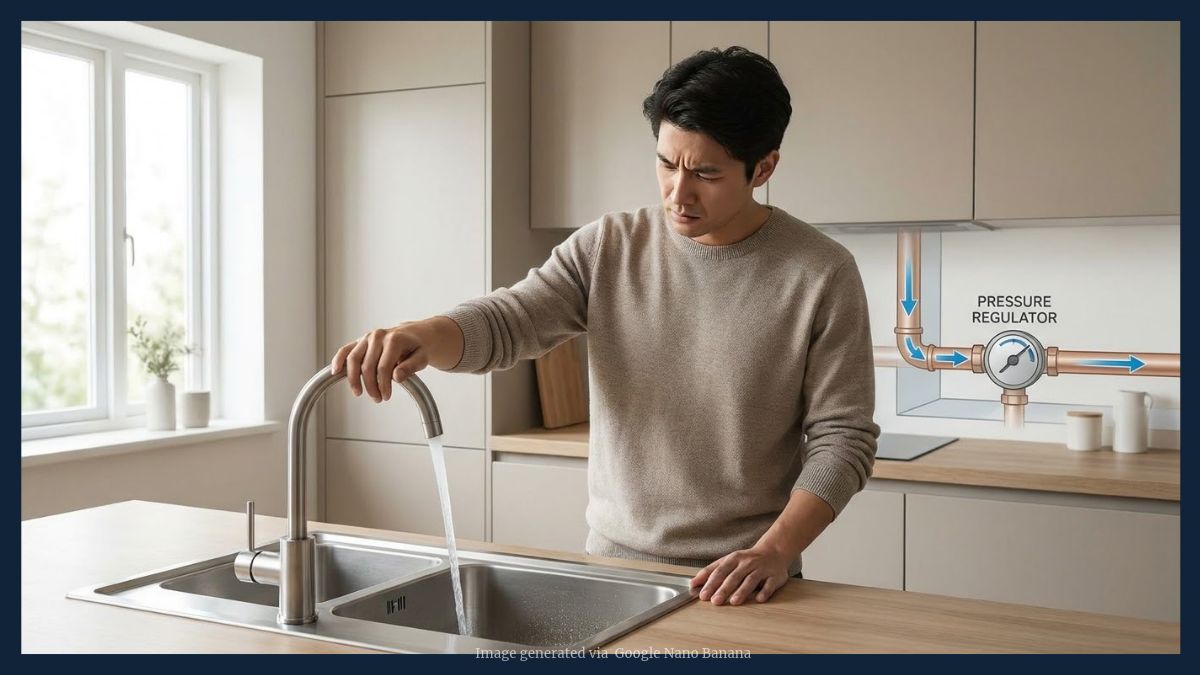
Water pressure that keeps changing can be caused by a partially blocked pipe, faulty pressure regulator, leaking plumbing, inconsistent municipal water supply, or a problem with a private well pump or pressure tank.
- Faulty pressure regulator: A malfunctioning pressure-reducing valve can cause inconsistent pressure throughout the house.
- Municipal water supply changes: Pressure may fluctuate because of utility maintenance, high demand, or problems in the local distribution system.
- Clogged pipes or fixtures: Mineral deposits, sediment, or corrosion can restrict water flow.
- Hidden plumbing leaks: Water escaping from a pipe can reduce the amount available to other fixtures.
- Well pump or pressure tank problems: Homes using private wells may experience pressure changes when the pump or tank is not operating correctly.
- Multiple fixtures running simultaneously: The plumbing system may struggle to supply enough water when several fixtures operate at once.
Common reasons your water pressure keeps changing
Water pressure is not always perfectly constant. Some variation is normal when other fixtures are being used, but repeated or significant changes may indicate a plumbing problem.
Here are the most common causes to investigate.
1. Your pressure regulator is malfunctioning
Many homes connected to a municipal water supply have a pressure-reducing valve, commonly called a pressure regulator.
Its purpose is to reduce incoming water pressure to a suitable level for the home’s plumbing system.
When the regulator becomes worn, clogged, or damaged, it may struggle to maintain consistent pressure.
You might notice that water pressure:
- Suddenly becomes stronger than usual.
- Drops while using a shower or faucet.
- Changes without an obvious reason.
- Varies significantly between different times of the day.
- Remains inconsistent even when only one fixture is operating.
A faulty regulator can affect several fixtures because it controls the incoming water supply to much of the house.
What to do:
If pressure fluctuations affect the entire home, have a plumber inspect the pressure regulator.
The plumber can measure the incoming and outgoing pressure, determine whether the valve is functioning correctly, and recommend adjustment or replacement if necessary.
Avoid adjusting an unfamiliar regulator without knowing the manufacturer’s specifications. Excessive pressure can damage plumbing components and appliances.
2. Your municipal water supply is fluctuating
If your home receives water from a public utility, the pressure may sometimes change before water reaches your property.
Possible reasons include:
- High water demand in your neighborhood.
- Water utility maintenance.
- Repairs to distribution pipes.
- Temporary supply interruptions.
- Problems with local pumping or distribution equipment.
- Changes in the operating conditions of the water network.
For example, pressure may be lower when many households use water simultaneously.
If the pressure problem affects neighboring properties as well, the cause may be outside your home’s plumbing system.
What to do:
Ask nearby households whether they are experiencing similar pressure changes.
You can also contact your water supplier to ask about maintenance work, supply interruptions, or reported pressure problems in your area.
If neighboring properties have normal pressure, have your own plumbing system inspected before assuming the utility is responsible.
3. Mineral deposits or sediment are restricting the pipes
Mineral deposits and sediment can accumulate inside plumbing components and pipes over time.
This is more likely in areas with hard water, older plumbing, or water supplies that carry sediment.
As the buildup increases, the opening through which water flows becomes smaller. This can restrict the amount of water reaching fixtures.
The resulting symptoms may include:
- Weak water flow from one or more faucets.
- Pressure that drops when multiple fixtures are used.
- Uneven pressure between different parts of the house.
- Reduced flow from older plumbing fixtures.
- Discolored water or visible particles in certain circumstances.
The location of the buildup matters. A clogged faucet aerator may affect only one fixture, while corrosion or deposits inside a main pipe can affect several areas.
What to do:
Start by checking whether the problem is limited to one faucet.
Remove and inspect the aerator, if the fixture has one. Clean it according to the manufacturer’s instructions and check whether water flow improves.
If several fixtures are affected, the restriction may be farther inside the plumbing system. A plumber can inspect the pipes and determine whether cleaning, repair, or replacement is appropriate.
Do not use aggressive chemicals to clear unknown pipe restrictions.
4. There is a hidden leak in your plumbing system
A leak can reduce the amount of water available to other fixtures.
When water escapes through a damaged pipe, loose connection, or faulty plumbing component, less water may reach the faucets and showers you are using.
The effect can become more noticeable when another fixture is operating at the same time.
Possible signs of a hidden plumbing leak include:
- Water pressure that drops unexpectedly.
- An unexplained increase in your water bill.
- Damp walls, ceilings, or floors.
- Musty odors near plumbing areas.
- Water stains or bubbling paint.
- The sound of running water when all fixtures are turned off.
Not every hidden leak causes noticeable pressure changes, but a leak should be investigated if these symptoms appear together.
What to do:
Turn off faucets, showers, washing machines, and other water-using appliances.
If your property has an accessible water meter, check whether its reading or leak indicator continues to show water use when everything is turned off. Some meters have indicators designed to reveal small flows.
If the meter continues registering water use and no appliance is operating, a leak may be present.
However, automatic appliances, irrigation systems, water storage equipment, and other connections can also use water. Make sure these are accounted for before concluding that a pipe is leaking.
If you suspect a hidden leak, arrange a plumbing inspection.
5. Your well pump or pressure tank has a problem
Homes that rely on private wells use a different water supply arrangement from homes connected to municipal systems.
A typical well system uses a pump and pressure tank to deliver water to the property.
The pressure tank stores pressurized water and helps reduce how frequently the pump needs to switch on and off.
If the pressure tank, pressure switch, or pump develops a problem, water pressure may become inconsistent.
Common causes include:
- Incorrect pressure switch settings.
- A worn or malfunctioning pressure switch.
- A waterlogged pressure tank.
- A failing well pump.
- A blocked well filter or intake.
- A problem with the well’s water supply.
Signs of a well-system problem:
- Water pressure rises and drops repeatedly.
- The pump switches on and off frequently.
- Pressure falls noticeably during extended water use.
- The pump runs longer than usual.
- Water delivery becomes inconsistent throughout the house.
What to do:
Check whether the pump is cycling more frequently than usual and whether the pressure changes happen throughout the property.
Do not open electrical pump controls, adjust pressure switches, or attempt to recharge a pressure tank unless you have the necessary training.
A well contractor or qualified plumber can test the pressure switch, tank, pump, and water supply.
6. Several fixtures are using water at the same time
Your plumbing system has a limited capacity to deliver water.
When several fixtures operate simultaneously, the available flow is divided among them.
For example, running a shower while a washing machine fills or another person uses a kitchen faucet may cause the shower pressure to drop.
This can be especially noticeable in homes with:
- Small supply pipes.
- Long plumbing runs.
- Older plumbing systems.
- Undersized water supply connections.
- Limited incoming water capacity.
A temporary pressure drop during simultaneous water use does not automatically indicate a fault.
However, a significant change during ordinary household use may suggest that the plumbing system needs attention.
What to do:
Observe whether the pressure becomes stable when other fixtures and appliances stop using water.
If the pressure consistently drops whenever more than one fixture operates, ask a plumber to assess the supply pipe sizing, incoming pressure, and plumbing layout.
Do not assume that increasing the pressure regulator setting will solve a capacity problem.
7. A faulty faucet cartridge or fixture valve is restricting flow
If water pressure changes at only one faucet or shower, the problem may be inside the fixture rather than the main plumbing supply.
Many modern faucets and showers use cartridges or mixing valves to control water flow and temperature.
These components can become worn, clogged with debris, or damaged.
Possible symptoms include:
- Pressure that changes only at one faucet.
- Water flow that weakens or becomes uneven.
- Sudden changes in flow when adjusting the handle.
- Hot water pressure behaving differently from cold water pressure.
- A shower that alternates between strong and weak flow.
What to do:
Check whether other fixtures have normal pressure.
If the problem is isolated to one faucet, inspect its aerator or showerhead first. If cleaning does not help, the cartridge, mixing valve, or fixture shutoff valve may need attention.
For shower valves and fixtures with complex temperature-control systems, follow the manufacturer’s instructions or have a plumber inspect them.
Why does my water pressure change when I use another faucet?
A noticeable pressure drop when another faucet is opened can indicate that the plumbing system is struggling to supply both fixtures at the same time.
When two or more fixtures operate, they draw water from the same supply network. If the incoming supply, pipe sizing, or plumbing components cannot deliver enough flow, pressure may decrease at one or more outlets.
For example:
- A shower becomes weaker when someone opens the kitchen faucet.
- The bathroom sink loses pressure when the washing machine fills.
- Water flow changes when a toilet refills.
- Two showers cannot maintain normal flow simultaneously.
A small temporary reduction may be normal, depending on the plumbing system.
However, a dramatic drop may indicate an undersized supply line, a restriction, a faulty regulator, or insufficient incoming pressure.
If the problem affects the entire house, a plumber can measure the supply pressure and assess the system’s capacity.
Why does my water pressure keep changing from hot to cold?
When pressure changes are accompanied by unexpected temperature changes, the problem may involve the water heater, mixing valve, or the way hot and cold water are supplied.
For example, opening another fixture may change the balance between hot and cold water reaching a shower.
Possible causes include:
- A faulty shower mixing valve.
- A clogged shower cartridge.
- A restriction in the hot water supply.
- A malfunctioning thermostatic mixing valve.
- An issue with the water heater or its connections.
- Unequal pressure between hot and cold water lines.
A sudden temperature change in a shower can be uncomfortable and may create a scalding risk.
What to do:
Check whether the temperature changes occur at one fixture or throughout the home.
If only one shower is affected, the mixing valve or cartridge may need inspection.
If several hot-water fixtures experience similar problems, have the water heater and hot water distribution system checked.
Do not adjust water heater safety controls simply to compensate for pressure fluctuations.
How to identify the cause of changing water pressure
Before replacing plumbing components, determine where and when the pressure changes occur.
The following checks can help narrow down the problem.
Step 1: Determine whether the problem affects the whole house
Turn on a few faucets in different areas of the property and observe their water flow.
Check:
- Kitchen faucets.
- Bathroom sinks.
- Showers.
- Outdoor taps, if available.
If pressure changes occur at several fixtures, the issue may involve the main supply, regulator, pump, or a shared pipe.
If only one fixture is affected, investigate its aerator, cartridge, or local shutoff valve first.
Step 2: Observe when the pressure changes
Pay attention to whether pressure fluctuations occur:
- At certain times of the day.
- When another faucet is opened.
- When a toilet refills.
- When the washing machine starts.
- When the water heater operates.
- When no fixtures are being used.
This pattern can help distinguish normal demand-related changes from a plumbing fault.
Step 3: Compare hot and cold water
Check whether the problem affects both hot and cold water.
If cold water pressure is stable but hot water pressure changes, the problem may be related to the hot water supply, heater connections, or mixing valve.
If both hot and cold water are affected, the issue may be farther upstream.
Be cautious when testing hot water because it can cause burns.
Step 4: Inspect accessible fixtures
Check faucet aerators and showerheads for visible sediment or mineral deposits.
A clogged aerator can reduce flow even when the rest of the plumbing system is working normally.
Clean removable components according to the manufacturer’s instructions.
If the pressure does not improve, the restriction may be inside the fixture or farther along the supply line.
Step 5: Look for signs of a water leak
Check accessible areas around:
- Under-sink plumbing.
- Toilet supply connections.
- Water heater connections.
- Exposed pipes.
- Outdoor taps and irrigation connections.
Look for moisture, corrosion, water stains, or unusual sounds.
You can also check the water meter when all water use has stopped, if one is available and accessible.
If there are signs of a leak inside a wall, ceiling, or floor, avoid opening the structure unnecessarily. A professional leak inspection may help locate the problem.
Step 6: Check the water supply with your provider
If the problem affects the whole house and nearby properties are experiencing similar symptoms, contact your water supplier.
Ask whether there are reported pressure problems, maintenance activities, or supply interruptions in your area.
If neighboring properties have normal pressure, arrange an inspection of your own plumbing system.
What your symptoms may indicate
| What you notice | Possible cause | Recommended next step |
|---|---|---|
| All faucets experience pressure changes | Main supply, regulator, or shared plumbing problem | Have incoming pressure and regulator checked |
| Only one faucet has inconsistent pressure | Clogged aerator, cartridge, or local valve | Inspect and clean the fixture |
| Pressure drops when several fixtures run | Limited supply capacity or pipe restriction | Have the plumbing system assessed |
| Pressure changes at certain times of day | Municipal supply variation or high demand | Check with the water supplier |
| Pressure fluctuates and the pump cycles frequently | Well pump, pressure switch, or tank problem | Contact a well-system professional |
| Pressure drops alongside unexplained water use | Possible plumbing leak | Check the meter and arrange leak detection |
| Hot water pressure changes but cold water remains stable | Hot water supply or mixing valve problem | Inspect the hot water system |
| Pressure suddenly becomes much stronger | Possible regulator or supply-control problem | Have pressure measured promptly |
These are diagnostic clues, not definitive diagnoses. Different plumbing systems can produce similar symptoms.
How to fix changing water pressure
The right solution depends on what is causing the fluctuation.
Some problems involve simple fixture maintenance, while others require changes or repairs to the main plumbing system.
| Problem | Possible solution | DIY difficulty |
|---|---|---|
| Clogged faucet aerator | Remove and clean the aerator | Easy |
| Dirty showerhead | Clean or replace the showerhead | Easy |
| Partially closed fixture valve | Check and fully open the appropriate valve if safe | Easy |
| Faulty pressure regulator | Inspect, adjust, or replace the regulator | Professional recommended |
| Hidden plumbing leak | Locate and repair the leak | Professional recommended |
| Restricted or corroded pipes | Clean, repair, or replace affected sections | Professional recommended |
| Faulty well pressure switch | Inspect and replace if necessary | Professional recommended |
| Waterlogged pressure tank | Diagnose and service or replace the tank | Professional recommended |
| Municipal supply fluctuation | Contact the water provider | Not a household DIY repair |
Clean a clogged faucet aerator
If only one faucet has inconsistent or weak flow, its aerator may be blocked by mineral deposits or sediment.
- Turn off the faucet.
- Remove the aerator carefully, following the fixture manufacturer’s instructions.
- Check for visible particles or buildup.
- Rinse away loose debris.
- Clean the component using a method suitable for its material.
- Reinstall it and test the water flow.
If the aerator is damaged or heavily clogged, replacing it may be easier than cleaning it.
Clean a showerhead
A showerhead can develop mineral buildup that restricts water flow.
- Check whether the showerhead can be removed safely.
- Follow the manufacturer’s cleaning recommendations.
- Remove visible debris from the spray openings.
- Reinstall the showerhead securely.
- Test the flow again.
If several fixtures are affected, cleaning the showerhead alone will not resolve the underlying problem.
Have the pressure regulator inspected
If pressure changes throughout the house, a plumber can measure the incoming water pressure and inspect the regulator.
The regulator may need adjustment, cleaning, or replacement depending on its condition.
A professional should also check whether the incoming supply itself is fluctuating. Otherwise, replacing the regulator may not solve the problem.
Repair hidden leaks promptly
If a leak is identified, the affected pipe, connection, or plumbing component needs appropriate repair.
The repair method depends on the pipe material, location, and extent of the damage.
Do not ignore small leaks simply because water is still reaching the fixtures. A leak can worsen and cause damage to walls, ceilings, flooring, or nearby building materials.
Service a well pump or pressure tank
If your home uses a private well, the pump and pressure tank should be checked by a qualified professional.
The inspection may include:
- Measuring system pressure.
- Checking the pressure switch.
- Testing the pressure tank.
- Inspecting the pump.
- Checking filters and supply restrictions.
Well systems can involve electrical components and pressurized equipment. Avoid opening control boxes or adjusting the system without proper training.
Can changing water pressure damage household plumbing?
It depends on how severe the fluctuations are and what is causing them.
A minor temporary pressure drop when another fixture is used is not necessarily harmful.
However, excessive or unstable water pressure can contribute to problems with plumbing fixtures, supply connections, appliances, and valves.
Potential warning signs include:
- Faucets that begin leaking.
- Repeated failures of flexible supply hoses.
- Water hammer or banging pipes.
- Leaking appliance connections.
- Pressure readings that are consistently higher than the plumbing system’s recommended range.
High pressure is particularly important to investigate because it can place unnecessary stress on plumbing components.
A plumber can measure static and flowing pressure to determine whether the system is operating within an appropriate range.
When should you call a professional plumber?
Some pressure problems can be traced to a dirty aerator or showerhead. Others require inspection of the water supply and main plumbing components.
- Pressure changes affect multiple fixtures.
- The pressure suddenly becomes much stronger than normal.
- You suspect a hidden leak.
- The pressure regulator appears damaged or is not maintaining stable pressure.
- Pipes make repeated banging or unusual noises.
- Water pressure keeps fluctuating despite cleaning individual fixtures.
- You notice corrosion, damp areas, or water stains around plumbing.
- Your well pump cycles unusually often or struggles to maintain pressure.
If you suspect a significant leak, shut off the appropriate water supply if you can do so safely and arrange prompt assistance.
For homes connected to municipal water, contact the water supplier if the problem appears to originate outside the property.
Should you hire a professional?
If the problem is limited to one clogged aerator or showerhead, you may be able to resolve it without professional assistance.
However, pressure fluctuations throughout the house are more complicated. The cause could be a pressure regulator, supply restriction, hidden leak, or water-system capacity problem.
A plumber can measure water pressure at different points, inspect the regulator and supply lines, and determine whether the issue originates inside or outside the property.
If you use a private well, a professional familiar with well pumps and pressure tanks is a better choice than a general fixture repair alone.
When requesting an estimate, ask whether pressure testing, leak inspection, replacement parts, and follow-up measurements are included.
Frequently asked questions
Small temporary changes can be normal, especially when multiple fixtures or appliances use water simultaneously.
However, repeated, severe, or unexplained fluctuations should be investigated. They may indicate a plumbing restriction, faulty regulator, supply issue, or leak.
Both fixtures draw water from the same supply system. If the incoming supply or plumbing network cannot deliver enough flow, pressure may decrease when another fixture is opened.
This can happen when a pressure regulator is malfunctioning, the municipal supply changes, or a private well system cannot maintain stable pressure.
Yes. Water escaping through a damaged pipe or connection can reduce the amount of water available to other fixtures.
Possible signs include pressure that changes throughout the house, unexpectedly high pressure, or a sudden drop in pressure without an obvious change in water use.
A shower can experience pressure changes because of a clogged showerhead, faulty mixing valve, inconsistent incoming supply, or changes in water use elsewhere in the house.
Yes. Mineral deposits, sediment, corrosion, or debris can restrict the amount of water moving through a pipe.
Water pressure is the force that pushes water through the plumbing system. Water flow is the amount of water delivered over a period of time.
Sources and references:
- U.S. Environmental Protection Agency: WaterSense – General guidance on household water efficiency and identifying water waste.
- U.S. Environmental Protection Agency: Fix a Leak Week – Information about identifying and addressing household leaks.
- International Association of Plumbing and Mechanical Officials (IAPMO) – Plumbing standards and technical resources relevant to water distribution systems.
- American Water Works Association (AWWA) – Water distribution and utility system resources.
- Amtrol: Well-X-Trol pressure tanks – Manufacturer information about well pressure tanks and their role in residential water systems.
