
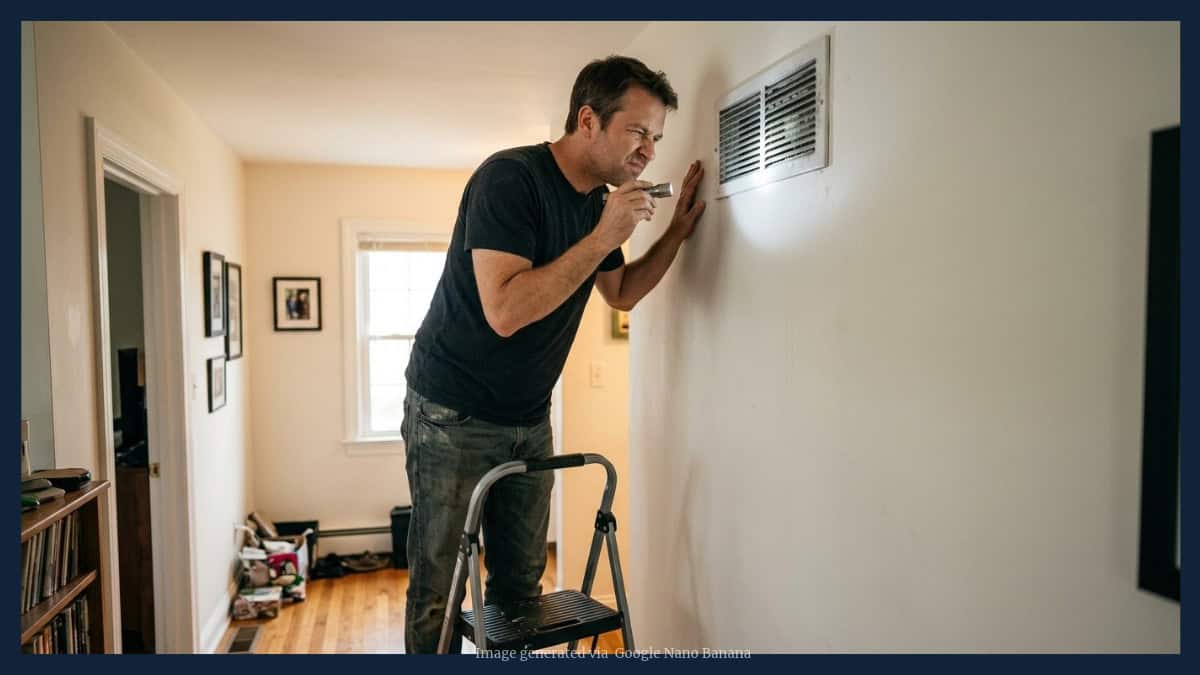
If your air conditioner smells like dirty socks, the most likely explanation is an odor-producing buildup on a damp evaporator coil, drain pan, or another component inside the system. This problem is sometimes called “dirty sock syndrome.” However, the smell alone cannot confirm the cause. A dirty air filter, standing condensate water, contaminated components, or another source of odor may also be responsible. Start by checking the accessible air filter and looking for visible signs of moisture, then arrange professional HVAC service if the smell persists.
- A sweaty, musty, or dirty-sock odor can indicate microbial buildup on damp AC components, particularly the indoor evaporator coil.
- A clogged filter, standing condensate water, or moisture problem may contribute to the smell.
- The odor alone cannot establish whether mold, bacteria, or another contaminant is responsible.
- Replacing an overdue filter and addressing moisture can help, but persistent odors may require professional cleaning or repairs.
- Stop troubleshooting if you notice a burning or electrical odor, smoke, or another sign of an immediate hazard.
A dirty-sock odor is not automatically an emergency, but some unusual smells require immediate attention.
- If you smell burning plastic, hot wiring, or a strong electrical odor, turn the system off if you can do so safely. Do not restart it until the cause has been assessed.
- If you see smoke, sparks, or signs of fire, leave the affected area and contact emergency services.
- If you suspect a natural gas leak because of a rotten-egg odor, leave the building without operating electrical switches or creating an ignition source. Contact your gas utility or emergency services from a safe location.
- Do not touch exposed wiring, open energized equipment, or reach into the blower compartment.
- If the odor is accompanied by significant respiratory irritation or other concerning symptoms, move away from the affected air and seek appropriate medical advice.
For a persistent musty or sweaty-sock odor without immediate danger, arrange an HVAC inspection rather than assuming that masking the smell will resolve the underlying issue.
What causes an air conditioner to smell like dirty socks?
Your air conditioner removes heat from indoor air. During cooling, moisture condenses on the cold indoor evaporator coil and drains into a collection pan before flowing through a condensate drain line.
That moisture is a normal part of cooling. The problem arises when moisture combines with accumulated dust and organic debris, drainage becomes restricted, or other conditions allow odor-producing contaminants to accumulate.
The main possible causes are described below.
1. Microbial buildup on the evaporator coil
The evaporator coil is one of the first components to investigate when an AC produces a persistent musty or sweaty-sock odor.
As warm indoor air passes over the cold coil, water condenses on its surface. Dust and other particles can collect on the coil, creating conditions that may support microbial growth when moisture remains present.
Some homeowners notice the smell most strongly when the air conditioner starts after being off for a while. Others notice it throughout the cooling cycle.
Possible clues include:
- A sweaty, musty, or sour odor coming from the supply vents.
- The smell returning shortly after the system is switched on.
- Odor that persists even after the accessible air filter has been replaced.
- Visible dirt or moisture around accessible parts of the indoor unit.
These observations make the evaporator coil worth inspecting, but they do not prove that microbial growth is present. Other components or sources can produce similar smells.
Carrier’s guidance on why an air conditioner smells identifies the evaporator coil and condensate drainage system as common places to investigate when unpleasant AC odors occur.
What to do: If the smell persists, ask an HVAC professional to inspect the evaporator coil, drain pan, and surrounding components. Coil cleaning may be appropriate if the technician identifies relevant buildup, but cleaning alone may not solve the problem if moisture or drainage issues remain.
2. A dirty or overdue air filter
Your AC filter captures airborne particles before they accumulate inside the HVAC system. As the filter collects dust, pet hair, and other debris, it can become dirty and restrict airflow if it is not replaced when needed.
A dirty filter is not necessarily the direct source of a dirty-sock smell. However, accumulated debris and restricted airflow can contribute to conditions that make other AC problems more likely.
Look for these clues:
- The filter appears visibly dusty or clogged.
- The odor develops alongside reduced airflow.
- The filter has not been changed according to the manufacturer’s recommended schedule.
- Dust or pet hair has accumulated around the return-air grille.
A dirty filter does not establish that the evaporator coil is contaminated. Likewise, a clean filter does not rule out a coil or drainage problem.
What to do: Check the filter if it is safely accessible. Replace a disposable filter with the correct size and type, following the equipment manufacturer’s instructions. Clean a reusable filter only as directed by its manufacturer, and allow it to dry completely before reinstalling it.
Do not install a filter that is more restrictive than your system is designed to accommodate.
If airflow remains weak or the odor continues after filter maintenance, arrange an inspection rather than repeatedly changing filters in an attempt to eliminate the smell.
3. Standing water or a problem with the condensate drain
Your AC removes humidity from indoor air, and that water needs a clear path out of the system.
If the condensate drain becomes restricted, water may collect in the drain pan or leak into nearby areas. Persistent moisture can encourage biological growth and produce unpleasant odors.
Possible warning signs include:
- Water around the indoor air handler.
- A musty smell near the unit.
- Visible standing water in an accessible area.
- A water stain on a nearby wall or ceiling.
- An AC that shuts down unexpectedly, if its installation includes a condensate safety switch.
Not every system has the same drain arrangement or safety features. Some units also have secondary drain pans or other protective measures.
Water around an indoor unit does not necessarily mean the drain is clogged. Other possible explanations include a frozen evaporator coil, a damaged drain pan, a disconnected drain line, or another equipment problem.
What to do: Look for visible water around the unit without opening the equipment cabinet. If you find a leak, persistent standing water, or a recurring drainage problem, contact an HVAC professional. Turn off the system if continued operation could worsen the leak, particularly if water is near electrical equipment.
Do not pour bleach, drain cleaner, or other chemicals into the AC unless the equipment manufacturer specifically permits the product and method. Some chemicals can damage components or create additional hazards.
The US Environmental Protection Agency’s guidance on air duct cleaning and moisture control emphasizes that moisture problems around cooling coils and condensate pans need to be addressed to prevent recurring contamination.
4. Dirt or moisture in other indoor AC components
The evaporator coil is not the only possible source of an unpleasant smell.
Dust, moisture, and organic debris may accumulate in the drain pan, blower assembly, or other components of the indoor air handler. If ductwork has a moisture problem, odors may also originate beyond the main unit.
Consider these clues:
- The odor is strongest near the indoor air handler rather than at every vent.
- You notice visible moisture, dirt, or water damage around the unit.
- The smell affects several rooms connected to the same HVAC system.
- The odor persists even after routine filter maintenance.
These clues can help an HVAC professional narrow the investigation, but they do not establish which component is responsible.
Do not assume that the entire duct system needs cleaning simply because the AC smells unpleasant. The EPA recommends duct cleaning in specific circumstances, including substantial visible mold growth in accessible hard-surface ducts or on other HVAC components, rather than treating it as a universal remedy for every odor.
What to do: Have the technician inspect the components relevant to the observed symptoms. If there is evidence of moisture or suspected biological growth, the underlying moisture source must also be addressed. Cleaning contaminated surfaces without correcting the conditions that caused the problem may allow the odor to return.
5. A different source of odor near the AC
Sometimes the smell is not coming from the evaporator coil or drain system at all.
Possible alternatives include debris near an air intake, an odor entering through outdoor air, a nearby plumbing problem, or a source within a room that becomes more noticeable when the AC circulates air.
A few observations can help:
- Does the odor occur only when the AC runs?
- Is it strongest at one vent or throughout the house?
- Does it persist when the system is off?
- Is the smell present in one room even when airflow is minimal?
If the odor persists while the AC is off, investigate other possible sources rather than assuming the equipment is responsible. Do not disable ventilation or safety systems to perform this comparison.
If the odor appears only during operation, the HVAC system remains a reasonable place to start, but the precise source may require inspection.
What to do: Note where and when the smell occurs, and share that information with an HVAC technician. If the odor is chemical, burning, or suggestive of a gas leak, follow the appropriate safety guidance instead of continuing ordinary troubleshooting.
How to identify the likely cause of the dirty-sock smell
The following comparison can help you decide what to investigate next. These are diagnostic clues, not definitive tests.
| What You Notice | Possible Explanation | Recommended Next Step |
|---|---|---|
| Musty or sweaty-sock odor coming from multiple supply vents | Evaporator coil or other shared HVAC components may be involved | Check the accessible filter and arrange an HVAC inspection if the smell persists |
| Odor accompanied by a visibly dirty filter | Filter maintenance may be overdue | Replace or clean the filter according to the manufacturer’s instructions |
| Musty odor with standing water or a nearby leak | Condensate drainage or another moisture problem may be present | Address the leak and have the drainage system inspected |
| Smell strongest near the indoor air handler | A nearby component or local moisture source may be involved | Have the relevant components inspected |
| Odor persists when the AC is off | Another household or outdoor source may be responsible | Investigate other sources without approaching hazardous areas |
| Burning, electrical, or rotten-egg odor | A potentially serious hazard may be present | Stop ordinary troubleshooting and follow the appropriate emergency or safety guidance |
Why does the smell sometimes appear only when the AC starts?
A smell that is strongest when the AC first turns on can be a useful clue. Odors may accumulate around a source while the system is off and become more noticeable when airflow begins.
However, this timing is not proof of dirty sock syndrome. A similar pattern can occur with other sources inside the equipment or nearby ductwork.
If the odor disappears quickly but returns every time the system starts, pay attention to the pattern and report it during an inspection. Repeatedly running the system to test the smell is not a substitute for finding its source.
How to get rid of the dirty-sock smell from your AC
The correct solution depends on the cause. Replacing a dirty filter may be sufficient when routine filter maintenance is the only issue, but microbial buildup or a drainage problem may require additional work.
Step 1: Check the accessible air filter
Turn the system off if required by the manufacturer’s filter-replacement instructions. Locate the filter access point and inspect the filter without opening electrical or mechanical compartments.
If the filter is dirty, replace or clean it as directed.
Make sure the replacement matches the specified dimensions and filter requirements. An incorrectly fitted filter may allow unfiltered air to bypass it, while an unsuitable restrictive filter may interfere with airflow.
Step 2: Look for visible moisture
Without removing panels or reaching into the equipment, check the area around the indoor unit for visible water, staining, or damp materials.
Do not touch electrical components or enter an attic or crawl space that is unsafe to access.
If you find standing water or an active leak, contact an HVAC professional. A technician can determine whether the cause is a blocked drain, damaged pan, frozen coil, or another issue.
Step 3: Arrange professional coil and drain inspection
If the odor continues after basic filter maintenance, ask an HVAC technician to inspect the evaporator coil, drain pan, condensate drain, and other relevant components.
The appropriate service may include cleaning, clearing drainage, repairing a leak, or correcting an airflow or moisture problem.
Evaporator coils contain delicate fins and may be difficult to access. Carrier’s evaporator coil cleaning guidance recommends professional cleaning for these components because improper handling can damage them.
Do not spray household disinfectants, fragrances, bleach, or unapproved coil cleaners into the AC. Products must be suitable for the specific equipment and used according to their labels and manufacturer instructions.
Step 4: Correct the underlying moisture problem
If the technician identifies persistent moisture, ask what is causing it and how the problem will be corrected.
Depending on the findings, the solution may involve repairing the condensate drain, correcting a leak, addressing airflow restrictions, or resolving another equipment issue.
If microbial growth is confirmed or strongly suspected, cleaning the affected components without correcting the moisture source may lead to recurrence.
The EPA’s biological contaminants and indoor air quality guidance explains the importance of addressing moisture problems and drying affected materials.
Step 5: Confirm whether the odor returns
After the cause has been addressed, observe whether the odor returns during normal AC operation.
If it does, contact the technician who performed the service and explain when the smell occurs, whether it affects every room, and whether any other symptoms have appeared.
Do not assume that a temporary reduction in odor proves the underlying problem has been resolved.
How to prevent your AC from smelling like dirty socks
Routine maintenance can reduce the likelihood of odor problems, although it cannot guarantee that they will never occur.
- Replace or clean the air filter on the schedule specified by the manufacturer. Check it more frequently when household conditions, pets, or heavy use warrant it.
- Keep the area around the indoor air handler accessible and free of stored items that could obstruct service or conceal leaks.
- Arrange routine HVAC maintenance. Ask the technician to check the evaporator coil, condensate drain, drain pan, airflow, and visible signs of moisture.
- Address leaks and damp materials promptly. Investigate recurring condensation or water damage rather than covering it up.
- Monitor changes in odor, airflow, and cooling performance. Recording when a smell begins and where it is strongest can help a technician identify the source.
Indoor humidity also matters. The EPA recommends keeping indoor relative humidity below 60%, ideally between 30% and 50%, when practical. A persistent humidity problem may warrant a closer look at ventilation, moisture sources, and AC performance.
Regular filter changes and maintenance are useful preventive measures, but neither can replace repairing a blocked drain, persistent leak, or other underlying problem.
DIY vs. Professional hvac service
Not every unpleasant AC odor requires an emergency service call. The appropriate response depends on the smell, visible conditions, and whether the system is operating normally.
What you can safely do yourself
Homeowners can generally:
- Inspect and replace an accessible air filter according to the manufacturer’s instructions.
- Observe whether the smell occurs at one vent or several.
- Look for visible water or staining around an accessible indoor unit.
- Record when the smell appears and whether airflow or cooling has changed.
- Arrange routine maintenance if the system is overdue for service.
These actions can help narrow the possibilities, but they cannot confirm microbial contamination or establish the condition of inaccessible components.
When to call an hvac professional
Arrange an inspection if:
- The dirty-sock smell persists after filter maintenance.
- The odor repeatedly returns when the AC starts.
- You see water around the indoor unit or evidence of a recurring leak.
- The system has reduced airflow or is not cooling normally.
- The smell appears to originate from an inaccessible coil, drain pan, or blower assembly.
- You suspect microbial growth in the HVAC equipment.
Ask the technician to identify the likely source, show you any relevant visible evidence when it is safe to do so, explain the proposed remedy, and identify what must be corrected to prevent recurrence.
A professional should not claim that a material is definitely mold based on appearance alone when confirmation is necessary. The EPA notes that substances resembling mold may require expert assessment or laboratory analysis for definitive identification.
When to stop using the AC
Stop ordinary troubleshooting if you notice smoke, sparks, a burning electrical smell, or another serious warning sign. Do not restart equipment that may have an electrical fault until it has been assessed.
For suspected gas leaks or other immediate threats, leave the affected area and contact the appropriate emergency service.
A persistent musty odor without these warning signs usually calls for investigation rather than panic. The important point is to identify and correct the source instead of relying on air fresheners or repeatedly cleaning only the accessible filter.
- Check the accessible air filter and replace or clean it if needed.
- Note whether the smell occurs at one vent, several vents, or near the indoor unit.
- Look for visible water or staining without opening equipment compartments or approaching hazards.
- Stop troubleshooting and follow appropriate safety guidance if you notice a burning smell, smoke, sparks, or a suspected gas leak.
- Arrange an HVAC inspection if the odor persists or returns after basic maintenance.
- Ask the technician to investigate the underlying cause and explain how the repair will prevent recurrence.
Frequently asked questions
The term “dirty sock syndrome” describes an unpleasant odor associated with certain HVAC conditions, but the smell alone cannot identify the organism responsible. Bacteria, fungi, accumulated organic debris, moisture problems, and other sources may contribute to AC odors. A technician should inspect the relevant components rather than diagnosing the cause from the smell alone.
The odor may become noticeable when airflow begins moving air past an odor-producing source. Damp evaporator coils, drain pans, or other HVAC components are possible sources. If the smell repeatedly returns, note when it occurs and arrange an inspection if basic filter maintenance does not resolve it.
It may help if the filter is dirty and contributing to the problem. However, replacing the filter will not resolve microbial buildup on an evaporator coil, a blocked condensate drain, or a persistent moisture problem. If the odor remains, further inspection may be necessary.
Do not spray household disinfectants, fragrances, bleach, or other unapproved products into the air conditioner. These products may damage equipment, introduce unwanted chemicals into circulated air, or fail to address the source. Use only products approved for the relevant equipment and follow the manufacturer’s instructions.
The smell alone does not establish a specific health hazard. However, persistent moisture and biological contamination may affect indoor air quality, and some people are more sensitive to indoor pollutants than others. Investigate the source, address moisture problems, and seek appropriate advice if occupants experience concerning symptoms. Burning or gas-like odors require a different and potentially urgent safety response.
The cost depends on the actual cause and the work required. Replacing a filter is generally a simpler maintenance task than accessing and cleaning an evaporator coil, repairing a condensate drain, or correcting a recurring moisture problem. Obtain an itemized estimate that identifies the suspected cause, proposed work, and any repairs needed to prevent the odor from returning.
Sources and references:
- Carrier. “Why Does My AC Smell?” https://www.carrier.com/us/en/residential/hvac-resources/air-conditioners/why-does-my-ac-smell/
- Carrier. “How to Clean Evaporator Coils.” https://www.carrier.com/us/en/residential/hvac-resources/how-to-clean-evaporator-coils/
- US Environmental Protection Agency. “Biological Contaminants and Indoor Air Quality.”
https://www.epa.gov/indoor-air-quality-iaq/biological-contaminants-and-indoor-air-quality - US Environmental Protection Agency. “Should You Have the Air Ducts in Your Home Cleaned?”
https://www.epa.gov/indoor-air-quality-iaq/should-you-have-air-ducts-your-home-cleaned - US Environmental Protection Agency. “What Can I Do to Improve Indoor Air Quality in My Home?” https://www.epa.gov/indoor-air-quality-iaq/what-can-i-do-improve-indoor-air-quality-my-home
