
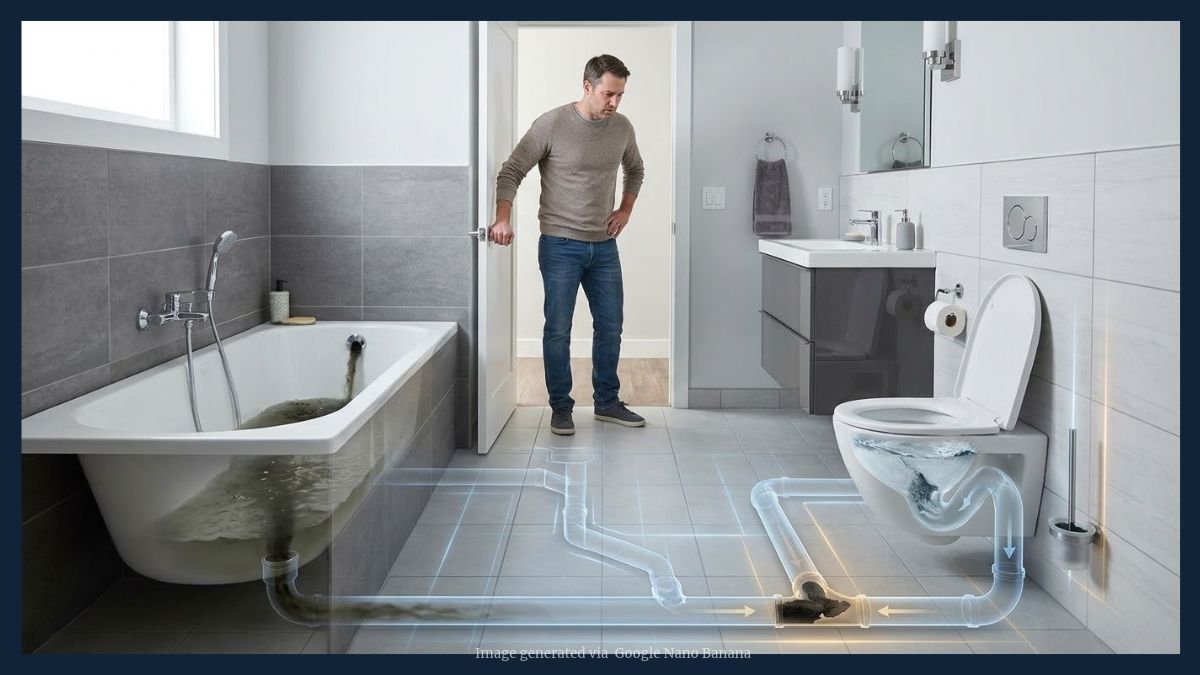
Water backing up into another drain usually means wastewater cannot flow freely through a shared drainage pipe. A blockage or restriction farther downstream may force water to rise through another connected fixture, such as a bathtub, shower, sink, or floor drain.
- Water backing up into another drain usually indicates a restriction in a shared drainage pipe or a downstream sewer connection.
- If a toilet flush causes water to rise in a bathtub or shower, a blockage farther down the shared drainage system is possible.
- One affected fixture may indicate a local blockage, while several affected fixtures suggest a larger drainage problem.
- The lowest drains in the home may overflow first when the main drainage line is blocked.
- Grease, wipes, accumulated debris, tree roots, and damaged pipes can obstruct wastewater flow.
- A blocked plumbing vent can cause gurgling and slow drainage, but actual wastewater backflow usually warrants investigation for a drainage restriction or surcharge.
- Stop using water if sewage is backing up into the home.
- Persistent or recurring backups should be inspected by a qualified plumber.
Treat water backing up from a drain as potentially contaminated, especially if it smells like sewage or contains visible waste. Stop using affected fixtures, keep children and pets away, and avoid touching or walking through the water.
Do not attempt to clean sewage with ordinary household cleaning methods. If wastewater has overflowed into the home, contact a qualified plumber and an appropriate water-damage or sewage-cleanup professional.
If water is near electrical equipment, outlets, or wiring, do not touch wet equipment or standing water. Leave the affected area and arrange professional electrical assessment if necessary.
How does water end up backing up into another drain?
Most residential drainage systems use gravity to move wastewater away from sinks, showers, bathtubs, toilets, and other fixtures.
Each fixture connects to a smaller drainpipe, often called a branch drain. These branch pipes eventually connect to larger drainage pipes that carry wastewater toward the main building drain and then the public sewer or private septic system.
Under normal conditions, wastewater flows in one direction.
However, when a downstream pipe becomes blocked or severely restricted, wastewater cannot move away as quickly as it enters the system.
As more water enters the affected pipes, the wastewater level rises. It may eventually escape through another connected fixture or drain opening.
This explains why:
- Flushing one toilet can cause water to rise in a bathtub.
- Running a washing machine can make a nearby floor drain overflow.
- Using a kitchen sink can cause water to appear in another sink.
- Several fixtures can become slow or back up at the same time.
The drain where water appears is not necessarily where the blockage is located. The obstruction may be farther along the shared pipe.
Common reasons water backs up into another drain
1. A blockage in a shared drainpipe
A shared drainpipe carries wastewater from more than one fixture.
For example, a bathroom sink, bathtub, and shower may connect to the same branch drainage system before joining a larger pipe.
If that shared section becomes blocked, wastewater from one fixture may have difficulty passing through. When another connected fixture releases water, the combined flow can push wastewater back toward an available drain opening.
Common materials that contribute to blockages include:
- Hair.
- Soap residue.
- Grease.
- Food particles.
- Paper products.
- Accumulated household debris.
What you may notice:
- Two nearby fixtures drain slowly.
- Running one sink causes another fixture to gurgle.
- Water rises in a bathtub when a nearby fixture is used.
- The problem appears limited to one bathroom, kitchen, or laundry area.
What to do: If more than one fixture in the same area is affected, the shared branch drain may need professional clearing. Avoid repeatedly running water to test the system if wastewater is already rising.
2. A blocked main sewer line
Important possibility when: Several fixtures in different areas of the home are affected.
The main sewer line carries wastewater from the home’s drainage system toward the public sewer or private septic system.
If this line becomes blocked, wastewater from multiple fixtures may have nowhere to go.
As water continues entering the drainage system, it can rise through the lowest available drain opening.
This is why a basement floor drain, ground-floor shower, or bathtub may overflow even when the blockage is located much farther away.
Common causes of main sewer line blockages include:
- Accumulated grease and debris.
- Wet wipes and unsuitable materials.
- Tree roots entering underground pipes.
- Damaged or collapsed sewer pipes.
- Heavy mineral or scale buildup.
- Objects obstructing the line.
What you may notice:
- Several drains become slow at the same time.
- Flushing a toilet causes another drain to bubble or overflow.
- Water appears in a basement floor drain.
- More than one bathroom experiences drainage problems.
- Sewage odors develop around affected drains.
What to do: Stop using water throughout the affected part of the home and contact a plumber experienced in sewer line inspection and clearing. If the blockage may be in the public sewer, contact your wastewater utility as well.
3. Grease and food waste buildup
Grease is a common contributor to kitchen drain blockages.
When cooking grease enters a drain, it may cool and stick to the inside of the pipe. Over time, other particles can attach to the buildup, gradually narrowing the available passage.
Food scraps, soap residue, and other debris can make the obstruction worse.
If the kitchen drain connects to another fixture through a shared or downstream pipe, the restriction may affect more than one drain.
What you may notice:
- The kitchen sink drains slowly.
- Water rises in another connected sink or floor drain.
- The problem becomes worse after washing dishes.
- Unpleasant odors come from the kitchen drain.
What to do: Avoid pouring cooking grease or oil into the sink. If wastewater is already backing up into another fixture, arrange a plumbing inspection rather than repeatedly flushing the line with more water.
4. Tree roots entering underground drainage pipes
Tree roots can enter sewer pipes through cracks, damaged joints, or gaps in older underground connections.
Once inside, roots can grow and trap debris, gradually restricting wastewater flow.
A small intrusion may initially cause slow drainage. As the obstruction grows, it can eventually affect multiple fixtures connected to the same sewer line.
What you may notice:
- Repeated drain blockages.
- Multiple fixtures draining slowly.
- Recurring sewage backups.
- Problems that return after previous drain-clearing work.
- Drainage issues near older underground pipes or mature trees.
What to do: A plumber may use a sewer camera to inspect the pipe and identify whether roots are present. Clearing the roots may restore flow temporarily, but damaged pipe sections may also need repair to prevent recurring problems.
5. Damaged, sagging, or collapsed drainpipes
Drainpipes need to be installed with the appropriate slope to allow wastewater to flow toward the main drainage line.
If a pipe becomes damaged, shifts, or develops a low section, wastewater and debris may collect instead of draining efficiently.
This can gradually create a blockage.
More severe pipe damage can restrict or completely stop wastewater flow.
Possible causes include:
- Ground movement.
- Poor original installation.
- Corrosion or deterioration.
- Heavy loads above buried pipes.
- Tree root damage.
- Age-related structural failure.
What you may notice:
- Recurring backups despite previous clearing.
- Several fixtures affected by the same problem.
- Slow drainage that gradually worsens.
- Persistent gurgling or unpleasant odors.
What to do: A plumber can inspect the affected pipe using a drain camera where appropriate. If a section is collapsed or badly damaged, mechanical clearing alone may not provide a lasting solution.
6. A full or malfunctioning septic system
Homes that use septic systems can also experience wastewater backing up into other drains.
A septic system receives wastewater from the home and separates solids from liquids before treating and dispersing the wastewater through the soil-based system or another approved treatment arrangement.
If the system cannot accept or process incoming wastewater properly, drainage problems may develop inside the home.
Possible contributing problems include:
- A septic tank that needs servicing.
- A clogged outlet filter.
- A malfunctioning septic pump.
- A blocked or damaged pipe between the house and tank.
- A saturated or failing drainfield.
- Excessive water entering the system.
What you may notice:
- Several drains become slow.
- Toilets do not flush normally.
- Floor drains overflow.
- Sewage odors appear indoors or outdoors.
- Wet areas or sewage appear near the septic drainfield.
What to do: Reduce water use and contact a qualified septic service provider. Avoid opening the tank or attempting to pump it yourself.
A failing septic system can release untreated wastewater containing harmful microorganisms. Keep children and pets away from sewage, wet areas, and suspicious standing water near the drainfield. Do not walk or play on areas where sewage may be surfacing. Contact a qualified septic professional and follow local health department guidance if wastewater is exposed.
7. A blockage or overload in the public sewer system
Not every sewer backup originates inside the property.
A public sewer system can experience blockages, damaged pipes, or excessive wastewater and stormwater inflow.
If the public sewer cannot carry wastewater away normally, the problem may affect connected properties.
The U.S. Environmental Protection Agency identifies blockages, line breaks, sewer defects, and stormwater or groundwater entering sanitary sewer systems among possible causes of sanitary sewer overflows.
What you may notice:
- Multiple drains back up unexpectedly.
- The problem appears during or after heavy rainfall.
- Neighbors experience similar drainage problems.
- Sewage backs up despite no obvious local fixture blockage.
What to do: Contact your local wastewater utility to report the suspected public sewer problem. A plumber can help determine whether the obstruction is within your property’s private sewer line or beyond the property connection.
8. A blocked plumbing vent
Plumbing drainage systems also require ventilation.
Vent pipes allow air to enter the drainage system and help maintain appropriate pressure as wastewater flows through the pipes.
If a vent becomes obstructed, airflow can be disrupted. This may contribute to gurgling, slow drainage, or unusual noises as water moves through the system.
Possible causes include:
- Debris.
- Leaves.
- Animal nests.
- Other obstructions in the vent opening.
However, a blocked vent should not automatically be blamed when wastewater is visibly coming back through another drain. Actual backflow is a stronger reason to investigate a downstream blockage, sewer restriction, or system surcharge.
What to do: Have a plumber assess the venting system if gurgling and slow drainage persist. Do not climb onto the roof to inspect or clear a vent yourself.
What does it mean when one drain causes another to back up?
The relationship between the fixtures can provide useful clues about where the restriction may be located.
Water comes up in the bathtub when you flush the toilet
This often suggests that the toilet and bathtub share a drainage route that is restricted farther downstream.
When the toilet releases a large volume of wastewater, it cannot pass through the blocked section quickly enough. The water may then rise through the bathtub or shower drain.
The bathtub is showing where the wastewater is escaping, not necessarily where the blockage is located.
Water backs up in the floor drain when the washing machine drains
Washing machines discharge a relatively large amount of water over a short period.
If the shared drainage pipe is restricted, the wastewater may not be able to leave quickly enough. It can rise through a nearby floor drain or another low opening.
A recurring backup during the washing machine’s drain cycle deserves investigation, especially if other fixtures are also slow.
Water backs up in another sink when one sink is used
If two sinks share a branch drain, a blockage in that shared section may cause water to rise in the other sink.
The problem may be limited to the kitchen or bathroom rather than involving the main sewer line.
However, if other fixtures are also affected, the restriction may be farther downstream.
Several drains back up at the same time
When multiple fixtures in different areas of the house are affected, a main building drain, private sewer connection, septic system, or public sewer problem becomes more likely.
The lowest available drain openings may overflow first.
This pattern should be treated as a potentially serious drainage problem rather than several unrelated fixture clogs.
How to identify whether the problem is a local clog or a main sewer blockage
The number and location of affected fixtures can help distinguish a local blockage from a larger drainage problem.
| What you notice | Possible location of problem | Recommended action |
|---|---|---|
| One sink drains slowly, but other fixtures work normally | Individual fixture or trap | Arrange local drain inspection if persistent |
| Two nearby fixtures affect each other | Shared branch drain | Have the shared pipe inspected |
| Toilet flushing causes water to rise in a bathtub | Shared downstream drain or main building drain | Stop using affected fixtures and call a plumber |
| Washing machine discharge causes a floor drain to overflow | Restricted branch or main drain | Stop using the appliance and arrange inspection |
| Several bathrooms and drains are affected | Main building drain, private sewer, or septic system | Stop nonessential water use and contact a plumber |
| Basement floor drain overflows when water is used upstairs | Possible main sewer line restriction | Treat as a potential sewage backup |
| Multiple neighboring properties experience backups | Possible public sewer problem | Contact the wastewater utility |
| Gurgling occurs without actual wastewater backflow | Possible venting or partial drainage problem | Arrange inspection if persistent |
These patterns help narrow down the likely location, but they cannot confirm the exact cause without inspecting the drainage system.
What should you do when water backs up into another drain?
The most important step is to stop adding more water to a system that may already be restricted.
1. Stop using the affected fixtures
Avoid flushing toilets, running faucets, taking showers, or operating washing machines and dishwashers connected to the affected drainage system.
Continuing to discharge wastewater can make the backup worse.
2. Keep people and pets away from the affected area
If the water contains sewage or appears to have come from a waste drain, treat it as contaminated.
Keep children, pets, and other household members away from the water.
3. Avoid using chemical drain cleaners
Chemical drain cleaners may not resolve a blockage in a shared branch or main sewer line.
They can also create additional hazards if wastewater is standing in the drain or if a plumber later needs to open the affected pipe.
Do not mix different drain-cleaning products or combine them with bleach or other household chemicals.
Chemical drain cleaners can cause severe skin and eye injuries and may release hazardous fumes, especially if products are mixed. Do not add chemicals to a drain that is backing up with wastewater. If a chemical has already been used, tell the plumber exactly which product was added before they work on the pipe. If a person or pet is exposed, follow the product label’s emergency instructions and contact Poison Control in the U.S. at 1-800-222-1222 or seek appropriate emergency veterinary or medical assistance.
4. Check which fixtures are affected without deliberately triggering another backup
You can record which drains have already shown symptoms.
For example:
- Which fixture was being used?
- Where did the water appear?
- Was the water clear, dirty, or visibly contaminated?
- Did the problem affect one room or several areas?
- Did the backup occur during heavy rainfall?
Do not repeatedly flush toilets or run appliances just to reproduce the problem.
5. Contact a qualified plumber
A plumber can determine whether the problem is in an individual fixture, shared branch, main building drain, or private sewer connection.
If you suspect a public sewer problem, contact the local wastewater utility as well.
How do plumbers diagnose water backing up into another drain?
A plumber usually begins by examining the symptoms and identifying which fixtures are connected to the affected drainage system.
Depending on the problem, the inspection may involve several methods.
Drain inspection
The plumber may inspect accessible drains, traps, cleanouts, and connections to identify obvious restrictions.
This helps determine whether the problem is limited to one fixture or involves a larger section of the system.
Drain auger or mechanical clearing
A drain auger uses a flexible cable to break up or retrieve certain obstructions.
It may be suitable for some local or downstream blockages, depending on the pipe and the material causing the restriction.
However, clearing the immediate blockage does not necessarily repair damaged pipes or prevent recurring problems.
Sewer camera inspection
A drain camera can be inserted into an accessible pipe to examine its interior.
It may help identify:
- Tree root intrusion.
- Cracks or broken pipe sections.
- Heavy deposits.
- Collapsed or deformed pipes.
- Persistent obstructions.
- Areas where debris repeatedly accumulates.
Camera inspection can be particularly useful when backups recur after previous clearing work.
Septic system inspection
If the property uses a septic system, a qualified septic professional may inspect the tank, filters, pumps, and drainfield as appropriate.
The correct inspection depends on the system design and the symptoms.
When should you call a plumber?
Call a plumber promptly if water repeatedly backs up into another drain, particularly when multiple fixtures are involved.
- Flushing a toilet causes water to rise in another fixture.
- Several drains are slow or backing up together.
- A floor drain or bathtub overflows.
- Sewage odors develop around multiple drains.
- The problem returns after drain clearing.
- Water backs up when the washing machine or dishwasher operates.
- You suspect tree roots or damaged underground pipes.
- You have a septic system showing signs of failure.
If sewage has entered the home, treat it as a health hazard rather than an ordinary plumbing spill. Avoid direct contact and keep children, pets, and other occupants away. Do not use household fans or equipment in standing water near electrical outlets or appliances.
Contact a qualified plumber and a professional sewage-cleanup service. The EPA advises avoiding contact with sewage because it may contain harmful pathogens.
Should you hire a professional?
Yes, if water is actually backing up from one drain into another, professional inspection is generally the safest approach.
A simple blockage in one fixture may be relatively straightforward to resolve. However, water appearing in another connected drain suggests the restriction may be farther downstream and could affect multiple parts of the plumbing system.
A qualified plumber can:
- Identify the affected branch or main drainage line.
- Clear suitable blockages using appropriate equipment.
- Inspect pipes for root intrusion or structural damage.
- Perform a camera inspection when necessary.
- Determine whether the septic system or public sewer may be involved.
- Recommend repairs if the pipe is damaged rather than simply blocked.
If the problem may involve the public sewer, contact your wastewater utility before assuming the homeowner is responsible for the entire repair. Responsibility for private and public sewer sections varies by location.
Homeowner checklist: What to check next
Use this checklist to record what happened before contacting a plumber.
- Identify which fixture was being used when the backup occurred.
- Identify which other drain received the water.
- Record whether the affected fixtures are in the same room or different parts of the home.
- Note whether the water was clear, dirty, or visibly contaminated.
- Check whether multiple toilets, sinks, showers, or floor drains are affected.
- Record whether the problem occurred during washing machine or dishwasher operation.
- Note whether the backup coincided with heavy rainfall.
- Determine whether your home connects to a public sewer or private septic system.
- Check whether neighbors have reported similar sewer problems, if a public sewer issue is suspected.
- Stop using affected fixtures until the drainage problem has been assessed.
- Keep children and pets away from any wastewater that has overflowed.
- Contact a plumber if water is actually backing up into another fixture.
Important: Do not deliberately flush toilets, run appliances, or pour water into drains to reproduce the problem. Do not enter contaminated standing water or attempt to open underground sewer pipes yourself.
Frequently asked questions
This often happens when the toilet and bathtub share a drainage route that is blocked farther downstream.
The sink may share a branch drainage pipe with another fixture. If that shared section is blocked or restricted, wastewater can rise through another connected drain instead of flowing away normally.
Not always. A blockage in a shared branch drain can affect two nearby fixtures. When several fixtures in different areas of the home back up together, a main building drain or sewer line problem becomes more likely.
A blocked vent can contribute to gurgling and slow drainage by disrupting airflow in the plumbing system.
Yes. Tree roots can enter underground pipes through cracks and damaged joints. As they grow, they can trap debris and restrict wastewater flow.
Not automatically. A plunger may help with an isolated fixture clog, but it is unlikely to resolve a blockage in a shared branch or main sewer line.
It can be, particularly if sewage is overflowing into the home, several fixtures are affected, or the backup is getting worse.
Sources and references:
- U.S. Environmental Protection Agency, Sanitary Sewer Overflows (SSOs)
https://www.epa.gov/npdes/sanitary-sewer-overflows-ssos - U.S. Environmental Protection Agency, Sanitary Sewer Overflow Frequent Questions
https://www.epa.gov/npdes/sanitary-sewer-overflow-sso-frequent-questions - U.S. Environmental Protection Agency, Resolving Septic System Malfunctions
https://www.epa.gov/septic/resolving-septic-system-malfunctions - Centers for Disease Control and Prevention, Guidelines for Septic and Onsite Wastewater Systems
https://www.cdc.gov/floods/safety/guidelines-for-septic-and-onsite-wastewater-systems.html - Metropolitan Sewer District of Greater Cincinnati, Understanding Sewer Backups
https://msdgc.org/sites/default/assets/downloads/programs/Sewer_Backup_Program/Customer_Guide_to_Sewer_Backups.pdf - U.S. Environmental Protection Agency, What to Do If Your Septic System Fails
https://19january2021snapshot.epa.gov/septic/what-do-if-your-septic-system-fails_.html
